
Review: How does one desperately try to justify owning a slave? With four mind tricks

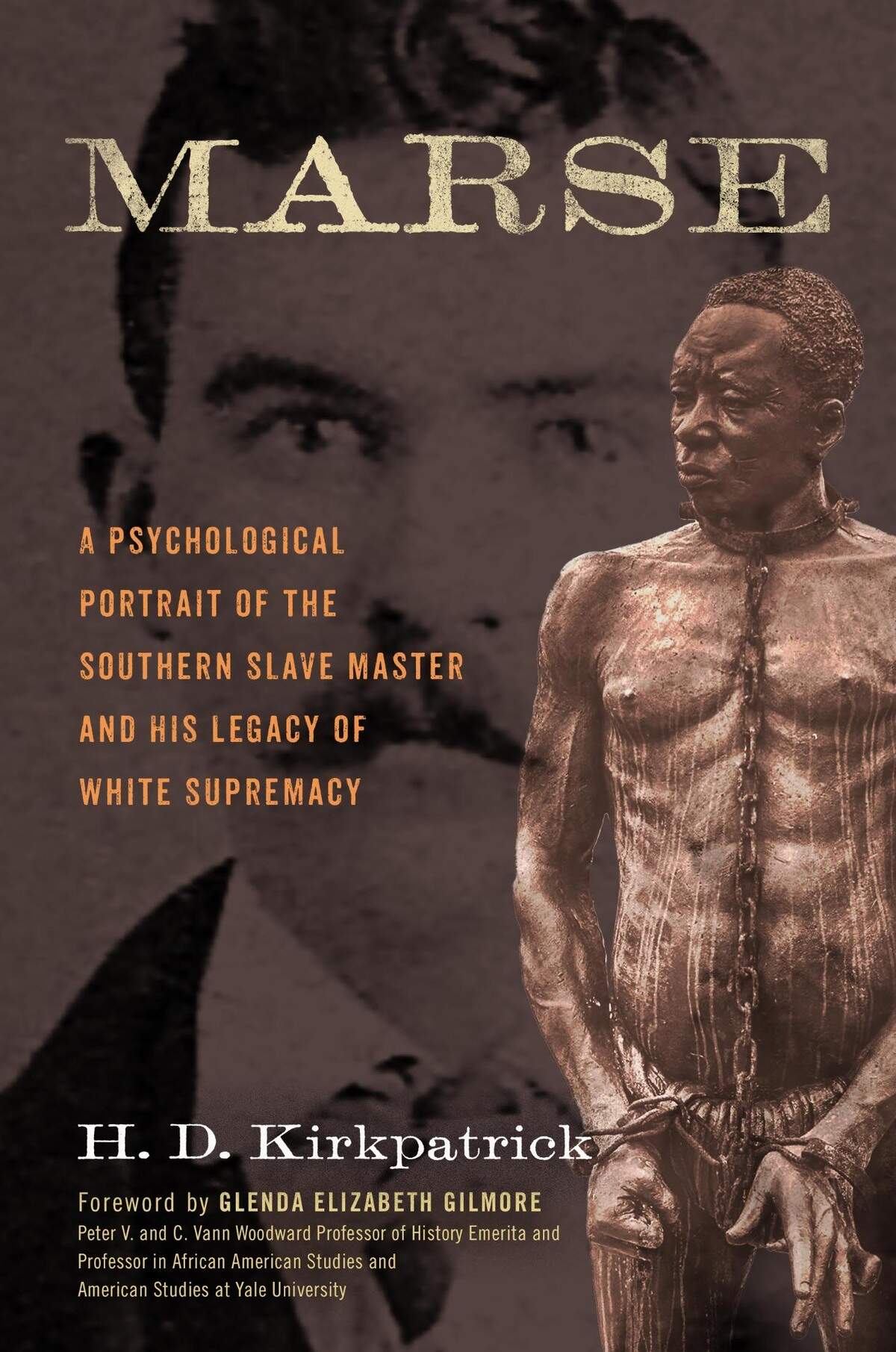
MARSE: A Psychological Portrait of the Southern Slave Master and His Legacy of White Supremacy, by H.D. Kirkpatrick. Foreword by Glenda Elizabeth Gilmore. Prometheus Books, $27.95 hardcover.
A white kid at Myers Park High named H.D. – De – Kirkpatrick knew a Black football player who led the school to the regional championship in 1965. That athlete was Jimmie Lee Kirkpatrick.
Everybody knew Jimmie Lee, and sometimes he and H.D. teased each other, calling out, “Hey, cuz.”
Decades later, in 2014, Jimmie Lee Kirkpatrick, calls up H.D. Kirkpatrick to say he’s been doing some ancestral work, and he’s discovered that his great-great-great grandfather had been a slave out in the country, south of town – owned by a man named Hugh Kirkpatrick.
H.D. Kirkpatrick has to acknowledge that, yes, Hugh Kirkpatrick was his great-great grandfather. Until that phone call, he hadn’t realized his ancestors owned even one slave, much less 30.
This begins years of soul-searching for H.D. How can a man justify to himself owning another man? Short answer: He cannot.
By profession, H.D. Kirkpatrick is a forensic psychologist. He has spent his career testifying in court on the “likely state of mind” of defendants when they committed crimes.
Now he must turn that question on himself and his great-great grandfather. How does one – especially a “Christian” slaveholder – justify this evil?
From this soul searching comes “Marse,” a “psychological autopsy” of a composite of the white slave master and how that master kept from feeling or even acknowledging to himself the evil he was perpetrating on the Black slave. (“Marse” is synonymous with the word “Master.” It refers to a collective class title, as well as the individual slave master.)
“Slaveholders became psychological acrobats,” writes Greensboro native and retired Yale historian Glenda Gilmore in her introduction.
Kirkpatrick says a slaveholder became a psychological acrobat by employing four basic defense mechanisms: Denial, Projection, Delusional Projection and Rationalization.
If a slaveholder wanted to maintain his self-image of religious piety and honorable moral character, Kirkpatrick says he unconsciously denied to himself his own brutality and his physical and sexual exploitation of Black people.
If denial wasn’t working, the slavemaster could also project his feelings of lust onto the slave herself, as if it were the slave who was desiring him. “Marse deceived himself by … imagining that his enslaved females directed lustful fantasies toward him,” Kirkpatrick writes. Therefore he believed his assaults on the Black female were “nothing more than responding to an enslaved girl’s sexual aggressiveness or seductiveness.”
And the defense mechanism of denial, Kirkpatrick writes, would likely distance him from any emotional pain his wife might feel when that enslaved female gave birth to a light-skinned baby.
If the slaveholder wanted to assure himself of his superiority over the Black slave, he unconsciously used delusional projection, allowing him to see the Black African as inferior, sub-human, “more animal-like than human-like.”
And if the slave master needed to convince himself that his enslaved people were content with their servitude and wouldn’t be able to handle freedom, Kirkpatrick says they turned to the fourth defense mechanism – rationalization.
In his zeal to understand his great-great grandfather as a slaveholder – and himself as a white man in a Black-white world – Kirkpatrick has ranged wide in “Marse” and plunged deep.
He has included, for instance, several pages of Punishment Methods from Theodore Weld’s 1839 book, “American Slavery As It Is: Testimony of a Thousand Witnesses.” These methods include “beaten about her head for serving too much molasses.” And “beheaded” for “running away.” And “feet hacked off with broad axe” for “breaking a vase.”
There’s an invaluable 10-page list of Further Reading, and a Hypothetical Proslavery Sermon delivered at the fictitious Ebenezer Ezekiel Memorial Church in Mecklenburg County in 1860, in which the fictitious Rev. McCracken preaches that “slavery is part of God’s plan.”
Now, near book’s end, Kirkpatrick asks: Is Marse dead?
Maybe not dead, he says, but on life support, fueled by white supremacy.
“We whites continue to enjoy the benefits derived simply from having white skin,” he writes, “and Black people continue to fear and feel the vestiges of many of the attitudes, beliefs and behaviors deeply ingrained in our white ancestors, whether they were slaveholders or not.”
So where from here?
Kirkpatrick is clear: White folks need to talk to white folks.
“It is we who have to dismantle the false premise that whites are better than people of color,” he writes. “We have to stop projecting the debilitating notion that Black folks and other people of color threaten our well-being.”
And maybe most important, he writes, “We must come to terms with the utterly horrible truth about racist slavery, and what it did to the heart and soul of our country.”
For starters, I recommend small groups of white folks reading and discussing the truth-baring, eye-opening and excellent “Marse”.
This story was originally published February 23, 2022 at 6:00 AM with the headline "Review: How does one desperately try to justify owning a slave? With four mind tricks."