



Money Research Collective’s editorial team solely created this content. Opinions are their own, but compensation and in-depth research determine where and how companies may appear. Many featured companies advertise with us. How we make money.
The Typical Home Now Sells for Below List Price in More Than 40 Major Cities
By Liliana Hall MONEY RESEARCH COLLECTIVE
Buyers are gaining leverage as homes sell below asking in dozens of major housing markets nationwide.

Homes are now selling for less than their asking prices in 41 of the nation’s largest housing markets, according to a new analysis of Redfin data from Best Interest Financial. The findings are another sign that, after years of bidding wars, buyers are finally gaining leverage.
During the pandemic housing boom, buyers routinely bid above asking prices and waived contingencies to win homes. Now higher mortgage rates, slower demand and a growing supply of homes for sale are shifting the balance, giving buyers more room to negotiate.
Must Read
- Gold Just Pulled Back From Its Record — Why Some Retirees Are Buying the Dip
- 10 Smart Ways Seniors Are Earning Extra Money
- Two Investing Tools Everyone Needs to Build Wealth
That doesn’t mean homes have suddenly become “affordable.” Prices remain near record highs, and mortgage rates are still elevated. But for buyers who’ve spent years waiting for the seller’s market to fizzle out, current conditions could offer more room for negotiation.
More than 40 major housing markets are now selling below asking
The Best Interest Financial analysis compared median sale prices with median list prices across the nation’s 50 largest metropolitan areas. Across the markets analyzed, the national median sale-to-list ratio was 98.3%, meaning the typical home sold for about 1.7% below its asking price.
The difference between a home’s list price and its eventual sale price varied by metro. In some markets, buyers are negotiating only slightly below asking, while in others, sellers are accepting significantly lower offers. Miami, Houston, Austin and Tampa, Fla., posted some of the nation’s largest gaps between list prices and final sale prices, indicating buyers had the greatest negotiating leverage in those markets.
Miami had the lowest sale-to-list percentage among the metros analyzed. Homes there sold for 95.42% of their asking price on average, meaning buyers paid roughly 5% less than sellers initially requested.
At the other end of the spectrum, homes in New York City, Boston and San Francisco continued to sell at or above list price, suggesting sellers still have the upper hand in some markets.
San Francisco, where median home prices are the highest in the country, recorded the nation’s highest sale-to-list percentage, with homes selling for 108.87% of their asking price on average. In other words, buyers typically paid nearly 9% more than sellers’ initial asking prices.
Where People Are Tapping Their Home Equity Right Now
- Explore Rocket Mortgage's Home Equity Options
- See if You Qualify for a Reverse Mortgage with Longbridge's Calculator
- Learn About Home Equity Sharing With Point — No Income Requirement, No Perfect Credit Score
Where homes are selling for less
Here are the top 10 metros where homes sold for the greatest percentage below asking price:
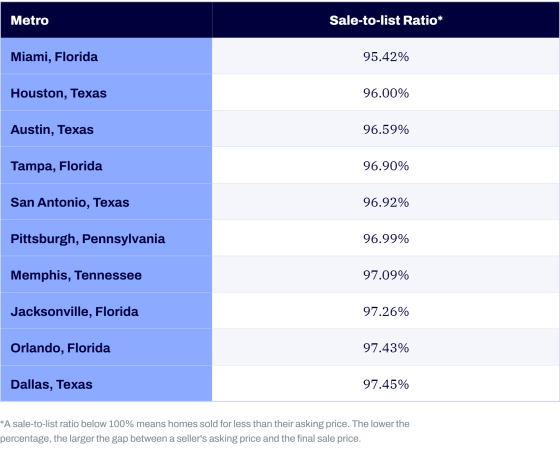
Texas stands out as one of the country’s most buyer-friendly housing markets. All four of its major metros — Houston, Dallas, Austin and San Antonio — ranked among the 10 markets where homes sold the furthest below asking price.
More than one-quarter of active listings in San Antonio (28.2%) have had a price reduction, the highest share among major U.S. markets analyzed in Best Interest’s report. Homes in Austin and San Antonio are also taking longer to sell, spending about three months on the market, giving buyers more time to compare options and negotiate with sellers.
Why buyers are gaining leverage
A growing supply of homes for sale is giving buyers more options and reducing the pressure to compete for limited inventory. The National Association of Realtors reported 1.56 million homes on the market in June, equal to a 4.6-month supply. That means there are enough homes currently listed to last nearly five months if no new listings were added.
While that’s still shy of the roughly six-month supply typically associated with a balanced market — when neither buyers nor sellers have a clear advantage — it’s an improvement from the inventory shortages that defined much of the pandemic era.
At the same time, elevated mortgage rates have cooled buyer demand, giving sellers fewer opportunities to spark bidding wars. There were nearly 500,000 more home sellers than buyers nationwide in June — the largest imbalance since 2020 — according to Redfin. About 70% of the country’s largest metropolitan areas are now considered buyer’s markets.
Still, affordability remains a significant hurdle. The median existing-home price reached a record $440,600 for June, up 1.8% from a year earlier, according to NAR. Meanwhile, the average rate on a 30-year fixed mortgage has remained above 6.5%, keeping monthly payments elevated despite buyers’ growing bargaining power.
Those affordability pressures are especially pronounced in some of the country’s most expensive markets. As Money recently reported, a record 242 U.S. cities now have starter homes worth at least $1 million — nearly triple the number before the pandemic — underscoring how the cost of homeownership remains out of reach for many Americans.
Must Read
- Gold Just Pulled Back From Its Record — Why Some Retirees Are Buying the Dip
- 10 Smart Ways Seniors Are Earning Extra Money
- Two Investing Tools Everyone Needs to Build Wealth
Liliana Hall is an Austin-based reporter for Money, where she covers a range of topics, including financial news, policy, banking, investing, passive income, financial planning and student loan debt. Passionate about accessibility and financial literacy, she’s dedicated to helping readers navigate the complexities of money management and feel empowered to make informed decisions about their financial futures. Previously, Liliana covered all angles of personal finance as a writer and editor at CreditCards.com, Bankrate and CNET. Before she ever wrote about money, she worked in a handful of newsrooms across Austin, Texas, covering everything from the Texas Legislature to SXSW and the 2019 Men’s NCAA Swimming and Diving Championships. Her work has been featured in The Daily Texan, Austin Chronicle and KUT. A Texas native, Liliana graduated from the University of Texas at Austin with a bachelor’s degree in Journalism. When she’s offline, you can probably find her paddle boarding on Lady Bird Lake, riding her moped around town or reading for her book club.