Why student free speech rights don’t extend to high school graduation speakers
AI-generated summary reviewed by our newsroom.
- Court ruling allows officials to censor school‑sponsored speeches like commencements.
- Many districts require submission and principal review of graduation speeches.
- Deviating from approved remarks can lead to removal or temporary diploma withholding.
Speakers at high school graduation ceremonies kicking off this week will be under even more scrutiny after a recent highly publicized incident at Clayton High School.
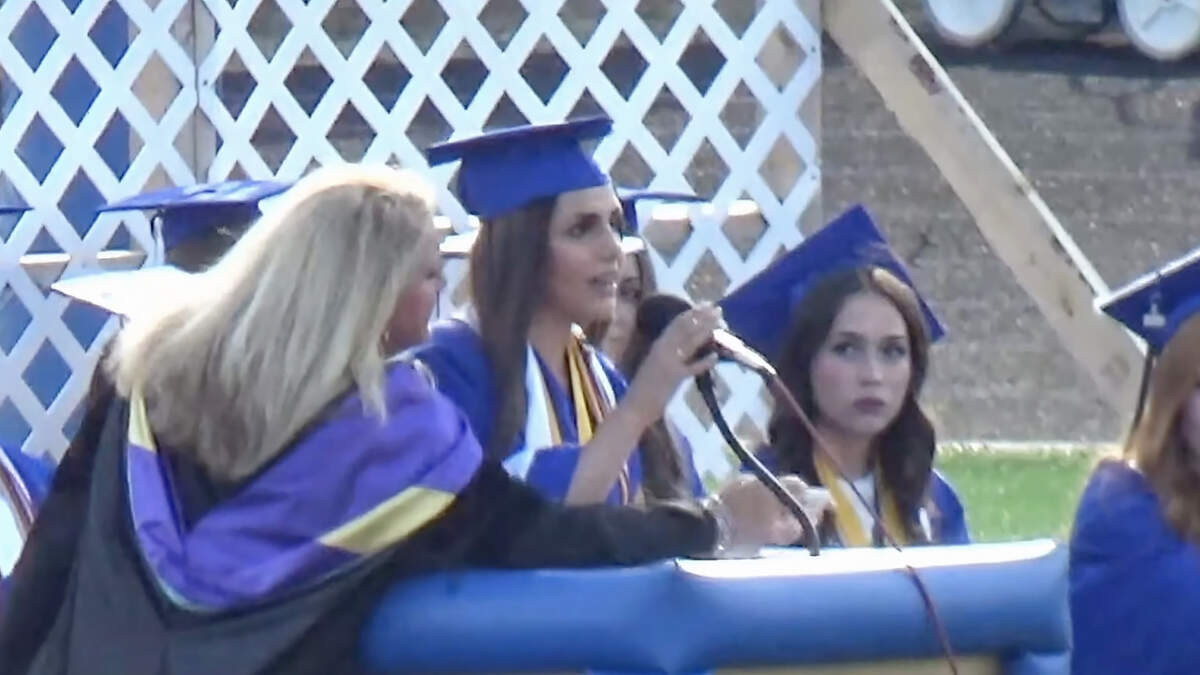
Leen Hijaz received national attention after Clayton High Principal Melissa Hubbard cut off her graduation speech when the senior mentioned Palestine and “families being torn apart by ICE,” The News & Observer previously reported. It’s a reminder that high schools typically review graduation speeches ahead of time and will take action if a speaker goes off their prepared remarks.
In 1988, the U.S. Supreme Court ruled in the Hazelwood School District v. Kuhlmeier case that schools can censor student speech in school-sponsored activities such as school newspapers and yearbooks. Lower courts have applied the Hazelwood decision in cases involving graduation speeches, according to Jonathan Gaston-Falk, staff attorney for the Student Press Law Center.
“A valedictory address from a podium at an official commencement is a school-sponsored speech, and the Hazelwood decision, governs here,” Gaston-Falk said in an interview with The N&O. “It lets schools exercise editorial control over style and content of students’ speech, as long as their actions are reasonably related to that pesky, legitimate pedagogical concern.”
While it’s legally permitted censorship, Gaston-Falk said it’s deeply unsettling for schools to silence a graduation speaker.
“When a microphone is cut off and remarks are halted mid-speech, I mean, many would see that as not just enforcement of a rule but suppression of a voice,” Gaston-Falk said.
Principals review student speeches
High schools typically pick multiple students to speak during graduation. The schools want to know ahead of time what the students will say.
“Student speakers are supported by a staff member throughout the writing process, and principals review and approve speeches prior to submission,” Crystal Roberts, a spokesperson for Durham Public Schools, said in an email. “Final copies of all student speeches are submitted through the district’s graduation review process prior to the ceremony.”
Similar guidance comes from Wake County, where the district tells principals they should personally review and approve any speeches or comments being made by each podium speaker.
Marissa Blount, 17, the student body president of Broughton High School in Raleigh, says she was initially upset when Principal Janiece Dilts told her not to talk about the deaths of her parents. But Blount said she’s glad that Dilts intervened.
“Grief is really dark, and that’s not necessarily a message that I want to be pushing onto the students as they’re leaving high school,” Blount said in an interview. “I kind of felt like thank goodness that my principal read over that before I went out there and gave some really dark speech.”
Savannah Lange, 18, the senior class president of Garner High School, said she wasn’t told to change her speech. But Lange said she’s avoiding talking about politics or any other controversial subjects.
Hijaz’ speech at Clayton High was subject to Johnston County school system rules, which say speeches are reviewed in advance “to ensure the students fulfill their intended purpose for a graduation ceremony.”
Gaston-Falk encouraged students to share online the original versions of their speeches so that people can see how much was changed by the school.
Students face consequences for going off script
Depending on the school and district, deviating from the approved script can have immediate consequences.
“When a student engages in behavior that substantially disrupts or interferes with the orderly conduct of a school activity, including a graduation ceremony, school administrators may take appropriate disciplinary action consistent with district policy,” Caitlin Furr, a Wake County school spokesperson, said in an email.
“Schools may hold a diploma for a period of time until school administrators have an opportunity to meet with the student and family, but the diploma cannot be permanently withheld if a student has met all of the graduation requirements.”
Lange said she got the message when she was told about how a prior Garner High speaker had their diploma withheld.
“I’d probably have some family that would be a little upset with me if I didn’t get my diploma by graduation,” Lange said in an interview. “I know I probably would receive it at some point, but I just wouldn’t want to take any chances after I’ve been working for four years to get it.”
Blount said she was warned that behavior at graduation that doesn’t match expectations will result in being removed from the stage.
“It’s implied if you don’t say what’s in the script, you’re going to get removed,” Blount said.
Clayton High student praised for her ‘courage’
The Johnston County school system says Clayton High administrators ended Hijaz’ speech to maintain the integrity and focus of the program in real time.
“This action was not about limiting a student’s voice, but about ensuring that a school-sponsored event remained consistent with its intended purpose,” the district said in a statement. “JCPS respects students’ rights to express their views and encourages thoughtful dialogue in appropriate settings.
“At the same time, we have a responsibility to ensure that official school events remain inclusive, respectful, and focused on celebrating all graduates.”
In addition to having her speech stopped, Hijaz didn’t receive her diploma until four days after the May 28 graduation ceremony.
Both Blount and Lange praised Hijaz for taking a risk by speaking out at graduation. But both Wake students also said they intend to stick to their speeches at Thursday’s graduation ceremonies.
“I don’t think I would want to go viral for that reason,” Lange said. “But I think if that’s something that she believes in, and she was willing to speak up for that, I think that’s really brave of her to do something like that.”
Blount said the desire to speak out about what’s happening in the world competes with how she doesn’t want to upset the people at graduation.
“It really is just a rock and a hard place, and I can’t imagine the courage that that student had to go out there and say that,” Blount said.
This story was originally published June 9, 2026 at 5:30 AM with the headline "Why student free speech rights don’t extend to high school graduation speakers."