NC workers helped create a new, multi-state union. Will it change the way we organize?
Ieisha Franeis has worked in the service industry for decades, but it was at her job at Freddy’s Frozen Custard and Steakburgers in Durham where she realized the power she had. At the height of the pandemic, she and her coworkers organized their first walkout with the help of Raise Up, the Southern arm of the Fight for $15 and a Union movement.
Franceis needed convincing at first, as did the other Freddy’s employees. But that moment — walking out and realizing that without employees, the restaurant would have to close for the whole day — made an impact. They would go on to walk out two more times while Franceis worked there.
“That gave me a sense of empowerment that I’m going to carry to my grave, that I’m going to pass along to my children and my grandchildren, so that they know that they don’t have to put up with certain things at any job, no matter what job it’s gonna be,” Franceis says of that day.
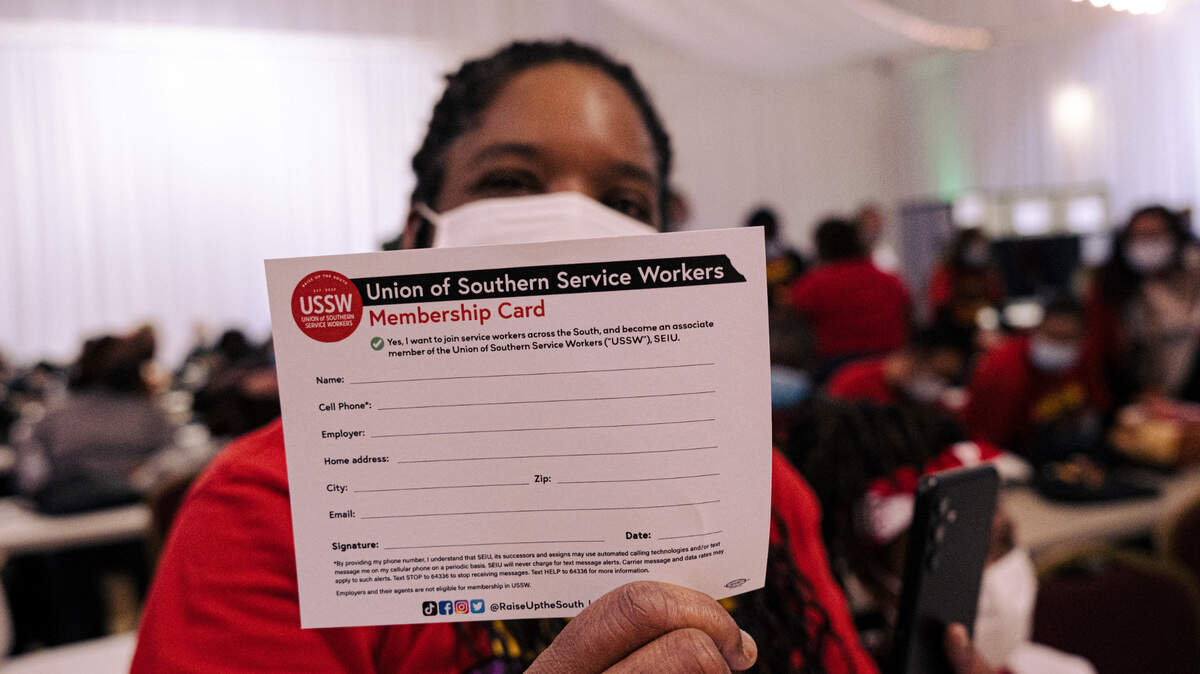
On Nov. 18, Franceis and 150 other service sector employees involved in Fight for $15 established the Union of Southern Service Workers (USSW), a branch of the Service Employees International Union. The union represents workers in restaurants, nursing homes and other service sector jobs for North Carolina, South Carolina, Alabama and Georgia. But more than that, it could represent a shift in how Southern workers attempt to organize and could prove more successful at unionizing states who have not been union-friendly.
Instead of focusing on a specific industry, or specific business, USSW represents a broad coalition of people who can pool resources and put public pressure on employers. It also forgoes the unionization process that other workers have gone through, which often includes a lengthy legal process to be recognized by the National Labor Relations Board (NLRB). Since there is a high turnover rate in the service industry, USSW is not going through a union vote at every business it can. Instead, the union is focused on getting individual members who can loosely organize their workplace to meet demands through public protest, similar to the work Fight for $15 has done over the last decade.
This form of labor organizing isn’t new but isn’t particularly common. In North Carolina and the South, however, workers need to try more paths that will empower others to stand up for themselves. North Carolina has the second-lowest union membership rate in the United States at 2.6%, with our South Carolina neighbors taking the top spot. Organizing the South has always been an uphill battle. Union membership nationally has been on the decline since the 1980s, and decreased sharply in the South last year. In spite of this, unionization efforts have gained media attention in recent years in the wake of the COVID pandemic.
North Carolina is not a union-friendly state and hasn’t been for decades. Our “right-to-work” law was established in the 1940s. The General Assembly barred public employees from collective bargaining in the 1950s. In these decades, unionization was associated with giving more power to Black workers and therefore was repressed in the state. While we currently have unions, they’re still unable to collectively bargain or go on strike. When North Carolina was declared the state that’s “Best in Business” by CNBC, one of the factors contributing to this win was how little oversight North Carolina has for trade and labor.
“I think unions rightly see this region as one in which if they can start making inroads, and it frankly benefits their members everywhere,” says Jeffrey Hirsch, a professor of labor law at UNC-Chapel Hill. Since businesses have migrated to the South for its relaxed labor laws, he says, strengthening union power in the region would mean that these corporations have nowhere to go.
Hirsch notes that other unions have tried to make this dent in the culture for years with very little to show for it. But the group’s unconventional structure could be an asset in North Carolina. Organizing outside of the traditional framework comes with risks, sure. The owner of a business doesn’t have to recognize the union and could retaliate against its members (something that could be less likely with a store-by-store unionization process). But it also provides a framework for future generations trying to organize.
“A lot of people here have no experience with unions, either directly or through friends and family,” Hirsch says, “and so they’re more susceptible to sort of negative information that employers and business groups put out, and they just don’t see the benefits.”
That, Franceis says, is why they formed the union.
“I want everyone to be able to feel what I feel, to know what I know, and be able to pass that along generation after generation and let this thing syndicate,” she says, “because it’s ours.”
This story was originally published December 5, 2022 at 4:00 AM with the headline "NC workers helped create a new, multi-state union. Will it change the way we organize?."