NC’s tight Senate race could be key to controlling chamber. COVID has pushed it online.
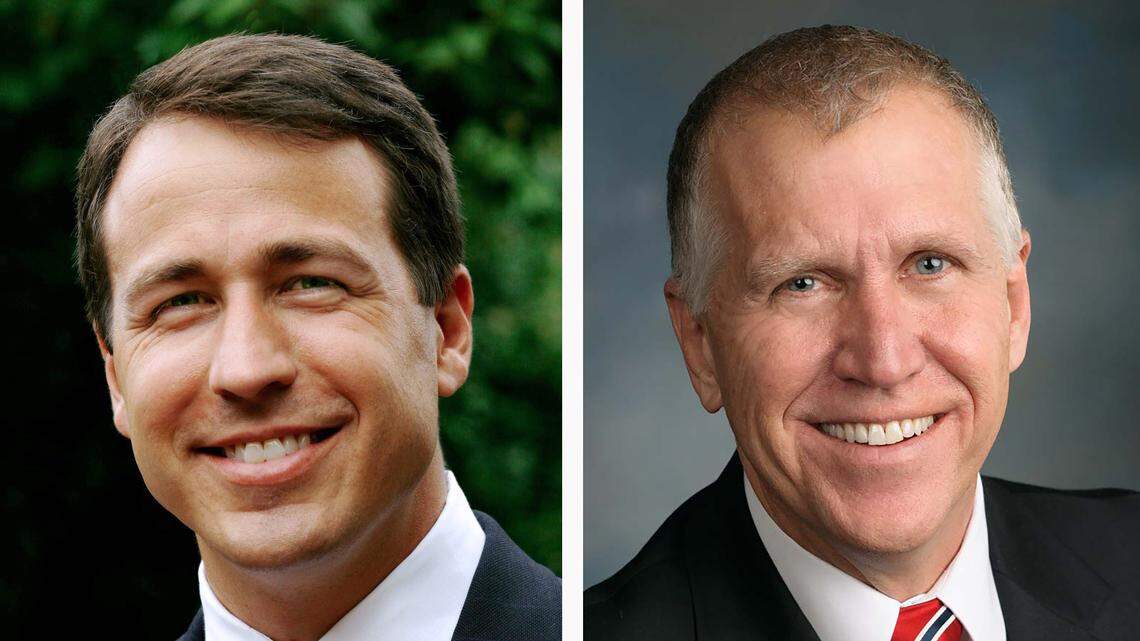
North Carolina’s U.S. Senate race between Republican Sen. Thom Tillis and Democratic challenger Cal Cunningham is being shaped — like so much else these days — by the coronavirus pandemic.
Considered by many the most important Senate race in the nation, the campaign is largely an online affair right now, with the candidates forced out of traditional face-to-face campaigning and, like many in the state, into chats and conference calls by the deadly virus and government shutdowns.
Tillis is holding regular public telephone town halls, pushing the callers to wear face masks and follow social distancing guidelines while answering constituent questions about government actions in response to the virus.
Cunningham is hosting his own virtual town halls, taking questions from voters and talking about experiences of living through outbreak.
There have been more than 7,200 laboratory-confirmed cases and 240 deaths in the state as of Wednesday morning, according to North Carolina’s Department of Health and Human Services.
The department says the number of cases is likely much higher due to a lack of testing, including of some who show symptoms of the virus.
The virus’ impacts and the nation’s response are likely to dominate the Senate race through November.
“It’s hard to imagine in this moment that there could be something bigger,” said Michael Steel, a North Carolina native and former press secretary for Republican House Speaker John Boehner.
The coronavirus response
Tillis, who held his 24th town hall on Wednesday, has been supportive of the response of governors, including Democratic Gov. Roy Cooper in North Carolina, and the federal government led by President Donald Trump. He has, instead, cast blame on China for its lack of transparency at the beginning of the outbreak.
Tillis, in his first term in the Senate, said his criticism is aimed at China “for allowing it to get to this point.”
“I don’t trust China, and I don’t believe their numbers,” he said. “I don’t believe you can believe the numbers they’ve reported. They started out by deceiving the rest of the world.”
In the calls, Tillis often invokes his daughter who is a nurse and his young granddaughter, who lives nearby but whom Tillis and his wife have not visited in weeks due to the stay-at-home orders. He implores people to wear face masks, comparing those that don’t to the oft-mocked college spring breakers who descended on Florida’s beaches early in the crisis.
The questions are most often about enforcing social distancing and government actions such as stimulus checks, small business assistance and unemployment insurance.
Tillis, who along with all but one other Republican senator was named to an economic task force for reopening the country’s economy, has supported the four coronavirus aid packages that have passed the Senate, including a replenishing this week of billions for loans and grants to small businesses to keep workers on their payroll.
He accused Democratic congressional leaders of playing “partisan political games resulting in extra unnecessary hardship and uncertainty for small business owners across the state and country.”
The program ran out of its original $350 billion allotment on April 16. The Senate approved another $310 billion for the program on Tuesday, and the House passed it Thursday.
Democrats held up the package to get additional funding for testing, hospitals and small businesses added. Cunningham, who wants more oversight of the federal spending, applauded the new funding and said additional money is needed for municipalities, who are struggling with financial hardships and may be forced to cut back on critical services.
“I do think Congress needs to act,” Cunningham said Tuesday before Senate passage.
Cunningham, a former state senator and Army prosecutor, has been critical of parts of the administration’s response, including asking for an investigation into the shipment of personal protective equipment overseas when the U.S. has faced shortages.
“We knew we were facing a crisis,” Cunningham said. “You look all the way back to the weeks after the senators were being given briefings about the risks. ... We were shipping PPE out of our country at a time when we needed it.”
Cunningham cited the State Department’s help in shipping almost 18 tons of PPE to China in early February, after senators received a briefing on the virus on Feb. 5. The supplies were donated by charitable organizations, including North Carolina-based Samaritan’s Purse.
“It isn’t about seizing the supplies. It’s about a coordinated national response. The message needs to be sent about where we need to be preparing. The national stockpiles were not ready for what many of the epidemiologists were preparing.” Cunningham said. “The first role in a crisis is to send signals to the marketplace where need is great.”
Cunningham pointed to reports that the Trump administration called Thailand asking for help with supplies only to find out that the U.S. had just shipped supplies to it. And a recent report from WBTV about the Defense Logistics Agency selling ventilators and face masks.
Cooper has said repeatedly the state needs help from the federal government securing additional personal protective equipment in order to ramp up testing.
The state of the race
The race is considered a toss-up by most political rating organizations — and it’s taken on outsized importance because it may determine control of the chamber in 2021.
Republicans hold 53 seats. The most obvious path to a Democratic majority — or a 50-50 split with the vice president breaking ties — runs through Republican incumbents in Arizona, Colorado, Maine and North Carolina.
And both parties seem to believe it may come down to North Carolina. At least, that’s what their spending habits are saying.
“Spending is a good indicator of where the true battleground lies. There’s often a lot of rhetoric about what is and what is not a battleground state. The dollars will tell you where the real fight is happening,” said Nathan Gonzales, editor and publisher of Inside Elections.
The Senate Leadership Fund, aligned with Republican Senate Majority Leader Mitch McConnell of Kentucky, announced $21.8 million in initial advertising reservations in North Carolina, far outpacing its commitments in Arizona, Maine and Colorado.
SLF spent $3 million during the primary, advocating for Democratic candidate Erica Smith.
The National Republican Senatorial Committee announced an initial television and radio buy of $7.5 million beginning July 5 in North Carolina. Again, it is the top state for spending.
Democrats, too, are investing in the state. Senate Majority PAC, a Democratic group, committed $25.6 million in North Carolina, its top spending state. It will start advertising in early August.
Cunningham, 46, raised nearly $4.4 million in the first three months of the year, more than double what Tillis raised, and has $3 million cash on hand, according to recent campaign finance reports.
“It is clearer than ever that North Carolinians are hungry for new leadership in Washington,” Cunningham campaign manager Devan Barber said in a statement touting her candidate’s fundraising totals.
Tillis, 59, raised nearly $2.1 million in the first three months, but has $6.4 million cash on hand, double what Cunningham has.
“We know full well that we need to ramp up our fundraising in order to keep pace with Chuck Schumer’s liberal donor machine that is coalescing behind our opponent,” Tillis’ campaign manager Luke Blanchat said in a statement, while touting his campaign’s overall edge in cash on hand.
Libertarian Shannon Bray and Constitution Party candidate Kevin Hayes will also be on the ballot in November.
Tillis and Cunningham have each led in recent polls, and Real Clear Politics’ average of polls has Cunningham leading by 0.3 points — about as close as you can get.
Cunningham led 47-40 in a Public Policy Polling survey released last week. The founder of the group is a Cunningham supporter. Right-leaning Civitas Institute showed Tillis up 38-34. Both polls showed Cooper with a large lead in gubernatorial re-election, leaving observers scratching their heads a bit.
“There is a big asterisk on every projection right now,” Steel said.
For more North Carolina government and politics news, listen to the Domecast politics podcast from The News & Observer and the NC Insider. You can find it on Megaphone, Apple Podcasts, iHeartRadio, Stitcher or wherever you get your podcasts.
This story was originally published April 22, 2020 at 2:17 PM with the headline "NC’s tight Senate race could be key to controlling chamber. COVID has pushed it online.."