
In the eye of the storms: NC emergency leader, Charlotte grad faces his latest challenge
For nearly a decade they’ve battered North Carolina like a series of Biblical plagues: hurricanes, tornadoes, floods, wildfires, ice storms, urban riots and now, a deadly pandemic.
Mike Sprayberry has been in the eye of every storm.
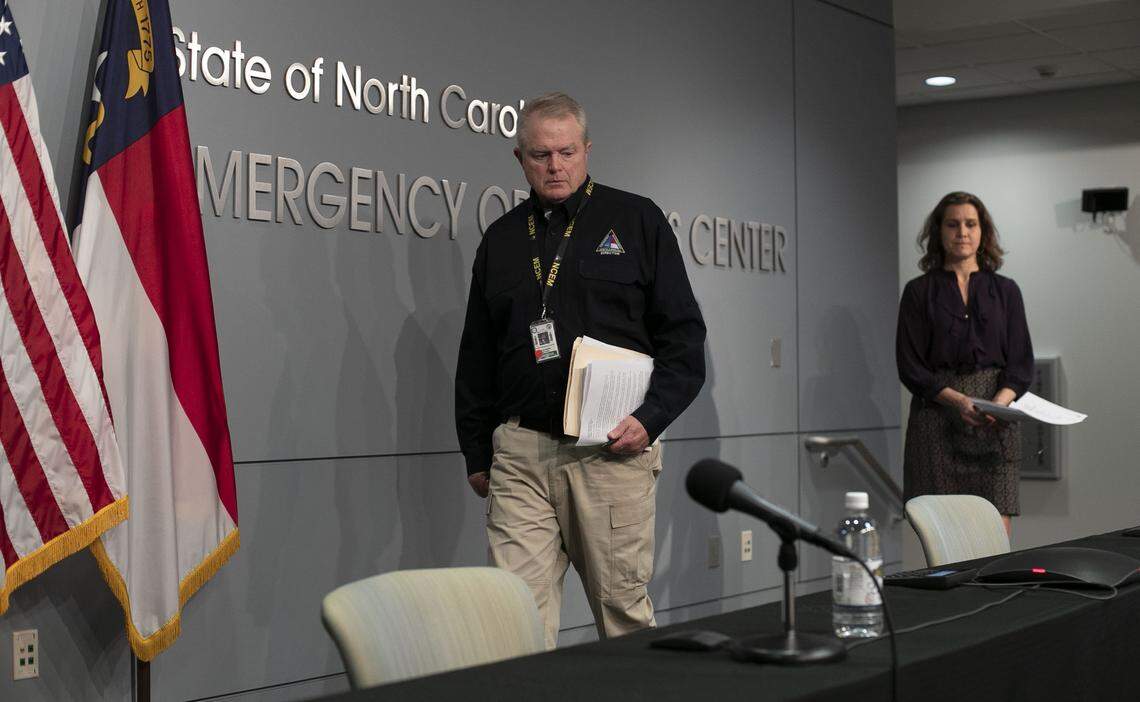
As North Carolina’s emergency management director, he’s in charge of responding to — and recovering from — natural and man-made disasters. Lately he’s become a fixture at the state’s coronavirus briefings, standing alongside Gov. Roy Cooper and Health and Human Services Secretary Mandy Cohen.
By all accounts Sprayberry, 65, brings a steady hand and calm self-assurance to every crisis. He’s a former National Guard officer and Marine whom colleagues describe as a self-effacing leader with a commanding presence and a natural empathy for the people he’s charged with helping.
“I’ve always found Mike Sprayberry to be a humble diplomat by nature,” says Brock Long, a N.C. native who headed the Federal Emergency Management Agency. “He is a top-notch emergency manager. He never overreacts to bad news and . . . takes ownership of the job that he’s been appointed to do.”
Sprayberry, who graduated from West Charlotte High School and UNC Charlotte, has worked in emergency management for 15 years. He has served as North’s Carolina’s emergency director under two governors: Cooper, a Democrat, and Pat McCrory, a Republican.
“He is one of the most experienced emergency management directors in the country,” says Trina Sheets, executive director of the National Emergency Management Association. “He is also one of the most respected emergency management professionals in the nation.”
Not even Sprayberry has seen a crisis like the current one.
The COVID-19 pandemic, as of Sunday, has spread to all but one of North Carolina’s 100 counties. It has led to more than 420 deaths and slammed the brakes on the economy. More than 960,000 North Carolinians have filed for unemployment since March 15, most related to coronavirus, state officials say.
As if that isn’t bad enough, Sprayberry has to prepare the next disaster. Hurricane season starts June 1 and forecasters predict a heavier-the-usual onslaught. Scientists say climate change has made weather extremes not only more severe but more common.
“Statistics will bear out that disasters are more frequent and I do think they’re becoming more severe,” says Sprayberry. “We are preparing for whatever’s over the hill to make sure we’re not only prepared but to increase our capacity. One of the things we never want to subject ourselves to is complacency.”
The decision ‘was mine’
Born in Atlanta, Sprayberry came to Charlotte as a high school sophomore. After finishing at West Charlotte, he joined the U.S. Marines and took college courses at night. By the time he left the Marines after four years, he had two years of college credit and entered UNCC as junior, graduating in business administration. He would go on to get a masters in history.
He joined the Army National Guard, where over 21 years he would rise from sergeant to major.
He joined the state Division of Emergency Management in 2005 and, in 2013 was named director by McCrory, who calls it “probably one of the best decisions I made as governor.”
Frank Perry, Sprayberry’s boss as secretary of the North Carolina Department of Public Safety, says he was a natural fit.
“He had that bearing and just a very good balance of human skills as well as knowing how to get the job done,” Perry says. “He had an intensity that was appropriate but the humor and the real person was always there.”
In October 2016, Hurricane Matthew plowed through the Caribbean as the strongest hurricane in years and was threatening the southeast. At first, McCrory says, the state considered deploying rescue equipment south to help neighboring states. But he says Sprayberry urged him to keep it positioned in North Carolina.
“He said, ‘Let’s keep it as is,” McCrory recalls. “By him keeping the equipment where it was . . . (he) probably saved a lot of lives.”
Matthew brought historic amounts of rain and flooding. The storm caused $4.8 billion in damage, according to the (Raleigh) News and Observer. It prompted $1.14 billion in state and federal recovery aide, according to the Department of Public Safety.
Last year several lawmakers criticized some Hurricane Matthew spending. They chided Sprayberry’s department for giving $5.3 million in recovery aid to a nonprofit that helped repair more than 400 storm-damaged units of affordable housing and develop new housing in affected counties.
In response, Sprayberry said he was unaware of rules that said the money be used only for immediate housing relief.
“The decision to use the funds in the manner described was mine and (was) based on the pressing need to get disaster survivors into sustainable living accommodations,” he told lawmakers.
‘Little bit of break’
When Hurricane Florence hit the state in 2018, Sprayberry reached out to a friend. Bryan Koon had been Florida’s emergency management director and, like Sprayberry, one-time president of their national association. Sprayberry called him a “graybeard.”
“My job was to trail him, watch him and say, ‘Maybe you ought to pay attention to this’,” recalls Koon. “That showed me that he was very receptive to growing and learning from others and taking in best practices on the fly.”
Disasters are complicated. There’s getting help to the places and people who need it, often over a wide area. There’s dealing with other governments, from Washington to county seats. Response is based on solid preparation. And when the immediate crisis has passed, there is the recovery.
Koon says Sprayberry can see the big picture.
“You need to be able to look across the spectrum of events going on and find the thread that ties them together,” Koon says. “You don’t need to be the smartest person in the room on a particular topic. You need to connect the dots. . . . Nobody’s coming to you with solutions. They’re coming to you with problems.”
Cohen, DHHS secretary, says Sprayberry is a “leader who cares about . . . the culture of our team.”
“He cares very deeply about the team, how we handle our relationships and our responsiveness to partners and how we communicate,” she says. “I’ve learned a lot from him in how to continually communicate our priorities and our values as we respond to a crisis.”
Asked what keeps him up at night, Sprayberry said it’s the prospect of a major event say a hurricane — coming on top of the pandemic. The rescue workers, utility crews and health care professionals who typically would come from elsewhere to help might not be able to.
“I just don’t think you’ll see all those resources be available,” Sprayberry says, adding, “It’s about time that North Carolina gets a little bit of break.”
Different kind of crisis
North Carolina was the first state with an Office of Recovery and Resiliency, according to Sheets of the emergency management association. Sprayberry, who directs that as well, knows that recovering from the current crisis will be different than any other.
Hurricanes, floods and wildfires affect some counties but not all. Local economies suffer. But not the entire state’s. And while storms blow away and floods recede, there’s also no defined end to the pandemic, at least before a vaccine is found.
“One of the things we know is instead of having a few counties in the recovery process it will be 100 counties,” Sprayberry says. And he considers counties the first lines of defense. His emails include a tagline: “What have you done for your counties today?”
With his two adult daughters living away, Sprayberry goes home at night to spend time with his wife Laura and their three dogs. He likes to read military history and tries to keep things in perspective.
“I’m sitting here in Raleigh and trying to support people with the hard jobs,” he says. “I’m the lucky guy.”
This story was originally published May 3, 2020 at 11:15 AM with the headline "In the eye of the storms: NC emergency leader, Charlotte grad faces his latest challenge ."
