They dressed presidents. Now Brooks Brothers shirt makers in NC await their fate.
In the best of times the workers inside the old brick factory made 7,000 shirts per week. They were not just any shirts, but Brooks Brothers shirts; and most were not just any Brooks Brothers shirts, but their flagship: the Original Polo Button-Down Oxford. An American classic made in an American factory, in the heart of an old eastern North Carolina town.
Each of those shirts required 30 minutes of labor, but it took three weeks for a shirt to wind its way through the factory; to transform into the final product after arriving as part of an industrial roll of cotton. For decades the factory came alive with sound: the cutting of fabric, the rhythmic staccato of sewing machines, the hum of chatter along the assembly stations.
The shirts they made here went to Brooks Brothers stores all over the country. They sat in storefronts from Manhattan to Los Angeles. They went home with people and became a part of weddings or graduations or boardroom meetings; a part of memories or everyday life. Inside the shirt factory on Church Avenue, they made shirts for United States presidents.
“We did big things here at Garland,” Katie Herring said last week, in the shade of a tree outside the factory. She’d worked there since 1986, rising from seamstress to a supervisor over custom orders. They made things, Herring said, that nobody ever knew “came through this little town” on the southwest edge of Sampson County in rural eastern North Carolina, about 80 miles and a world away from Raleigh.
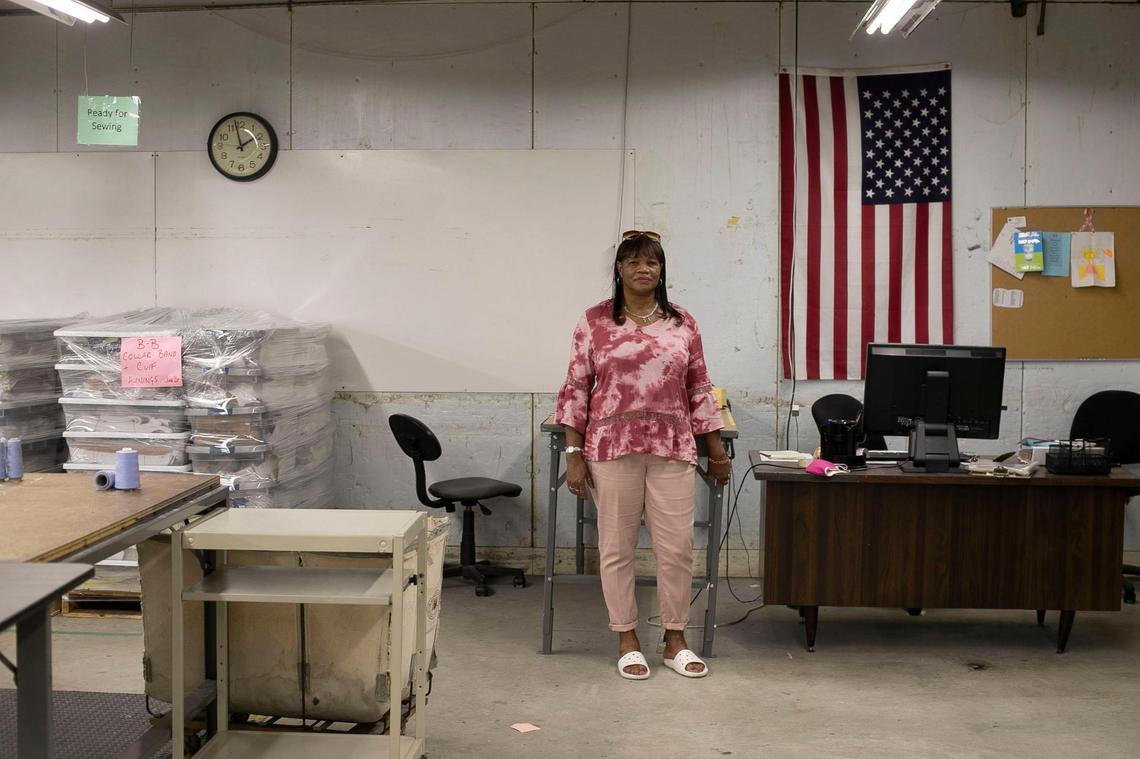
Now, less than a week before the Garland shirt factory was due to close, the loudest sound was the absence of it. It was the quiet where there’d always been so much energy. It was the steady drone of the HVAC system, the soft conversation of the few employees who remained. It was the silence of the machines, turned off and covered in plastic, and the empty chairs beside them.
For months employees had been preparing for the factory’s closing, and now the official last day, set for Monday, was near. Brooks Brothers announced in April that the plant would close on July 20, eliminating about 150 jobs in a town of about 600 people, in a part of the state long besieged by economic decay. The company blamed the decision on the coronavirus pandemic but in reality, several employees said recently, the closing was likely inevitable, and sooner rather than later.
“If you come in here on a regular day, when we’re working, it’s noisy,” Kelly Riley, the plant’s production manager, said last Thursday, walking through the factory. Riley is 58 and has worked at the factory for nearly two and a half years. “All your teams are running. There’s activity running. And now I walk through, and everything is covered with plastic.”
He walked past a large machine. A sign above said SLEEVES. Riley looked around.
“It does look pretty good for an old plant, doesn’t it?” he asked, and it did. The floors were spotless and shined under the fluorescent lights; the pieces of unattended equipment created rows of straight lines. Everything was in its place. It was as if the factory, after years of making designer clothes, had cleaned up for a job interview of its own. In some ways it had.
A potential buyer had emerged, and optimism was high, Riley said last week, that maybe the plant could be saved — that maybe the people who’d left in stages over the past several weeks and months might be able to come back. For now the only certainty was that the factory was closing, at least for a while.
Maybe it would be down for only a month. Maybe only a few months. Nobody wanted to think that this might be it — that a factory that had been open since the early 1950s, and that ever since had been the centerpiece of the town and its economy, might be closing for good.
“We know there’s an attempt being made to purchase the factory, and to keep it going as a sewing facility,” said Rick Alexander, the plant manager. “But there’s a lot of things that have to happen for that to come to fruition.”
American textile workers are a dying breed
In a world of globalization, with abandoned factories decaying in American towns large and small; with countless jobs lost to automation and the cheaper labor of overseas manufacturing, the Garland shirt factory had long ago become an anomaly. And yet its closing, even if it could be foreseen, still felt sudden.
“It kind of caught all of us off guard,” said Matthew Register, who owns a popular restaurant and catering business, Southern Smoke BBQ, a few blocks from the factory. Register, 41, has spent most of his life in Sampson County. His grandparents lived in Garland, and his grandfather owned a dry goods store here back when the town was “hustling and bustling,” he said.
And now: “It’s just hard,” Register said. “You ride around our town, we’ve got closed buildings all over the place. And it’s just scary.”
Throughout eastern North Carolina are once-vibrant small towns that gradually deteriorated amid abandoned storefronts; towns that have become little more than dots on a map. Many of those places could trace their roots to the manufacturing and textile industries, which, along with tobacco, fueled North Carolina’s growth throughout the 20th century.
While mills and factories shut down over the years, and as jobs moved overseas, smaller towns across the state have withered or died. Larger cities have had to adapt. All along, Garland has remained a throwback, something like a last vestige of the old North Carolina. The factory, and Brooks Brothers, has been its lifeline.
The factory, owned by Fleetline Industries in its earliest decades, has long been the town’s economic driver and largest employer. For a while, there was also the Brooks Brothers outlet store, which was a short walk away from the factory.
The outlet store was not the sort that would have been found among the more commercialized, mall-style outlets along interstate highways. No, the Brooks Brothers store in Garland was a true outlet, full of authentic merchandise that suffered the occasional manufacturing error: maybe a stray button or button hole where there shouldn’t have been one; or misplaced seam; or a shirt cuff that wasn’t quite up to snuff.
Brooks Brothers did not advertise the store, and so over the years it became something like a secret club, a word-of-mouth legend for the thrifty and style-minded. Shoppers traveled from all over the state, and even from out of state, to find deals. A 2007 story in The News & Observer described some of those deals in Garland: $75 shirts for $15; ties for a little less than $10; wool suit jackets for $39.50.
When Register opened Southern Smoke in 2014, he envisioned a symbiotic relationship with the outlet store, and that vision became reality — for a while. People showed up to shop on Thursdays or Fridays, then lined up for ribs or pulled pork in the moments before his restaurant opened at 11:30 a.m. Brooks Brothers closed the outlet in April 2018.
Two years later, the space it occupied is still empty. Anyone who comes close enough to the vacant storefronts along Front Street will see the dead bugs gathered at the bottom of the display windows. Inside, some of the ceiling tiles, stained with water damage, are starting to cave in. In the back, the door to a fitting room is ajar. Pieces of the floor are starting to warp and buckle. A paper sign taped to the door says the store is CLOSED, and offers a short note:
“We want to thank all of our loyal customers for your years of patronage and friendship.”
The place next door, what used to be a formal wear store, is closed, too. And so is the place next to that, which looks like it used to be a restaurant.
A couple of blocks away, the Garland water tower rises in the middle of town. Beneath it is the factory. If it sits empty, Register fears what will happen to the rest of Garland — to the Piggly-Wiggly grocery store just up the street; to the pizza place and the few other restaurants around. He worries about the employees, many of whom became regulars at his restaurant.
The first day he opened, six years ago, a group of seamstresses came over for lunch in their Brooks Brothers smocks. Register keeps a photo of the moment. One of the guys who unloaded trucks at the factory came into Southern Smoke every Friday, and Register could recite his order: a half-rack of ribs with mac and cheese and potato salad. When factory workers called in to place orders, he didn’t have to ask their names. He knew their voices.
“It’s always been a sense of pride for me,” Register said. “I have friends that live all over the South, and a lot of them are doctors and lawyers, and they love walking into the Brooks Brothers store, and buying a suit. And every time when I travel, and see that Brooks Brothers symbol, especially on an Oxford shirt, I’m like, yeah, that’s Garland. I know the people that sewed the seams. I know the guys that unloaded the truck with the fabric on it. Like, I know those faces.”
Nowadays they’re not around as much as they used to be. The factory workers are in limbo.
When the pandemic arrived in force in America in mid-March, some of them tried to brace for change. Management sent most of the staff home. Conference calls followed. In late March, Brooks Brothers announced that it would shift production in its American factories from clothes to personal protective equipment in response to the virus.
The news was met with pride in Garland, and praise everywhere: an American company contributing to the effort to slow the spread of disease. Gina Williams, a seamstress who’d worked at the shirt factory for 21 years, was among those called back to work. She was part of a smaller crew that, for weeks, made face masks, many of which were then shipped to the Navy.
Soon enough, Williams said, came an omen: She and her colleagues were told to stop sewing the Brooks Brothers label into the masks. The company announced on May 15 that the factory would close. Earlier this month, Brooks Brothers, the oldest American fashion company, filed for Chapter 11 bankruptcy.
Brooks Brothers was proud to be made in America
Since its founding in 1818, Brooks Brothers had prided itself on American manufacturing. While other larger American fashion brands outsourced all of their production overseas long ago, Brooks Brothers maintained three American factories. The one in Haverhill, Massachusetts, which also closed this month, made suits and sport coats. The one in Long Island City, New York, which is set to close next month, made ties.
Brooks Brothers had owned the factory in Garland for nearly 20 years, and relied on it before then to make garments. While the company also used overseas production, it marketed its relationship with American workers. It devoted a section on its website to promoting its three American factories, under a banner that said “Made in America.”
The page for Garland described it as “classic small-town America,” a place that could “boast a certain measure of fame” as the home to the button-down Oxford. “Naturally,” the website said, “the workers here have a deep connection to this shirt, and the pride they feel echoes beyond the town limits.”
The website, which was online as recently as June before Brooks Brothers removed it, featured brief testimonials from factory workers who provided proud accounts of what their work meant to them. Among those featured from the Garland factory was Gaynelle Bryant, who was looking forward to her 30th anniversary at the plant. It would’ve been in November.
“There’s a lot of new machinery and a lot of new techniques, but some things you just can’t do with a machine,” Bryant said in her blurb on the website.
In an interview last week, Bryant said she hadn’t worked at the factory since mid-March. She’d spent about half of her life working there, and talking about it now was enough to make her cry. When she’d arrived in 1990, she first worked in the trousers division, which long ago ceased to exist.
Then she transferred to the shirt division. She set cuffs.
“God, I hated it,” she said with a laugh.
Soon she found her place making shirt collars. She discovered a talent for it.
“I loved it,” Bryant said. “And I made money. I was fast, and I made money.”
Bryant, now 63, worked her way up over the years. She became part of the team that handled custom orders. Those orders arrived from all over the country, and the world. Anyone who ordered a custom-made Brooks Brothers shirt in the past 20 years likely received one that was made in Garland, by people who lived somewhere in Sampson or Bladen County.
Bryant, who lives eight miles from the factory, helped make shirts for a who’s-who of clientele: Vince Gill, Garth Brooks, the king of Spain. She helped make shirts for customers whose orders arrived from Milan and Hong Kong and everywhere in between. She and Katie Herring, the supervisor in the made-to-measure department, made shirts for American presidents.
The white dress shirt that former President Barack Obama wore during his first inauguration, in 2009, was made in Garland. Only about a handful of people in the factory knew. They had to sign confidentiality agreements. Herring sewed Obama’s name into the shirt in secret. The day of the inauguration, Herring and others revealed to their coworkers the plant’s small part in history.
“It was kind of fun doing that,” she said, “and then to see the expression on their face when they realized that we did it.”
Herring could provide a long list of high-profile Brooks Brothers customers who received custom-made shirts from Garland: Kobe Bryant, Kanye West, the Jonas Brothers, LeBron James. The shirts that Denzel Washington and Forest Whitaker wore in “The Great Debaters” were made in Garland; so were the ones that Will Smith wore in “Ali.”
In late 2016, an order arrived for a shirt for President Donald Trump to wear at his inauguration. Herring said she played a leading role in its production. Gaynelle Bryant said Trump “was hard to please.”
“We inspected it to death,” she said of the shirt the factory eventually shipped out.
From precision cuts to unstructured days
There was always a calculus to making a shirt — the certainty of measurements and the precision of straight lines. In the small world of the factory, inside a rectangular building about 100 yards long, workers could count on a reliable outcome so long as they followed the steps and trusted their experience. Now neither Herring nor Bryant knew what they were going to do. There was no guide for this.
Last week, Herring found herself scrambling to find an appointment with an eye doctor before her insurance expired. She hoped that after a while she might still have a job at the factory if a deal went through with another company. Bryant, meanwhile, said she had a couple of leads for other jobs, but they were contingent on the economy reopening.
She tried to save as much as her unemployment checks as she could. She ran the numbers on her Social Security benefits and concluded that she’d be living “hand to mouth.” She worried about buying health insurance after hers ran out. Bryant missed her coworkers at the factory. She missed the work. She’d always been proud to say she made shirts for one of the most well-known American fashion brands.
“I always wanted our stuff to be perfect,” she said. “Because to me that was Brooks Brothers.”
She wasn’t mad at the company, she said. If anything, she was grateful the factory made it this long. She spoke of some lean years, ones when the factory operated at a loss. Once, she said, word spread among the employees that Claudio Del Vecchio, the CEO of Brooks Brothers, was visiting with bad news.
“He actually came one time with intentions to close the factory,” Bryant said. “And he said when he saw those faces, he couldn’t do it.”
In her best years at the factory, Bryant earned more than $40,000, with overtime. After almost three decades there, though, she usually made around $35,000. She’s a grandmother of three, and lives alone. She needs another job, she said.
She tried to occupy herself with her garden. She’d built a patio. She liked being out of her house but felt scared of the virus, given her age.
“Some days, if it rains, I just walk from the window to the door,” she said. “I hate being at home. I like being where people are.”
Now she and her colleagues wait to find out if they’ll work together again. They wait to find out if the factory will be sold and, if so, to whom, and what will happen to their jobs. Gina Williams, the seamstress who’d worked there for 21 years, has taken a job at a Taco Bell. She helped form a Facebook group for the employees of the factory, and in that group her coworkers posted messages of support and pictures from happier times.
There was one from a costume party at the factory. And a birthday party. And a baby shower.
“We were like a big family,” Herring said, and that’s what she and her coworkers miss the most. There were little traditions, like pinning money to people’s shirts on their birthday. Herring’s first day at the factory was Sept. 30, 1986. She remembered because they celebrated anniversaries there. For her 30th, she received a Brooks Brothers luggage set.
Now, four days before the factory was set to close, the parking lot was nearly empty. Rick Alexander, the plant manager, stood outside and spoke with pride about how clean the employees had left the place.
“We believe our people take more pride than the other manufacturing facilities that Brooks Brothers has,” he said. “They’ve done it with dignity, they’ve done it with pride, they’ve done the right thing. There’s been no anger, no animosity. No ill will.
“No bad language about Brooks Brothers.”
That says something about the people who worked there, Alexander said, especially because nobody knew whether Brooks Brothers would offer any kind of severance package. Bryant, for one, wasn’t counting on it.
“The deck is actually stacked against them of whether they’ll receive it or not,” Alexander said. “Because the court gets to decide that. So we’re in line in a bankruptcy court for our severance. ... You have people who’ve worked here 40, 45 years. They may not get any severance. ...
“So even with that question mark, these people have done the right thing and shown their true colors by performing to the absolute best of their ability to the last day.”
Alexander described the Garland shirt factory as “the absolute best shirt-maker in America.”
“Or, we were,” he said.
Mission and values still hang from a wall
He wanted to show it off. Inside the lobby, Brooks Brothers memorabilia and signage greeted visitors. Beyond, inside the factory, a banner with the company’s mission, vision and values hung on the wall, but few people were left to see it.
In the distance, a group of about five women worked to make prototypes of face masks for a potential buyer. One of them attached the straps, while another sewed a light-blue trim around the border, giving it a stylish touch.
“I like that one,” Riley, the production manager, said as he walked past, and like everybody else here he hoped that the factory still had life. “We’ve been working with different fits and stuff recently. We get that seal right, it’ll sell as I think a level three.
“Which is not quite surgical, but it’ll be medical. So if we can do that ...”
If they could do that, maybe the factory could stay in business. Maybe Garland could keep its largest employer. One of the companies interested in buying the factory wanted to use it to make personal protective equipment, and Riley said his workers had already made 450,000 masks since the start of the pandemic. Meanwhile, an Italian-based company called the Giglio Group, the Wall Street Journal reported earlier this week, was interested in buying Brooks Brothers and keeping its American factories open.
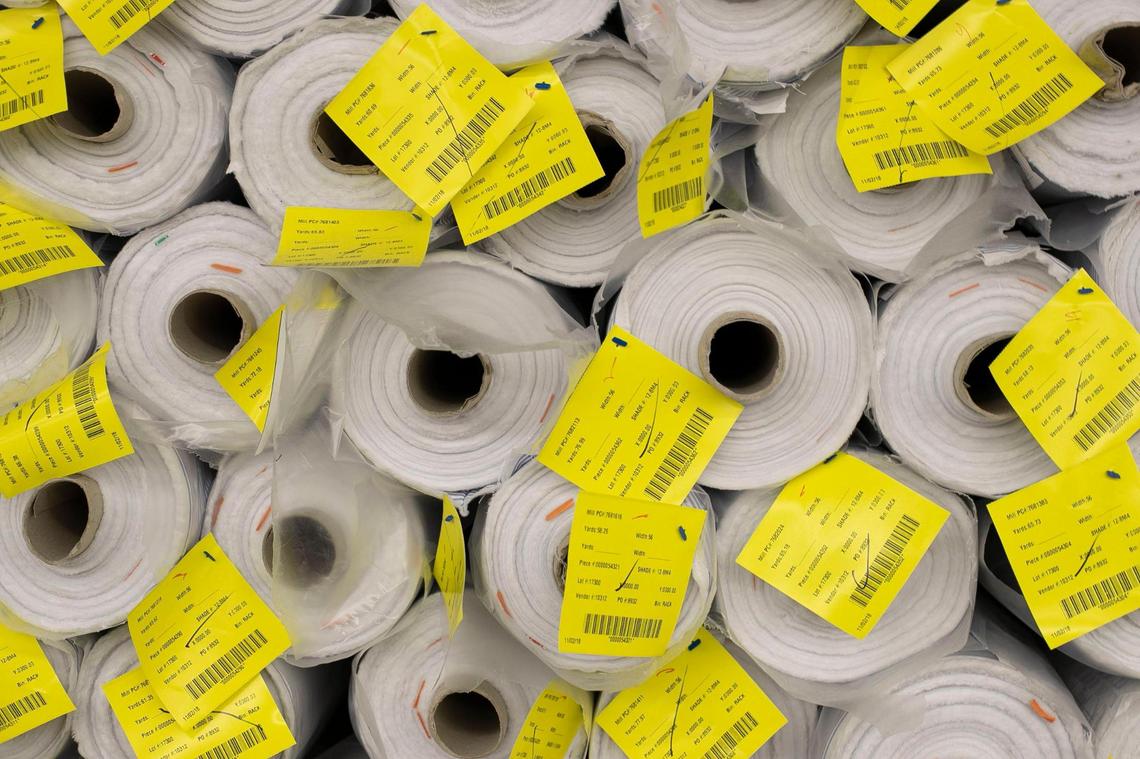
And so there was hope in Garland. Across the factory, there were also rolls and rolls of cotton fabric that never had a chance to be used. Some plain white. Some plaid. Some in the classic light blue pinstripe that would’ve been turned into a shirt that retails for $140. The workers who made the first cut to that fabric had been the first to go, because those first cuts began the process anew.
By last Thursday, the final shirts had been made. They’d been packaged and boxed, and workers had stacked those boxes near the back of the factory, near the loading dock. The only thing left was to load them in trucks. For months, the factory’s workforce had been phased out according to where they happened to fall in the production line. There were tearful departures, coworkers who’d become family saying goodbye.
They said they’d see each other soon but they couldn’t be sure. They’d made things they were proud of here. Shirts for presidents and movie stars, and everyday people who wanted to put on something nice. As recently as March, the Garland shirt factory churned out about 4,500 shirts per week. Now the machines sat silent, and inside of a place usually loud with the sound of production and work, there was an emptiness.
This story was originally published July 23, 2020 at 9:13 AM with the headline "They dressed presidents. Now Brooks Brothers shirt makers in NC await their fate.."