Charlotte may try to alleviate growth with a fee developers oppose. But hurdles remain
Each month, the Charlotte City Council hears many of the same gripes about proposed developments: more traffic, overcrowded schools, lack of open space. And nearly every time, the projects are still approved.
“At the end of the day, we all walk away from it,” said Taiwo Jaiyeoba, assistant city manager and planning director. “Nobody offers a solution.”
But now, Jaiyeoba is considering a controversial plan to help alleviate concerns that come with growth: a fee assessed on new development.
He’s leading the effort to present a proposal around what he calls “community benefit fees” to the city manager in the next few months. The idea, referred to in other cities as impact fees, is for builders and developers to pay a tax for new construction that would fund parks, schools and transportation infrastructure in the surrounding area.
“As people move here, we definitely need to make sure that we prepare to handle the growth and the development that comes with it,” Jaiyeoba said.
But if the city moves forward with the policy, it will need permission from the state legislature — potentially setting up a battle with lawmakers who have resisted the idea for decades. And the fees are fiercely opposed by builders, who say they are forced to pass on the added cost to homebuyers.
“Charlotte is really becoming a leader in the country when it comes to the issue of trying to deal with affordable housing,” said Tim Minton, assistant executive vice president at the North Carolina Home Builders Association. “And I just see this contrary to that policy.”
Who pays for growth?
In April, school board chair Elyse Dashew took the unusual step of speaking at a zoning meeting. She implored the City Council to consider “crisis-level” school overcrowding in Ballantyne as it pondered a 455-acre revamp of the corporate park.
Ultimately, the council agreed to the rezoning. But the debate renewed Jaiyeoba’s interest in impact fees.
Charlotte largely relies on property and sales taxes, as well as bonds, to fund infrastructure. But proponents say impact fees allow cities to better keep up with development.
High-growth areas in south Charlotte have increasingly struggled with school overcrowding. Road congestion is also on the rise, and the city consistently ranks near the bottom of a list of the largest cities in an annual study from the Trust for Public Land that measures spending and access to public parks.
“Livability is what drives our economic growth,” said Shannon Binns, executive director of the nonprofit Sustain Charlotte. “If we continue to reduce the livability here by allowing congestion to grow, by not building sufficient parks and places for families to recreate outdoors, we are sort of killing the golden goose.”
Other municipalities across the country require impact fees to bring in additional revenue for infrastructure.
Decades ago in North Carolina, the state gave a number of local governments permission to charge impact fees. Durham, Cary, Raleigh and Chatham County all levy some form of a fee on single-family and multifamily developers for parks, schools or roads.
Orange County collected nearly $45.3 million for local schools through its impact fees since 1987, when it was first given the authority to charge them, the Durham Herald-Sun reported in 2017. That year, the fees were repealed by the North Carolina General Assembly.
It’s more efficient for local governments to ensure there are adequate community services before it becomes a crisis, said David Owens, a public law and government professor at UNC Chapel Hill. But he said it’s often difficult for cities to get public support for initiatives like tax increases until those needs become visible.
Charlotte City Council member Julie Eiselt supports looking into impact fees and how they could be used, particularly for transit. “We’ve definitely got to find out ways that we can try to get ahead of growth and not always be catching up,” she said.
But homebuilders say the taxes place the burden of paying for infrastructure on some homebuyers and not others.
For example, people buying an older home would not bear the additional expense that trickles down from those fees, said Joe Padilla, vice president of governmental affairs for Georgia-based Smith Douglas Homes. But someone moving into a new house would face that extra cost, he said.
“It’s much more equitable to have a property tax or a bond that everybody is paying than to say to the new residents, you guys are funding all of the growth,” he said, “whether you contribute to it or not.”
Political will
Local governments in North Carolina can only exercise authority explicitly granted to them by the state. Because most impact fees are not included in that authority, experts say Charlotte would need to pursue legislation to levy them.
But lawmakers have not granted a city the authority to implement an impact fee since 1991, said Owens, the UNC professor.
“The likelihood that a municipality would come forward and be granted the ability to provide a new set of impact fees, that’s a really heavy lift,” said state Rep. Chuck McGrady. The Henderson County Republican unsuccessfully proposed allowing local governments to charge system development fees for water and sewer in 2017.
The state instead provided funding for sewer and water systems through an omnibus bill passed this year.
Charlotte leaders say they aren’t deterred by the state’s history of opposition to the issue.
“If and when leadership does change in Raleigh, things that might not have had legs previously, might suddenly,” said council member Larken Egleston. “We can’t wait to determine what is best for Charlotte until we think we have a favorable landscape in Raleigh.”
Legal fights could loom
Homebuilders often mount legal challenges to programs that function like impact fees.
In 2012, the state supreme court overturned a Cabarrus County ordinance through which the county would determine whether there was sufficient capacity in the public schools to accommodate a proposed development. If there wasn’t, the project could be denied or delayed, or the developer could pay a “voluntary mitigation” fee.
In the last year they were in effect, fees ranged from just under $4,000 per unit for multifamily, to $8,241 per single-family, detached home.
Jonathan Marshall, deputy manager for Cabarrus County who was the planning director at the time, said the county has since managed to fund school construction in other ways, such as through property and sales tax revenue.
But new home construction was a factor in the local schools’ overcrowding issues, the county determined in a 2006 analysis of its fees. “I think it would’ve been a great deal of help to offset some of those costs,” Marshall said.
Affordability, development concerns
As Charlotte grapples with a housing affordability crisis, impact fees could contribute to the rising cost of homes, builders say.
The Real Estate and Building Industry Coalition, a Charlotte-based industry lobbying group, is concerned that impact fees could be a barrier for homebuyers.
Homebuilders argue that the fees are regressive, because they are generally a fixed amount per unit. For someone buying a lower-priced home, the fee, if passed down to the buyer, would comprise a larger percentage of the overall cost of the house.
“That is going to keep a number of buyers who are right on the cusp of qualifying from qualifying (for a mortgage),” said Padilla, with Smith Douglas Homes.
Jaiyeoba said he’s looking into several methods other cities use to give affordable housing developers a break on their impact fees.
Builders also say impact fees stifle new development.
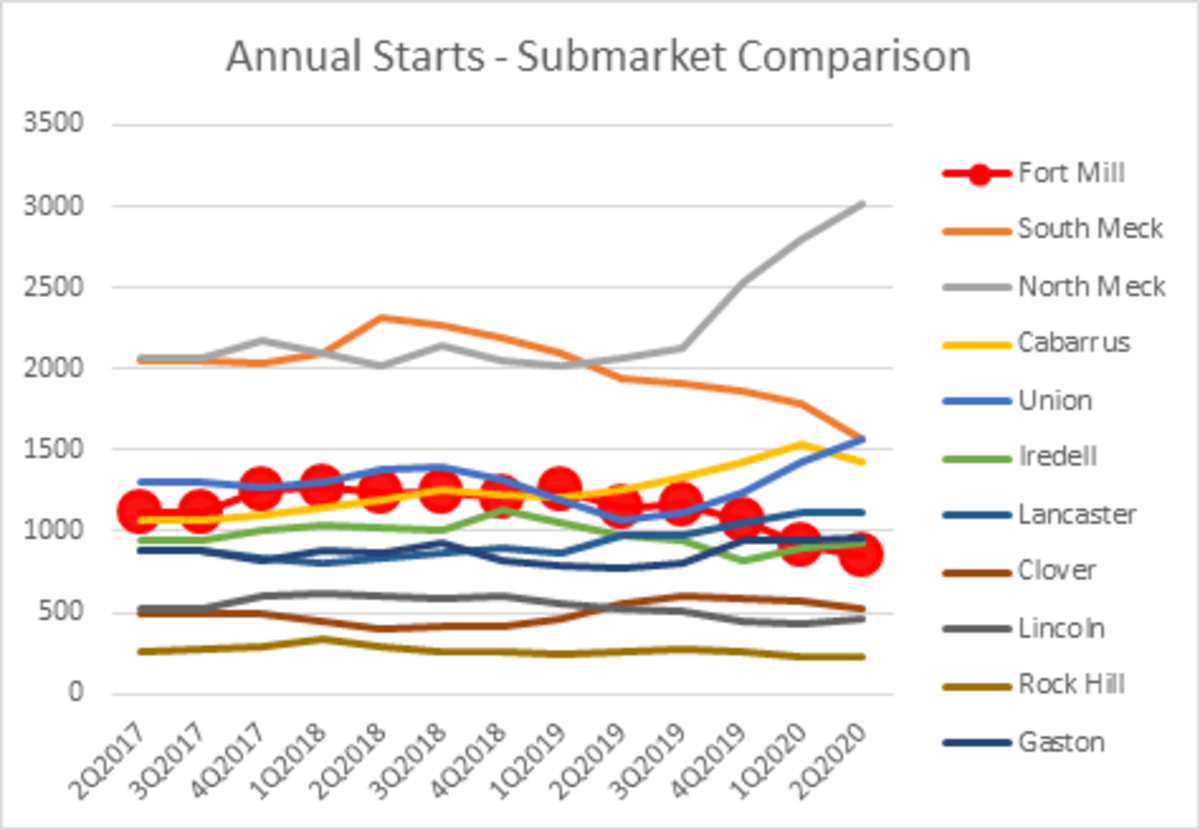
In 2018, Fort Mill, S.C., raised its impact fee to more than $18,000 per home, and was met with a legal challenge from the building industry. In January, a York County judge upheld the fees at the current rate.
Annual housing starts, a measure of the number of new houses that construction has started on, fell by nearly one-third in Fort Mill between the second quarter of 2018 and the second quarter of this year. That’s according to an analysis conducted for the Observer by Jenifer Gooch, regional director of housing market industry data provider Metrostudy.
During that same time, housing starts increased by 5.2% for the Charlotte market overall.
Still, Charlotte leaders point to the pace of development that has continued in cities with impact fees, like Phoenix and Atlanta.
“I don’t think it’s anybody trying to take an adversarial position against developers,” Egleston said. “But I also would be skeptical if somebody said, ‘Well I’m not going to look at Charlotte to develop in,’ when we’re one of the fastest growing markets in the country.”
Changing how business gets done
In the two-and-a-half years Jaiyeoba has run Charlotte’s planning department, he’s proposed sweeping changes as part of an overhaul of rules guiding zoning and land use.
He is considering the idea of eliminating single-family zoning to repair the damage of segregation. And his department wrote rules that govern development next to mass transportation to encourage affordable housing.
In the face of a politically powerful building industry, impact fees could be Jaiyeoba’s most controversial effort yet. But he’s determined to make the city’s growth more equitable.
“We cannot come out on the other side of this pandemic, and do business the same way we’ve been doing it,” he said.
This story was originally published July 28, 2020 at 9:34 AM with the headline "Charlotte may try to alleviate growth with a fee developers oppose. But hurdles remain."