‘I thought I was gonna die in prison.’ How COVID is opening NC prison gates.
After spending nearly 30 years in prison, Sandy Dowell stepped through a time machine of sorts as she walked through the chain link gate at Swannanoa Correctional Center for Women in Black Mountain to her wife’s gray Honda Accord.
Dowell was 22 years old when she went to jail and then prison in 1992 after she and another man pleaded guilty to second-degree murder in the killing of 20-year-old Shannon Gail Newman in Stokes County.
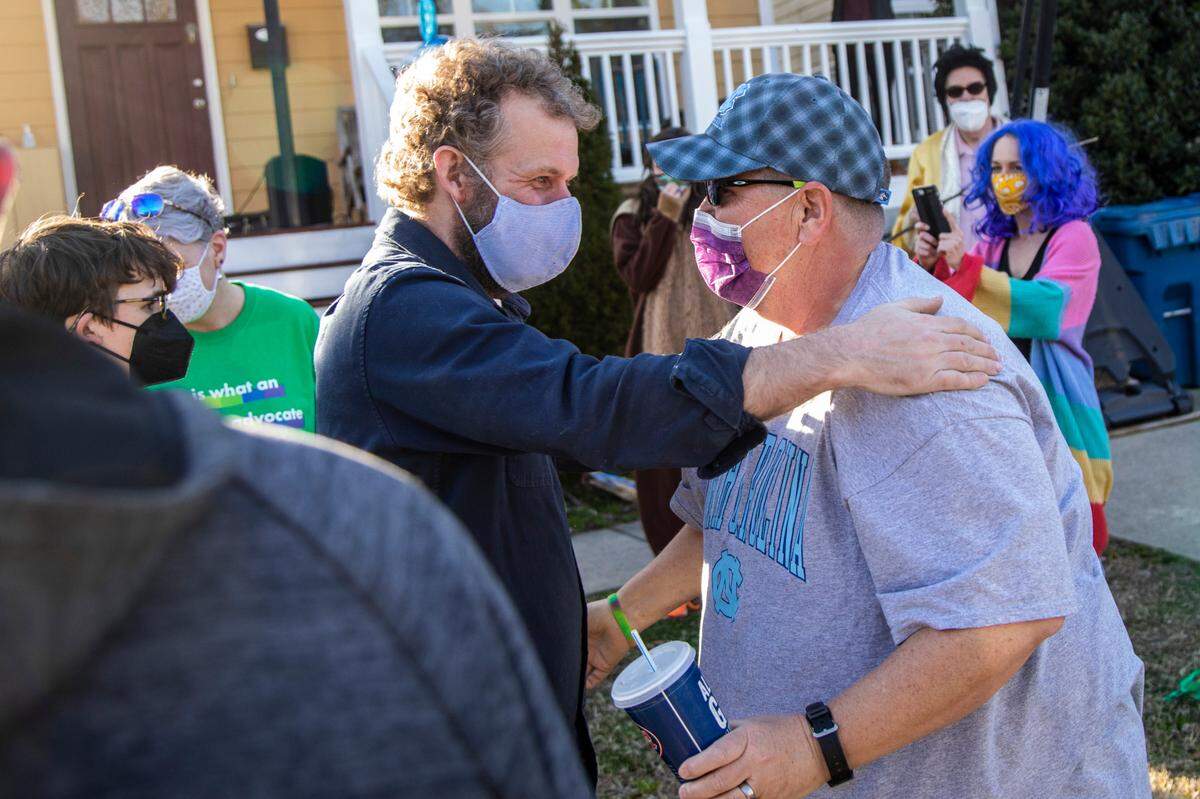
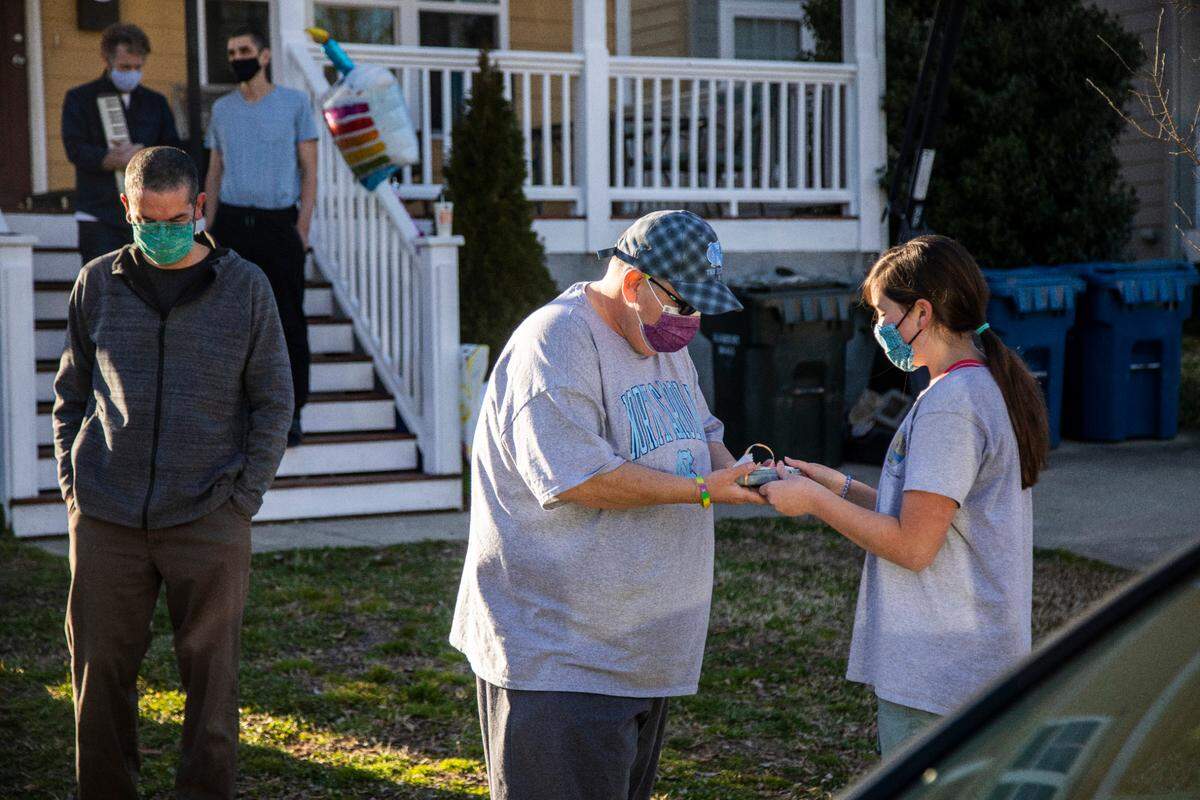
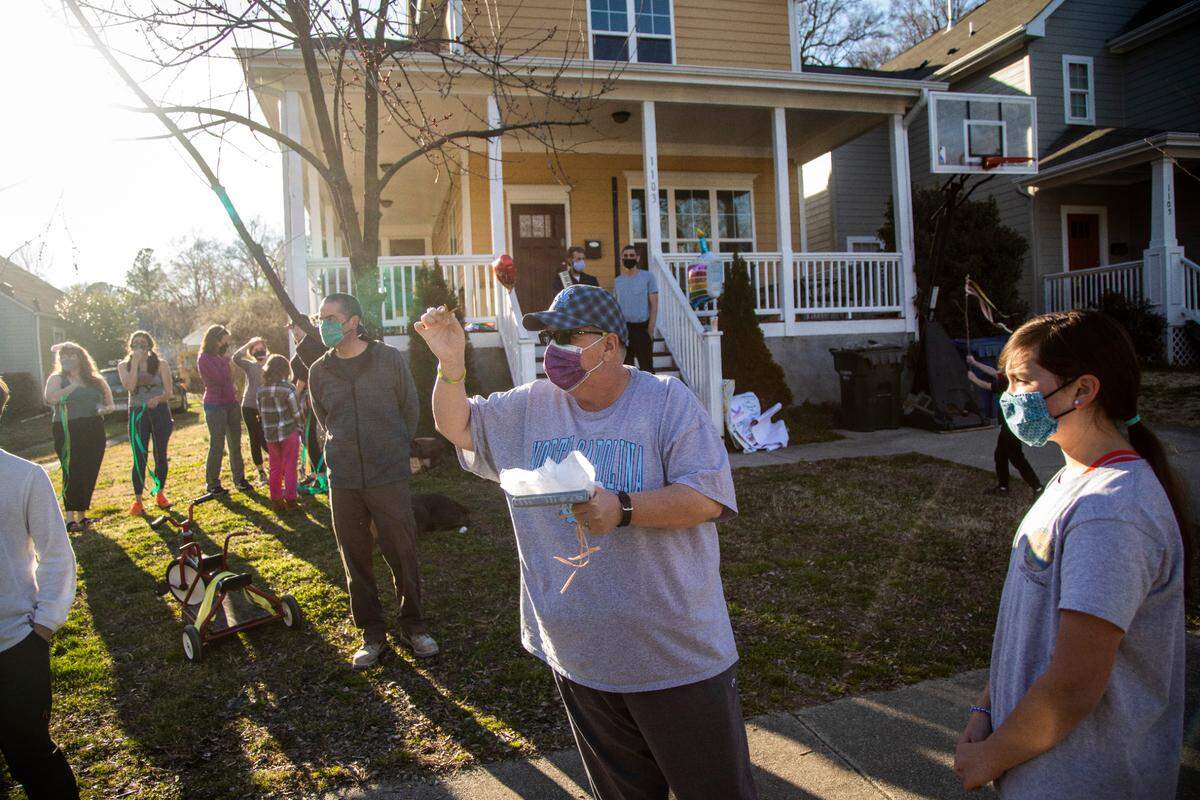
On Monday, Dowell’s wife, Amanda Marringer, was waiting in the prison parking lot, with a UNC-Chapel Hill T-shirt, baseball cap and sweatpants for Dowell to wear out the door.
The outside world had changed much since Dowell last experienced it, she said, from opening car windows with buttons to buying gas with a plastic card.
“It just blows my mind,” she said. “I am in culture shock.”
In recent weeks, Dowell, 52, has gone from believing she might die in prison to freedom.
She was a plaintiff in a lawsuit filed by three prisoners and social justice groups challenging state prison conditions during the COVID-19 pandemic.
Under a settlement announced last month, 3,500 prisoners will be granted early release over the next six months. While Dowell fits into the category of those who qualify, her attorney Elizabeth Simpson said, the actual names of those released through the lawsuit will only be shared with re-entry programs.
“Advocacy works,” Simpson, an attorney for Emancipate NC, wrote in a text. “It is my fervent wish that everyone in prison would have someone who cares about them and is working hard to get decision makers to see their humanity.”
The lawsuit defines early reentry as the release of someone after Feb. 15 at least two weeks before their projected release date, a reinstatement of supervised release, or an early release to parole.
NC Republican Party objections
The settlement came 10 months after Dowell and the two other inmates, along with the NAACP, ACLU of NC, Disability Rights NC, Emancipate NC, Forward Justice, and the National Juvenile Justice Network, filed the lawsuit in the Wake County Superior Court on April 20, 2020.
The lawsuit contends that Gov. Roy Cooper, Secretary of Public Safety Erik Hooks and others weren’t doing enough to protect North Carolina’s roughly 30,000 people in state prisons from the coronavirus.
Since February 2020, the state’s prison population fell by nearly 17% to 28,670, the lowest population since the state adjusted sentencing laws in 1995. More than 9,800 people in prison have tested positive and 50 have died. Currently there are 141 active COVID-19 cases and one person is hospitalized, according to prison data.
The settlement was criticized by the North Carolina Republican Party and some lawmakers at two hearings of the Joint Appropriations Committee on Justice and Public Safety, and at a state sentencing commission meeting.
Opponents have asked whether the state gave in too easily to liberal demands, why officials are cutting violent offenders sentences short and if it will affect public safety.
“Governor Cooper’s incompetent management of the COVID-19 crisis risks turning a public health crisis into a public safety crisis,” said NC GOP spokespersonTim Wigginton in a press release.
Meanwhile, the plaintiffs touted the settlement in an online forum as proof that the system needs to change. They called for a focus on mass incarceration and the over-representation of people of color in prison.
“This settlement is an implicit acknowledgment that people are being held on inhumanly long prison terms for reasons unrelated to public safety,” said Anthony T. Spearman, president of the NC NAACP.
“It should serve as a wake-up call that both the pandemic and mass incarceration have a disproportionate impact on Black, brown and poor people, making this a racial injustice issue,” he said.
Crowded prison conditions
Commissioner of Prisons Todd Ishee told lawmakers that crowded prisons have been a concern since the start of the pandemic.
Two of three paths to early release under the settlements allow offenders convicted of violent crimes to be released early, he said.
“All three of those categories, we do an extensive individualized review to assess risk and also readiness to safely return to North Carolina communities,” Ishee said.
Most of those who will be released early were already scheduled to be released in 2021, officials said.
Some lawmakers expressed concern about violent offenders getting out early. Ishee said it is a common occurrence.
About 70% of the prison population has a history of violence, Ishee said, and nearly 20,000 people are released from prison each year, many after earning discretionary credits.
The average prison sentence is just over two years.
3 paths to community re-entry
Prisoners can gain early release through
▪ Discretionary sentence credits that move some individuals to their mandatory minimum sentence sooner.
When someone is convicted of a crime that requires prison time, a minimum and maximum sentence is typically imposed.
About 81% of prisoners released last year earned credits for taking classes, participating in programs or having a full-time job, Ishee said.
Many of the opportunities to earn discretionary credits have been halted during the pandemic, he said, so officials are accelerating and expanding options to earn credits for good behavior and related items.
▪ Special reviews by the N.C. Post-Release Supervision and Parole Commission.
The commission, an independent quasi-judicial agency that releases offenders when they are deemed eligible, can reinstate individuals who have been returned to prison on technical violations to post-release supervision and grant early release through the Mutual Agreement Parole Program.
▪ Extended Limits of Confinement, which let some individuals serve out their sentences at home or in transitional housing under the supervision of community corrections officers. To qualify, offenders must not be serving a sentence for a crime against a person. Prison officials said a narrow group of people qualify for this program.
Discretionary credits
Shannon Nyamodi was sentenced to eight to 11 years after pleading guilty in 2014 to conspiracy to commit first-degree murder in Franklin County.
Nyamodi, 27, told The News & Observer on Wednesday that he was innocent of the charges but pleaded guilty for reasons he declined to elaborate on.
“I can’t really get into that,” he said.
Nyamodi said he was scheduled to be released from prison in May but officials gave him credits for working in the kitchen and washing pots and pans.
“Hundreds of pots and pans,” he said.
In prison, Nyamodi said he felt defenseless against the coronavirus.
“We are clustered together,” he said. “There is no way to social distance. ... It was crazy.”
Nyamodi said he slept in a dormitory situation and that someone who eventually tested positive for COVID-19 was left in the pod while he was sick for three days.
When Nyamodi was released on Feb. 23, he didn’t believe it was happening until they handed him his clothes to wear out of a prison in Lumberton.
When he walked out, his mother grabbed him and started crying, he said.
“She was holding me extremely tight,” he said. “It was just an indescribable feeling.”
Nyamodi, who is now on post-release supervision for 12 months, is living with his mother. He is considering three job offers and wants to return to school, he said.
“I got personal plans of my own,” he said.
Other settlement promises
In addition to releasing about 1,800 people early each month, the state also agreed under the settlement to provide incentives for people in prison to get vaccinated, implement an anonymous complaint system for prisoners to report COVID-19 related concerns, and reach out to incarcerated people’s emergency contacts when someone is seriously ill.
Ishee said officials have been using the three early re-entry mechanisms since early in the pandemic, as they cut the prison population by about 6,500.
“What are the guard rails for the public that you are not going to release people who aren’t ready to go out?” due to the pressure of the lawsuit, state Sen. Amy Galey, an Alamance County Republican, asked Ishee at a hearing Tuesday morning.
Individual assessments, Ishee responded, and staff with years of experience of predicting risk.
If officials can’t identify enough people, he said, they could consider people with 2022 release dates.
While Community Corrections staff, who supervise people on parole, probation and post release supervision, can handle the increase, Chief Deputy Secretary for Adult Correction and Juvenile Justice Tim Moose said, reentry, housing, and support services are strained in normal times. They are working with agencies to expand resources, he said.
Re-entry programs
Kerwin Pittman, executive director of Recidivism Reduction Educational Program Services and an Emancipate NC community organizer, said the lawsuit settlement will force local governments to take their reentry programs more seriously, to ensure those being released “have a peaceful and smooth transition into society.”
People leaving prison often lack support and face challenges finding housing and employment that can increase their chances of returning to prison, Pittman said.
He said he and others are working to get ready for people who get released, but said they haven’t received any information about those who have been or will be released.
Married in prison
Dowell met Marriner at the N.C. Correctional Institute for Women in Raleigh. Marriner was convicted in 2000 of second-degree murder in Orange County. In 2015 she was released and moved in with her mother, but soon sought a different situation.
She had a job but had difficulty finding housing because of her conviction. She eventually moved in with Jonathan Wilson-Hartgrove, his wife, Leah, and their three children in the Rutba House. The Wilson-Hartgroves founded the Rutba House, a community living situation for range of people who need housing.
Dowell and Marriner were married at Neuse Correctional Institution in 2019. Prison officials initially blocked the same-sex marriage but allowed it after Marriner’s attorney sent a letter and threatened a lawsuit.
The killing of Shannon Newman
In 1991, Dowell said, she and others celebrated Thanksgiving at a party with alcohol, cocaine and marijuana in a mobile home where she and her girlfriend, Newman, lived. They were renting a room from Glen Allen Irvin, who was dating Dowell’s cousin, she said.
Her cousin and Newman got into an argument that escalated and Newman’s throat was cut, Dowell said.
Dowell said Irvin cut Newman’s throat, and Irvin said it was Dowell.
Officials believed Irvin, she said. Irvin faced similar charges, including second-degree murder, but got a shorter sentence and was released in 2004.
Newman’s body was found in a well in Stokes County, the News & Record reported. She had been stabbed in the throat and the stomach.
Dowell was sentenced under a system that the state no longer uses, but which allowed her to be considered for parole starting in 2005. Initially she had hearings every year but that slowed to every three years due to a change in the law.
Her last parole hearing was Dec. 20 and included testimony and letters from Marriner and people at Durham Presbyterian Church who said they would support Dowell when she got out. Dowell, who will live in the Rutba House with Marriner, will remain on parole for five years. She learned Feb. 22 she would be let out two weeks later.
“I just cried,” she said. .
Dowell said she regrets the choices she made in her early 20s as she struggled to find acceptance as a gay woman.
“I was a young,” she said. “I was trying to fit with all the wrong people.”
The News & Observer was unable to reach members of Newman’s family.
Leah Wilson-Hartgrove believes people are capable of change.
“None of us are defined by the worst things we have ever done,” she said.
Dowell: ‘You made it perfect’
It was on Interstate 40, Dowell said, that the reality of her freedom sank in.
“I started tearing up and crying because I was like, ‘Oh my God, it’s real,’” said Dowell, who said she had a mild case of the coronavirus in prison.
Dowell’s first stop was her parents’ graves for the first time. The died while she was in prison.
“I got to spend a little time with my Mom and Dad,” she said.
For the rest of the day, Marriner tried to line up activities that brought her wife joy.
Dowell face timed with her mother-in-law and the attorneys who helped set her free. She had a salad with blue cheese dressing at Cracker Barrel, and she got her hair cut. She bought fresh fruit at the grocery story and tried on clothes at thrift stores.
“I wanted to make it perfect for her,” Marriner said. “I tried to think of everything I did and enjoyed.”
“You made it perfect,” Dowell said.
As Marriner drove up to the Rutba House in Durham, a crowd of about 20 dressed in costumes, playing musical instruments and holding signs greeted her and Dowell. Someone switched the song on the stereo to Kool and the Gang’s “Celebration.”
Dowell, tears flowing behind her sunglasses, finally got to meet the people she had known through letters, phone calls and pictures.
The moment means the world, to her, she said. After years of people telling her she can’t, there are people that believe in her, she said.
“They actually think that much of me to do all this,” she said. “It is just amazing.”
This story was originally published March 12, 2021 at 5:45 AM with the headline "‘I thought I was gonna die in prison.’ How COVID is opening NC prison gates.."