If you’re a Certified Management Accountant (CMA) or considering becoming one, understanding the Continuing Professional Education (CPE) requirements is crucial. These requirements ensure that CMAs stay current in their field, maintaining the high standards expected in management accounting.
And when you become a CMA, you’re not just earning a credential—you’re also joining IMA’s global network of about 140,000 accounting and finance professionals, giving you access to a wealth of resources, support, and ongoing learning opportunities. Let’s dive into the essentials of CPE for CMAs, breaking it down into manageable sections.
Key Takeaways
- Annual Requirement: CMAs must complete 30 CPE hours each year, including at least 2 hours in ethics.
- Multiple Learning Options: CPE credits can be earned through college courses, online programs, seminars, and self-study.
- Tracking Is Essential: Keeping accurate records of your CPE activities ensures compliance and makes reporting easier.
- Non-Compliance Has Consequences: Failing to meet CPE requirements can lead to inactive status and reinstatement fees.
- Plan Ahead: A proactive approach to fulfilling CPE requirements prevents last-minute stress and keeps your certification in good standing.
What Are the CPE Requirements for CMAs?
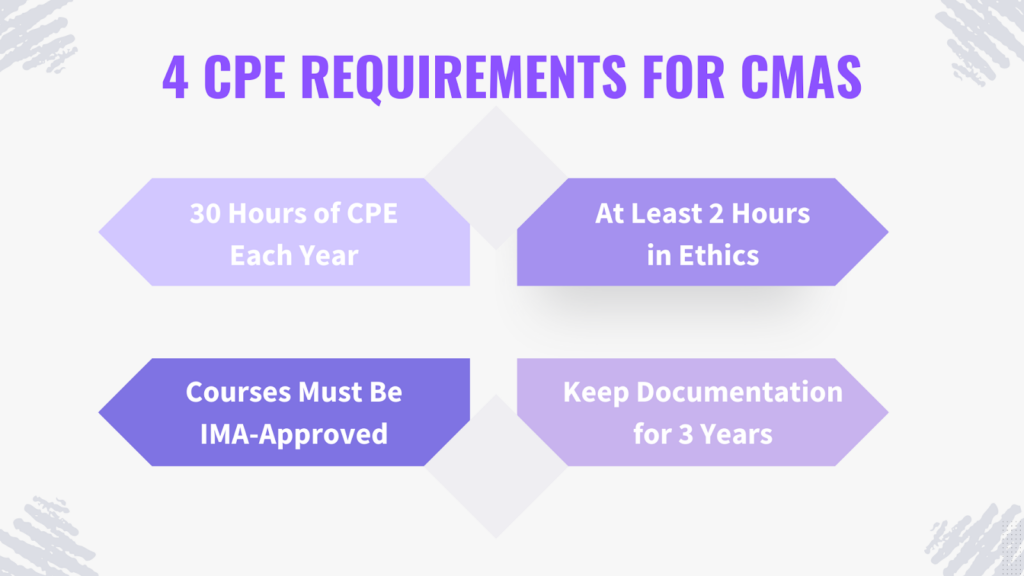
As a CMA, you’re required to complete 30 hours of CPE each year, as per the requirements of the Institute of Management Accountants (IMA). This will entail:
- Annual Requirement: 30 CPE hours between January 1 and December 31.
- Ethics Component: At least 2 of these hours must focus on ethics.
- Start Date: It’s advisable to start earning CPE credits in the year you pass the CMA exam. Even if you exceed the number of hours required, these can be carried over to the next year.
- Carryover Policy: The IMA allows CMAs to carry over up to 10 excess CPE hours from one year to the next.
These guidelines ensure that CMAs continue to uphold the integrity and competencies associated with the designation.
Acceptable CPE Subjects
Not all courses qualify for CPE credit. The Institute of Management Accountants (IMA) approves subjects that are pertinent to the CMA profession. Acceptable topics include:
- Accounting
- Financial management
- Business applications of mathematics and statistics
- Computer science
- Economics
- Management
- Production
- Marketing
- Business law
- Organizational behavior
This list isn’t exhaustive, so it’s wise to consult the IMA or a trusted CPE provider to ensure your chosen courses meet the criteria.
How to Earn CPE Credits
There are several avenues to accumulate CPE credits, including:
- College or University Courses: Enrolling in relevant courses can earn you credits. For instance, a one-semester course is typically equivalent to 15 CPE hours.
- Online Courses and Webinars: Many providers like Becker offer online CPE courses tailored for CMAs. These can be convenient and flexible, fitting into your schedule seamlessly.
- Conferences and Seminars: Attending industry conferences can provide both learning opportunities and CPE credits.
- Self-Study Programs: Some providers offer materials that you can study at your own pace, followed by an assessment to earn credit.
Remember, the key is to choose programs that align with the IMA’s approved subjects and enhance your professional competence. Don’t see CPE as just another box to check — it’s a chance for you to dive a little deeper into something that interests you.
Ethics Requirement
Ethics plays a pivotal role in the accounting profession. Each year, you must complete at least 2 hours of ethics-focused CPE. This ensures that CMAs remain committed to ethical standards and practices in their professional roles.
These ethics courses focus on real-world scenarios that you may encounter as a CMA. These might include:
- Understanding Conflicts of Interest: A typical ethics course might focus on how to navigate situations where personal interests could conflict with professional duties. For example, a CMA working for a corporation might face a situation where a supplier or vendor relationship could influence their professional judgment, such as giving preferential treatment to a friend or family member who owns a business. The course would emphasize how to disclose these conflicts and recuse oneself from decisions that might be biased or improperly influenced.
- Ensuring Financial Transparency and Reporting Integrity: Another example could include reviewing ethical practices in financial reporting. CMAs are responsible for ensuring that financial statements reflect the true and fair state of a company’s finances. An ethics-focused CPE course might cover the ethical implications of “creative accounting” or misrepresenting financial figures to benefit the organization, such as manipulating earnings to meet quarterly targets. The course would guide CMAs on how to maintain transparency and uphold financial reporting standards, aligning with both legal and ethical expectations.
By engaging with these topics, CMAs ensure they maintain not only their technical competence but also the ethical standards that are critical to the profession.
Tracking and Reporting CPE Credits
Reporting your hours is pretty easy: simply log into your IMA account annually and update your completed CPE hours. However, there are a few key things to remember to make this process as smooth as possible when tracking and reporting your hours:
- Maintain Records: Keep detailed records of all CPE activities, including certificates of completion, course descriptions, and dates.
- Use IMA’s Resources: The IMA provides tools and guidelines to help you track your CPE credits. Regularly updating your records will make the annual reporting process smoother.
- Be Prepared for Audits: The IMA may audit your CPE records, so having organized documentation is crucial.
What Happens If I Don’t Earn CPE Credits?
Failing to meet CPE requirements can have significant implications on your career. These could include:
- Inactive Status: Your CMA certification may become inactive, affecting your professional standing and employment opportunities.
- Reinstatement Process: To reactivate your certification, you’ll need to complete the outstanding CPE hours and possibly pay reinstatement fees.
Maintaining compliance preserves your certification and demonstrates your commitment to professional growth.
Tips for Successfully Fulfilling CPE Requirements
With so much already on your plate, it’s easy to become overwhelmed and put off your CPE requirements until the last minute. This can be avoided! Here are some tips to remember to keep you on track with your CPE:
- Plan Ahead: At the beginning of each year, outline a plan for how you’ll achieve your 30 CPE hours.
- Diversify Learning Methods: Mix different types of learning—online courses, seminars, self-study—to keep the process engaging.
- Set Reminders: Regularly check your progress throughout the year to avoid last-minute scrambles.
- Leverage Employer Resources: Some employers offer support for continuing education, so explore any available assistance.
By proactively managing your CPE, you ensure continuous professional development without unnecessary stress.
Final Thoughts
Meeting the CPE requirements as a CMA is more than just a regulatory obligation; it’s an opportunity to enhance your skills, stay updated with industry trends, and uphold the esteemed standards of the profession.
By understanding the requirements, choosing relevant subjects, and effectively tracking your progress, you can seamlessly integrate continuing education into your professional journey. Remember, staying informed and proactive is key to maintaining your CMA certification and advancing in your career.
FAQ
You must begin accumulating CPE credits starting one calendar year after earning your CMA certification.
Yes, you can carry over up to 10 extra CPE hours from one year to the next.
Your CMA certification may become inactive, and you’ll need to complete the missing credits and possibly pay a reinstatement fee to regain active status.
Yes, as long as the course meets IMA’s approved subject criteria and you receive proper documentation of completion.
You can log your CPE activities through the IMA’s online reporting system, keeping all certificates and records in case of an audit.