
Let’s be honest — “risk management” doesn’t sound glamorous at first. But in today’s finance world, risk professionals are the quiet power players behind billion-dollar decisions.
Here’s the truth: when markets swing overnight, it’s the risk managers who keep institutions steady, investors confident, and portfolios alive.
Why does that matter? Because firms are paying big for that kind of expertise.
Earning the FRM® (Financial Risk Manager) designation isn’t just a résumé booster; it’s a ticket into one of the most in-demand, high-paying careers in global finance. From six-figure analyst roles to C-suite leadership, the earning potential for certified risk managers keeps climbing year after year.
Key Takeaways
- Risk management roles offer competitive salaries at every level, with rapid growth as experience increases.
- Top earners in CRO and director roles can exceed $300,000–$500,000 annually, particularly in major financial centers.
- Specialization in credit, market, or regulatory risk can significantly influence pay.
- Geographic location plays a key role, with New York, London, and other financial hubs offering the highest compensation.
- Earning the FRM® designation can accelerate career advancement and boost salary potential.
The Risk Management Career Landscape
The financial risk management field is broad, spanning functions like credit, operational, regulatory, and market risk. Many professionals begin their careers in specialized analyst roles and gradually move into managerial or strategic positions. Top earners often work in leadership roles within asset management firms, investment banking, or large multinational corporations.
Key roles include:
- Market Risk Analyst: Focuses on exposure to interest rate, foreign exchange, or equity market movements.
- Credit Risk Analyst: Evaluates counterparty and borrower risk to minimize losses.
- Operational Risk Manager: Identifies and mitigates non-financial risks such as fraud, process failures, or cybersecurity threats.
- Regulatory Risk Analysts: Ensure compliance with global regulations like Basel III and stress testing requirements.
- Risk Directors and Chief Risk Officer (CRO): Oversee enterprise risk strategy, policy, and governance at the highest levels.
Average FRM Salary by Role and Experience
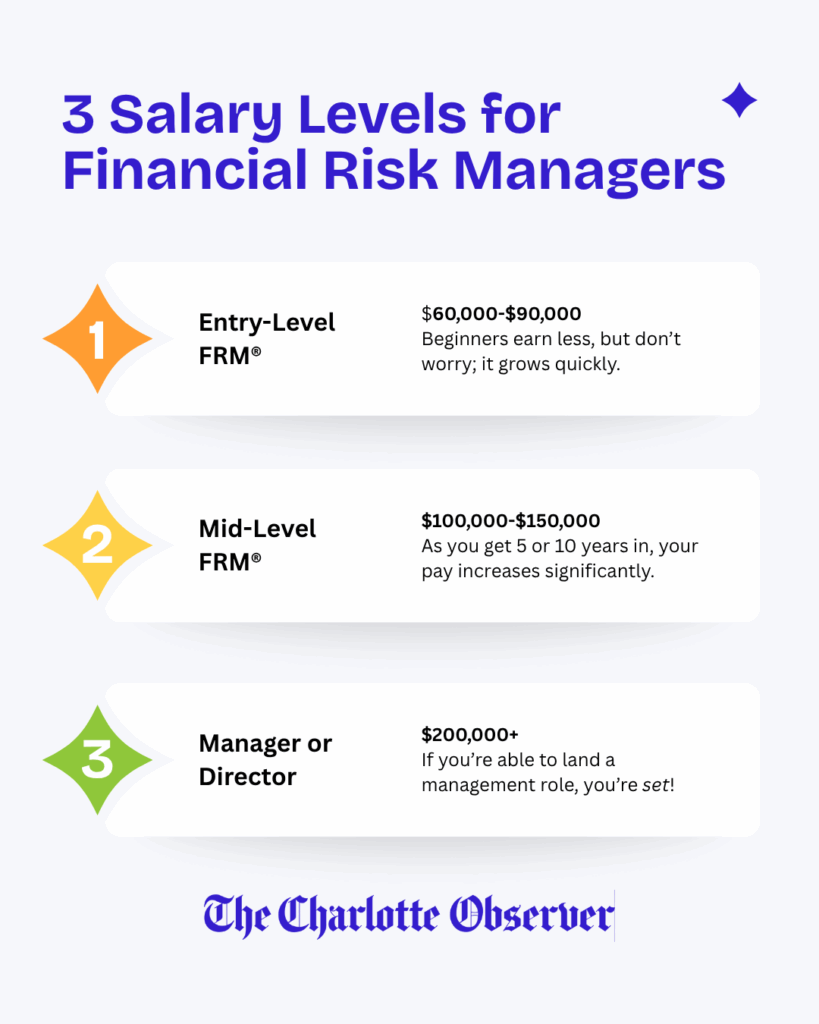
According to industry surveys and hiring data, the average FRM salary tends to increase rapidly with seniority. Entry-level analysts may start in the $60,000–$90,000 range, depending on the employer and location. As professionals gain experience and pass the FRM exam, mid-level salaries often rise to between $100,000 and $150,000 annually.
Senior managers and directors frequently exceed $200,000, with chief risk officer roles sometimes reaching compensation packages of $300,000 to $500,000+ at major institutions. These figures can grow even higher when bonuses and profit-sharing arrangements are included—particularly within hedge funds and trading firms.
Specialization also plays a role. Credit risk specialists working for large banks or structured finance groups can command higher salaries than their counterparts in operational risk, while portfolio-focused professionals in asset management or portfolio management functions may see significant performance-based incentives.
Geographic Variations: Where You Work Matters
Salaries in the risk management profession are heavily influenced by geography. Financial hubs like New York, London, Hong Kong, Singapore, and Zurich offer some of the highest compensation packages in the world. These regions host the headquarters of global banks, regulators, and asset managers—creating intense demand for qualified risk talent.
Meanwhile, professionals in smaller cities or emerging markets may see lower base salaries but sometimes benefit from faster career progression or lower living costs. Remote work has also begun to reshape compensation expectations, particularly for mid-level roles that don’t require constant on-site presence.
Industry Trends and Salary Growth Potential
The demand for skilled risk talent has accelerated in recent years. Economic uncertainty, regulatory changes, and the growing complexity of financial products have all elevated the importance of risk functions. Firms are investing heavily in both human expertise and technology to strengthen their defenses.
Notably, the FRM® credential is increasingly seen as a strategic differentiator. Many senior risk directors and CROs are certified, and employers often prefer candidates with formal risk designations over those with only a certified public accountant license or a general finance background.
In addition, areas like climate risk, cybersecurity, and digital asset regulation are opening new avenues for growth. Professionals who adapt to these emerging areas may see salary acceleration even faster than in traditional roles.
Education and Certifications
While a bachelor’s degree in finance, economics, or mathematics remains the typical entry point, advanced credentials help professionals stand out. The FRM® designation is especially valuable because it focuses deeply on applied risk concepts—unlike some broader certifications. Earning this credential signals mastery in areas like quantitative methods, derivatives, and risk modeling.
Some professionals pair the FRM® with other certifications or graduate degrees, especially when aiming for leadership positions. A strong academic foundation combined with practical experience can position candidates for rapid salary growth.
Final Thoughts
The risk management field is both financially rewarding and intellectually challenging. As global markets evolve, organizations will continue to depend on skilled individuals to identify threats, protect assets, and navigate complex regulatory landscapes. Whether you’re just starting as a credit risk analyst or aspiring to lead as a CRO, the potential for lucrative compensation is substantial.
By developing specialized expertise, pursuing certifications, and targeting top-paying regions and firms, financial risk manager professionals can build careers with strong earning potential and long-term stability.
FAQs
Average salaries range from $70,000 for entry-level analysts to well over $200,000 for experienced managers, with top executives earning even more.
Yes. The FRM credential is widely respected and often leads to higher salaries, faster promotions, and access to specialized leadership roles.
Credit and market risk roles, especially in investment banking and trading environments, tend to offer the highest salaries due to their direct impact on revenue and capital allocation.
Absolutely. Working in top financial centers like New York, London, or Singapore can significantly increase your earning potential compared to smaller markets.
FRM salaries are generally competitive with CFA® charterholders and often exceed those of general accounting certifications for roles focused on risk and quantitative finance.