If you’re thinking about sitting for the Certified Financial Planner exam, chances are you’ve already done the hard work of finishing the CFP Board–approved coursework. That’s months (if not years) of digging through the financial planning process, memorizing definitions, and piecing together how it all fits into personal financial planning.
So why does the exam itself still feel like such a looming challenge?
Because the CFP® test isn’t just about knowing things. It’s about proving you can apply what you know in real-life scenarios, under time pressure, across multiple areas at once. That’s a different game entirely.
Key Takeaways
- Beyond Memorization: The CFP® exam tests applied knowledge with complex case studies, not just definitions.
- Pass Rates Tell a Story: With only 60–65% passing, preparation and endurance matter more than raw intelligence.
- Harder Than Licensing Tests: Broader and more integrative than insurance and securities licensing exams, the CFP® measures true planning skills.
- Mental Marathon: At six hours long, fatigue and time pressure make the exam feel tougher than it already is.
- Practice Wins: Practice exams and case-based practice questions are the best way to prepare for exam day.
Not Just Memorization
If you’ve breezed through your program exams by highlighting and re-reading notes, you’ll find the CFP® exam a very different experience. It’s not just about recalling tax brackets or listing steps in the financial planning process.
Instead, the exam tests how you integrate knowledge across the eight principal knowledge topics: investment planning, insurance planning, tax planning, income planning, estate planning, professional conduct, and more.
A single case study might drop a fictional client in front of you who needs advice on retirement contributions, tax strategies, and risk management all at once. It mirrors the kind of complexity that financial planners face every day. That’s what makes the exam tricky — it’s about synthesis, not flashcard memorization.
The Pass Rate Reality
Here’s the cold truth: most people don’t pass on their first try. Pass rates hover around 60–65%. That means four out of every ten candidates walk out of the testing center without a passing score.
Why? It’s usually not because they’re “bad at finance.” Instead, it’s because the exam is deliberately designed to stretch candidates beyond their comfort zones.
- Some underestimate how much review they need outside their day-to-day specialty. (You might be strong in investment planning but weaker in insurance planning or tax planning.)
- Others treat it like a school exam when it’s really more like a licensure test, measuring readiness to practice.
- And many simply run out of steam. Six hours is a long time to stay sharp.
So when you hear “the CFP® is hard,” what that really means is that it requires holistic preparation, not just cramming or leaning on professional experience.
CFP® Exam vs. Other Licensing Tests
If you’ve taken other financial exams before, like insurance and securities licensing tests, you might be tempted to assume this one will feel similar. It won’t.
Licensing exams are narrower, focused on product knowledge, rules, and regulations. They measure whether you understand compliance and distribution.
The CFP® exam, on the other hand, is broad and integrative. It’s not just about whether you know the rule. It’s whether you can apply that rule in the messy context of personal financial planning.
That’s why people often describe it as harder. It tests your ability to think like a planner, not just to recite facts.
Why The CFP® Feels Harder Than It Is
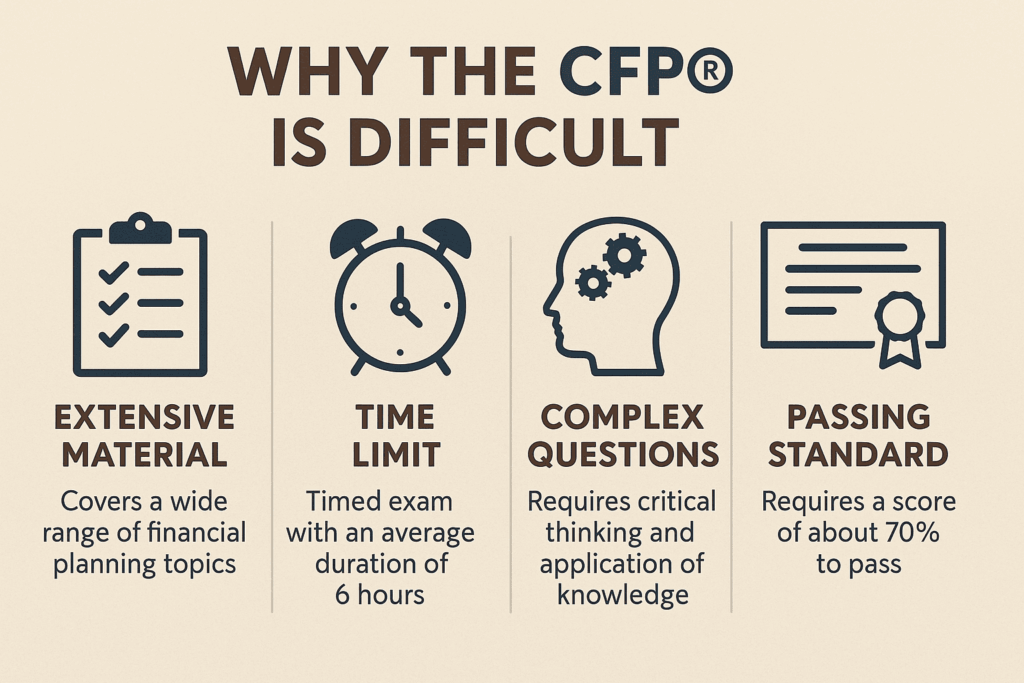
The CFP® is hard, but sometimes it feels even harder than it really is. That’s partly because of the exam duration. Two three-hour sessions, with 170 questions, make for a long, grueling day. By hour five, even the strongest candidates feel brain-fogged.
It’s also about the mental marathon. A case that looks straightforward at first glance can spiral into multiple calculations, forcing you to shift gears quickly. One minute you’re projecting retirement income, the next you’re solving a tax planning scenario, then pivoting to client psychology.
This constant switching adds to the sense of difficulty, even if each question is fair on its own.
What Actually Helps
Looking back, many successful candidates say the same thing: the key wasn’t highlighting textbooks. It was practicing in exam conditions.
- Practice exams are essential. They train your endurance and help you get comfortable with timing. Nothing replicates exam day quite like doing the full six-hour simulation.
- Targeted practice questions also matter. They expose blind spots and force you to recall information quickly.
- Don’t just study harder — study smarter for the CFP®. Work through questions that combine topics (like income planning and tax planning) so you get used to integrated thinking. Use a top CFP® exam prep course like Boston Institute of Finance to help you pass.
- And pace yourself. Three or four months of steady review is more effective than one month of frantic cramming.
Is CFP® Certification Worth It?
Yes. The CFP® exam is tough, but that’s by design. The CFP Board’s goal isn’t to trip you up; it’s to make sure that when you earn the credential, you’re truly ready to guide clients with competence and integrity.
Passing means you’ve proven mastery of the exam topics, from professional conduct to retirement projections. More importantly, it signals to clients and employers that you can translate complex rules into actionable strategies for real people.
So while the difficulty is real, it’s also what makes the CFP® credential valuable. If you can pass the exam and become a CFP®, you’ll join a community of planners who have demonstrated the knowledge and judgment needed to serve at the highest standard of the profession.
FAQs
The CFA is more quantitative and investment-focused, while the CFP® is broader and client-focused. Most consider the CFA harder, but the CFP® is still rigorous.
The CPA exam is known for its depth in accounting standards. The CFP® exam is less technical in accounting but broader across financial planning. Difficulty depends on your background. See this comparison of CFP® and CPAs to learn more.
The pass rate typically falls between 60% and 65%, meaning a significant number of candidates don’t pass on the first attempt (and they’ll have to pay the standard registration fee again for the next testing window).
It’s challenging because it integrates multiple areas like tax planning, investment planning, and income planning into complex, real-world client scenarios.
Not especially. There are calculations in areas like retirement and investment projections, but the math is generally high-school to college-level applied math. Generally speaking, you’ll want to focus on financial planning knowledge for the real exam.