With three levels, multiple testing windows, and a reputation for rigor, the CFA® exam isn’t just another test—it’s a marathon of finance knowledge, strategy, and endurance. And the pass rate proves it, hovering around 45-50% across each level.
But here’s the catch: each level of the CFA® Program has an entirely different exam format and time commitment.
From the Level I exam’s fast-paced multiple-choice questions to the essay-style challenges of the Level III exam, knowing precisely what you’re up against can make or break your prep strategy. Let’s break down how long each CFA® exam level is, what that means for your study plan, and how you can use that time to your advantage.
Key Takeaways
- Level I Exam Format: The CFA® Level I exam lasts 4.5 hours, split into two sessions covering topics like ethical and professional standards, financial statement analysis, and quantitative methods.
- Level II Exam Depth: The CFA® Level II exam is 4 hours and 24 minutes, but it focuses on advanced investment analysis, financial reporting, and portfolio management, requiring mastery of learning outcome statements.
- Level III Exam Challenge: The CFA® Level III exam spans 4 hours and 24 minutes, and emphasizes wealth planning, portfolio management, and alternative investments, with an essay-based component.
- Time to Complete the CFA® Program: Most candidates take 3–5 years to complete the CFA® Program, factoring in the exam registration fee, study schedules, mock exams, and achieving the minimum passing score.
- Which CFA® Level is Hardest: Many find the CFA® Level II exam toughest due to its heavy focus on financial analysis and applied investment analysis.
The Big Picture: Time on Test Day vs. Time to the Charter
The CFA® Program consists of three exams delivered by the CFA Institute. Each level uses computer-based testing with two sessions of 2 hours and 12 minutes (2:12) and an optional 30-minute break in between. That’s 4 hours and 24 minutes of testing per level, save for Level I, which adds six minutes for a total of 4 hours and 30 minutes.
Pass all three, meet the work experience requirement, and you’re on your way to adding “CFA®” after your name. But time adds up: most candidates need 3–4 years from first exam registration fee to final pass, and often 4–5 years to the charter once qualifying experience is factored in.
Level I Exam: Broad, Fast, and Structured
The Level I exam (you’ll also see it called the CFA® Level I exam) checks whether you know the building blocks:
- Ethical and professional standards
- Quantitative methods
- Financial statement analysis
- Economics, Corporate Finance, Alternative investments
- Equity, Fixed Income, Derivatives, Portfolio management
Exam format: two sessions, 2:30 each, with a 30-minute break in the middle. You’ll face a large set of independent multiple-choice items mapped to learning outcome statements (LOS). Nothing fancy—just a lot of ground to cover quickly.
How long it feels: brisk. You’re switching topics often, so pacing matters. Aim to finish each question in well under two minutes, leaving buffer for flagged items.
Study time: ~300 hours is the classic target. Use mock exams and lots of practice questions to build speed, especially across quantitative methods and financial analysis.
Level II: Case-Based Depth and Application
The CFA® Level II exam raises the bar. You’ll still sit for two 2:12 sessions with a break, but the question style changes to item sets—vignettes followed by several related multiple-choice questions.
What’s tested more deeply:
- Financial reporting (think adjustments, quality of earnings, intercorporate investments)
- Valuation-heavy investment analysis across equity investments, fixed income, and derivatives
- Integration across topics that mimics analyst workflows
Exam format: 2:24, higher cognitive load. You’re reading more, interpreting exhibits, and applying rules. Time management gets real here.
Study time: plan 325–375 hours. Full-length vignette mock exams matter because they train you to move from reading to calculation to conclusion without getting stuck. Many candidates say Level II is the toughest because it combines detail with pace.
Level III: Essays, Strategy, and Client Lens
The CFA® Level III exam keeps the same timing but introduces constructed-response (essay) questions in one session and item sets in the other. You’ll apply everything through the lens of clients and policy.
What dominates:
- Portfolio management (both institutional and individual)
- Wealth planning (objectives, constraints, taxes, liquidity, legal)
- Asset allocation, risk control, and monitoring—plus ethical and professional standards (still critical)
Exam format: Also 2 hours and 24 minutes; essays are structured prompts (“calculate,” “justify,” “recommend”) with targeted answers. Clarity and brevity win; long narratives don’t.
Study time: 350–400+ hours. Mastering past essay styles and learning how graders award credit is huge. Many well-prepared candidates lose points by writing too much or skipping command verbs.
The Break: Use It Like a Pro
Between sessions, you get an optional 30-minute break. Most candidates take it. Grab water, eat a snack, and reset your eyes and brain. Don’t over-review notes—that can spike stress. Set an alarm so you’re back in your seat early; if you cut it close, you’ll start flustered.
How Long to Study—Realistically
A practical plan if you’re working full-time:
- Months 1–2: Learn content steadily, following the CFA® exam format topic weights.
- Months 3–4: Shift toward applied work—end every study block with mixed practice questions.
- Final 4–6 weeks: Two to four complete mock exams under timed conditions; deep review of errors.
Targets by level are typically 300/350/400 hours (I/II/III). Track hours weekly, not daily. Consistency beats bursts, and studying with a top CFA® prep program is recommended.
Minimum Passing Score and What That Means for Time
The minimum passing score (MPS) isn’t published. In practice, plan to target 70%+ on mocks across major areas like financial statement analysis, equity, fixed income, and ethics. If your mocks are at or above that level under real timing, you’re pacing well. If not, extend your runway by a few weeks and keep cycling weak topics until scores stabilize.
Registration, Windows, and the Hidden Time Costs
The exam registration fee varies by early/standard/late windows. Early registration often locks in the date you want and keeps costs down. Another time factor: not every level has the same number of sittings each year in every location. If you miss a window, you could add months to your path.
Add in logistics, commute, check-in, reading the CFA Institute policies, and your “day of” time is closer to five hours plus. Plan your route and arrive early so the clock only starts when the exam does.
Total Time to the Charter
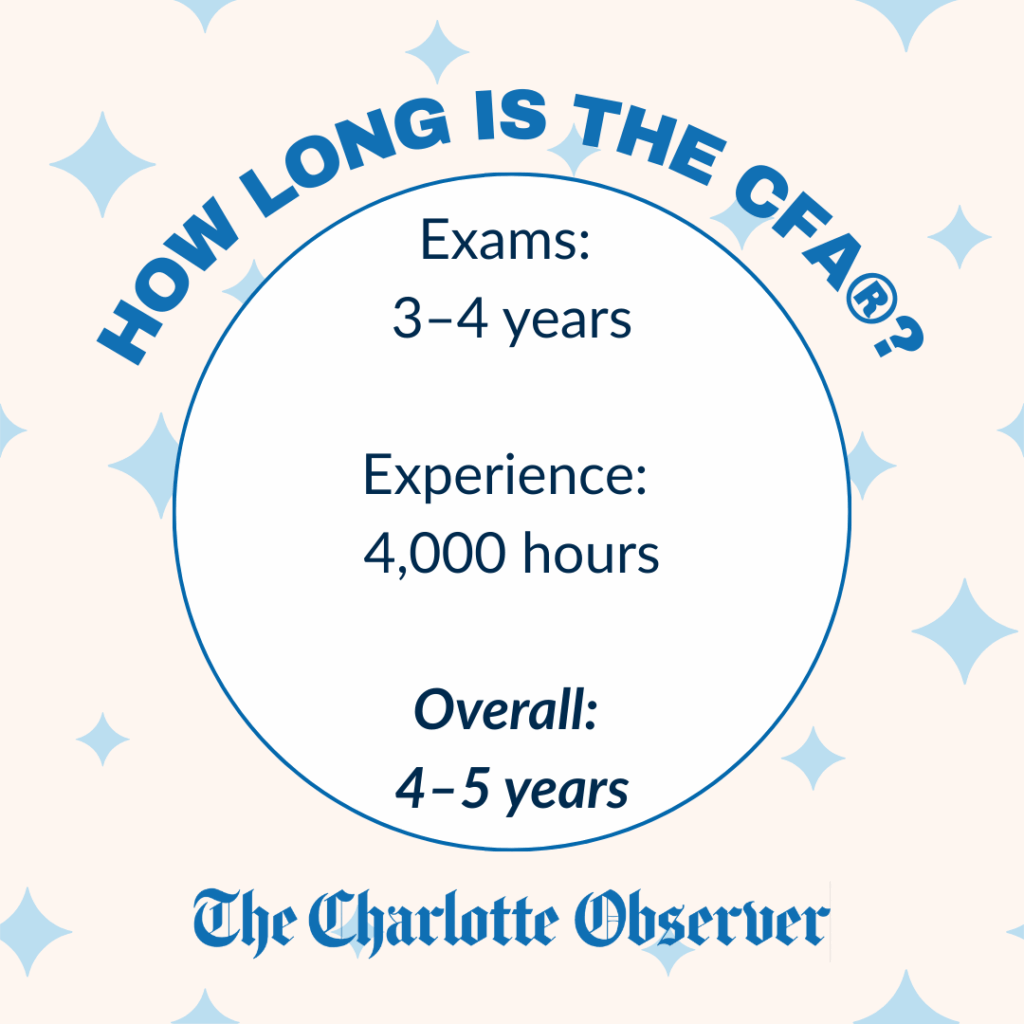
Even if you pass each level back-to-back, the absolute fastest timeline is roughly 18–24 months. More typical:
- Exams: 3–4 years across all levels (prep + test cycles, possible retakes).
- Experience: 4,000 hours of relevant work over at least 36 months.
- Overall: 4–5 years to the letters, depending on your starting point and work history.
Remember, the goal isn’t just to pass; it’s to complete the CFA® Program with skills you use on the job.
Why the Timing Matters
Each level’s ~4.5-hour structure forces a different muscle:
- Level I: breadth and recall, quick switches between topics.
- Level II: applied reading and calculation under time pressure.
- Level III: judgment, precision writing, and client-centered synthesis.
That’s by design. Employers want a Chartered Financial Analyst who can move from granular financial analysis to portfolio-level decisions without losing the thread.
Quick Prep Priorities by Level
- Level I: Drill quantitative methods and financial statement analysis early; finish with mixed-topic sets.
- Level II: Live in vignettes; tie financial reporting nuances to valuation.
- Level III: Practice essay structure; anchor answers to client facts and risk constraints; keep ethical and professional standards fresh.
Across all levels, rotate equity investments, fixed income, derivatives, and alternative investments so nothing gets rusty.
Bottom Line
How long is the CFA® exam? On the day: about 4.5 hours per level, with a 30-minute midpoint break. In prep: 300–400 hours per level. In life? It usually takes 4–5 years to earn the charter once exams and experience are done.
If you plan your calendar, budget for the exam registration fee, build a steady routine, and use timed mock exams to sharpen pacing, the hours you invest will start working for you—on exam day and long after, in real portfolio management and client work.
FAQs
Each CFA® exam level lasts about 4.5 hours total, split into two sessions of ~2 hours and 12 minutes each. There’s a break in between, and you can choose whether or not to take it.
The CFA® exam includes an optional 30-minute break between the two sessions. You can skip it if you prefer, but most candidates take the pause to reset.
On average, candidates spend 300+ hours per level. Some study more depending on their background in finance and test-taking ability.
Most candidates need 4–5 years to complete all three levels and the required work experience, though the absolute minimum is around 18 months.
Many consider Level II the hardest because of its depth and item-set format, though Level III is also challenging due to essay-style questions.

![UWorld Coupon Codes [2026 Verified Discounts]](https://www.charlotteobserver.com/careers-education/wp-content/uploads/sites/8/2026/07/uworld-coupon-codes-1024x768.jpg)