For financial professionals pursuing the CFP Board’s credential, the exam is the final hurdle after completing the required coursework. It’s a demanding test, with two three-hour sessions; the content is heavy on advanced subjects like financial planning topics, case studies, and applied knowledge. Plus, the 64% pass rate for July 2025 test takers isn’t exactly motivating. Passing it is a major milestone, but the cold, hard truth is that thousands of candidates fail every year.
So, how many times can you take the CFP exam®—and what happens if you use up all of your chances? Let me break it down for you.
Key Takeaways
- Lifetime Cap: The CFP Board limits candidates to five lifetime attempts at the CFP® exam.
- Rolling Limit: You may not take the exam more than three times in a 24-month period.
- Waiting Rule: After a failed attempt, you must wait until the next scheduled testing window to try again.
- Preparation Is Critical: With limited tries, using practice exams, focusing on weak areas, and building a solid study schedule are key.
- Career Impact: Passing earlier saves time, money, and stress—and speeds up your path to certification.
CFP® Exam Attempt Limits
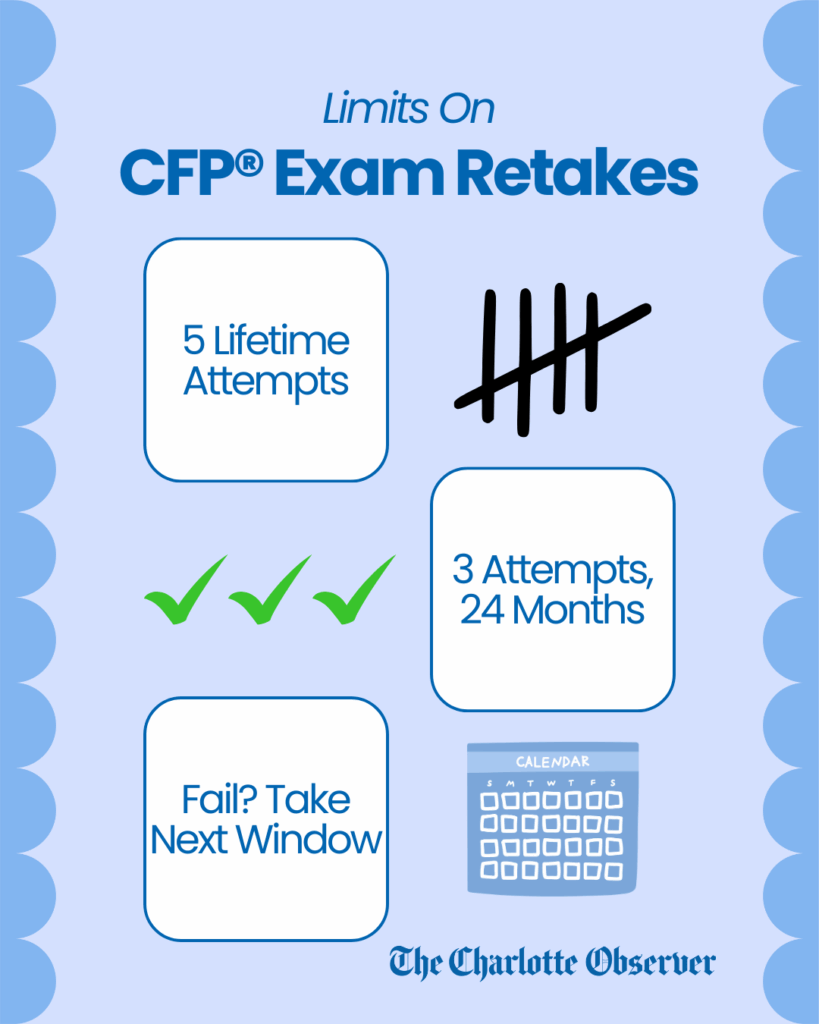
The CFP Board enforces clear rules about exam attempts to maintain the rigor and prestige of the credential:
- Five Lifetime Attempts: You get a maximum of five chances to pass the CFP® exam over your lifetime. That’s it—once you’ve used all five, you cannot sit for the exam again.
- Three Attempts in 24 Months: You cannot take the exam more than three times within any rolling two-year period. This prevents candidates from repeatedly testing without adequate preparation.
- Next Scheduled Testing Window: After a failed attempt, you’ll have to wait until the next scheduled exam period to try again. There’s no immediate retake option.
These rules are strict, and they highlight why it’s so important to approach each attempt with a strong study schedule and preparation plan.
Why Success on the First Try Matters
With only five lifetime attempts, the stakes are high. While most candidates don’t max out all five, using multiple attempts can create stress and long delays in your career progression.
Passing on the first try also saves you money and time. Each registration fee adds up, not to mention the hundreds of hours candidates spend studying. For many aspiring financial planning professionals, delaying certification also means delaying promotions or new job opportunities.
And let’s not forget the emotional toll. Failing once can be discouraging—failing multiple times, even more so. The best strategy is to give yourself enough time and go into your first attempt as prepared as possible.
Strategies to Boost Your Odds
If you want to avoid repeat attempts, preparation is everything. Here are proven strategies from success stories and experienced planners:
Build a Realistic Study Schedule With a Review Course
Most candidates need three to four months of consistent study time before test day. Break it into weekly goals with the help of an online CFP® prep course that covers all financial planning topics, leaving time at the end for review and practice.
Focus on Weak Areas
Don’t just re-read material you already know. Use practice exams to identify weak areas, whether it’s tax planning, risk management, or retirement projections. Spend extra time where you score the lowest.
“Study your hardest material first. Have a plan of what you will study the next day and start out with your most demanding/troublesome areas. This is crucial as you will absolutely get tired after study hour 5 or 6 of the day.”
Reddit User
Use Mock Exams to Simulate Test Day
Mock exams are invaluable. They mirror the actual format—two three-hour sessions—and help you practice pacing, focus, and endurance. By the time you sit for the real thing, you want the process to feel familiar.
Learn the Case Study Approach
Many questions present complex client scenarios. These case studies test whether you can apply knowledge across multiple domains. Practice breaking them down into smaller steps and identifying what’s actually being asked.
Protect Your Energy and Master Your Mindset
Your brain can only absorb so much. Short daily sessions tend to be more effective than marathon cramming. Rest matters too—don’t underestimate how mental sharpness can make a difference on test day.
“I had to remind myself to stay well rested, drink lots of water, and stay positive. I indoctrinated myself with toxic positivity videos on YouTube. A lot of Eric Thomas motivational speeches. LOTS! My study group probably was tired of seeing all of my motivational videos in our WhatsApp chat but I needed to stay strong.”
Reddit User
What Happens After a Failed Attempt
If you fail the exam, you’ll need to wait until the next scheduled testing window to try again. Testing windows are offered three times a year, so you’ll usually wait a few months.
Use that time wisely:
- Analyze your score report to see where you fell short.
- Adjust your study schedule to emphasize those weak areas.
- Take more practice exams to track improvement.
Remember, each failed attempt counts toward your lifetime maximum of five. Treat every retake as precious.
Maxing Out the Five Attempts: Then What?
While rare, some candidates do use all five lifetime attempts. If that happens, you cannot reapply for the CFP® exam. The CFP Board does not make exceptions, even for experienced financial professionals.
What’s next if you’re in that situation? Some turn to alternative designations such as the Chartered Financial Consultant (ChFC®) or specialized certifications in investment management or risk management. These credentials may not carry the same global recognition as the CFP®, but they can still help advance a career in financial advisory or related fields.
Still, most candidates never reach this point. With focused preparation, five attempts are more than enough to succeed.
Preparing With the End Goal in Mind
Ultimately, the goal isn’t just to pass the CFP® exam—it’s to prepare for a career delivering high-quality, ethical financial planning services. The exam is designed to reflect real client situations, ensuring you’re ready for the challenges of working as a planner.
That’s why it’s so demanding, and why the CFP Board puts strict limits on the number of attempts. By enforcing these rules, the organization ensures the certification remains meaningful for both financial advisors and the clients who rely on them.
Final Thoughts
So, how many times can you take the CFP® exam? Five lifetime attempts, with no more than three in any 24-month period. Failures mean waiting until the next testing window, and maxing out your tries closes the door permanently.
For most candidates, though, that’s more than enough. With the right preparation—steady practice, targeted focus on weak areas, and consistent use of mock exams—you can walk into test day confident and ready to pass.
The CFP® credential is worth the effort, but success depends on treating each attempt like it matters—because it does.
FAQs
You’ll need to wait until the next scheduled testing window to retake. Each failed attempt counts toward your five lifetime limits.
The CFP Board allows a maximum of five lifetime attempts, with no more than three attempts in any 24-month period.
The pass rate typically falls around 60–65%, meaning roughly four out of ten candidates don’t pass on their first try.
Yes. The Series 7 focuses on securities licensing, while the CFP® exam is broader, covering the full financial planning process and applied case studies.
They’re tough in different ways. The bar exam is more intensive in law, while the CFP® exam is challenging for its integration of complex financial planning topics.