
With CFA® pass rates as low as 45% in 2025, nailing your study strategy can make or break your attempt. With three exam levels to conquer, and none of them easy, success will require discipline, strategy, and a lot of study hours.
Point blank? This isn’t the kind of exam you can cram for.
The CFA® Institute recommends a minimum of 300 study hours per level, but successful candidates often put in more. Whether you’re tackling the CFA® Level I exam for the first time or gearing up for Level II or III, you need a smart approach that balances your work schedule, personal life, and the vast CFA® program curriculum.
Let’s break it down.
Key Takeaways
- Start Early: Give yourself at least six months of structured CFA® preparation for the best shot at passing.
- Prioritize Ethics: Ethical and professional standards are heavily weighted and can determine borderline pass/fail outcomes.
- Practice Actively: Use practice questions, timed sessions, and mock exams to lock in concepts and improve pacing.
- Balance Life and Study: Schedule consistent study hours around work and family commitments to avoid burnout.
- Target Weak Areas: Identify and revisit your toughest topics often, especially in the final weeks before exam day.
Understand the CFA® Exam Structure
Before you dive into the books, know what you’re up against. Each exam level builds on the last, but they have different formats and focuses:
- Level I: Focuses heavily on basic concepts, ethical and professional standards, and an introduction to tools like financial analysis and technical analysis. The multiple-choice questions test your breadth of knowledge across all CFA® exam topics.
- Level II: Emphasizes application of concepts, especially through case-based vignettes. Your ability to interpret data and apply formulas is key.
- Level III: Centers on portfolio management and advanced applications. Written responses play a bigger role here.
Knowing the learning outcome statements (LOS) for your exam level is crucial—they’re essentially the “syllabus” for what the CFA® Institute expects you to master.
Start With the CFA® Institute Curriculum
While many candidates rely on third-party providers like Kaplan Schweser, the official CFA® curriculum provided by the CFA® Institute is your definitive guide. The exam questions are written based on this material, so skipping it entirely is risky.
That said, third-party resources can help condense complex topics, offer more practice questions, and break the reading into more digestible sections. A good hybrid approach is to use the CFA® curriculum for depth and third-party materials for reinforcement.
Build Your Study Plan Early
Your exam date is fixed. Your CFA® study plan should be, too.
Most students find success by starting at least six months in advance, devoting 10–15 hours per week. That pace allows for thorough coverage of the material, repeated practice, and time to work on your weak areas.
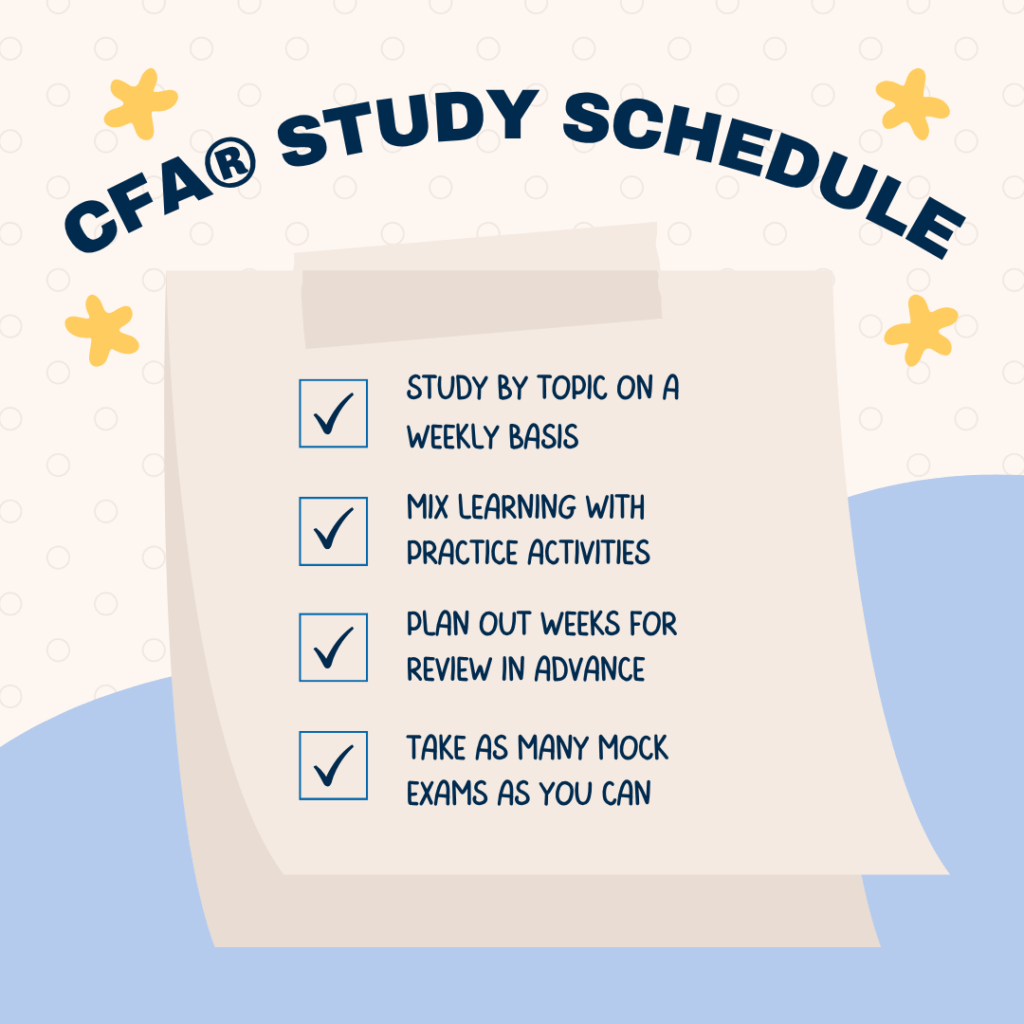
A solid weekly study schedule should:
- Allocate specific topics to each week, starting with heavier-weight sections like ethical and professional standards.
- Mix reading with active learning (practice questions, flashcards, etc.).
- Include review weeks at the end to consolidate learning.
- Schedule mock exams under realistic conditions.
Focus on Heavily Weighted Topics
The CFA® exam is not weighted equally across topics. For example, ethics is worth a significant portion of your score at all levels, and strong performance here can even boost borderline test scores into passing territory.
Other high-value areas for Level I include:
- Financial Reporting and Analysis
- Quantitative Methods
- Economics
For Level II and III, focus shifts toward application—think portfolio management, equity valuation, and risk management.
Active Practice Beats Passive Reading
Reading is not studying. To actually prepare for the CFA® exam, you need to actively engage with the material.
- Practice Questions: Do these daily, especially on topics you find challenging.
- Practice Sessions: Simulate timed mini-tests to build endurance.
- Mock Exams: Take at least three full-length mocks before exam day to master pacing and identify final weak areas.
The CFA® Institute offers official mock exams, and choosing one of the best CFA® prep courses, like AnalystPrep and Kaplan Schweser, provides excellent practice sets.
Manage Your Time (and Your Life)
For most candidates, the CFA® is something you study for around a full-time job. That means balancing family commitments, work deadlines, and social life with hundreds of hours of study.
Some tips:
- Block study hours into your calendar like work meetings.
- Use commuting or lunch breaks for quick reviews or flashcards.
- Protect at least one rest day a week to avoid burnout.
Review Ethical and Professional Standards Often
One of the biggest mistakes candidates make is treating ethical and professional standards like just another topic. In reality, ethics is both heavily weighted and often used as a tiebreaker for borderline test scores.
Review ethics throughout your prep—not just at the end. Keep the CFA® Institute’s exact wording in mind, because these questions can hinge on subtle distinctions.
Learn From CFA® Charterholders
Talk to people who have already earned the CFA® charter. They can offer realistic advice, share study hacks, and warn you about pitfalls. Many will tell you their biggest regret was not starting early enough—or underestimating the sheer volume of material.
Sample CFA® Study Schedule
Here’s an example of a 24-week CFA® study schedule for the Level I exam, assuming ~12 hours per week:
Weeks 1–4:
Ethics + Quantitative Methods (reading + practice questions)
Weeks 5–8:
Economics + Financial Reporting & Analysis
Weeks 9–12:
Corporate Finance + Equity + Fixed Income
Weeks 13–16:
Derivatives + Alternative Investments + Portfolio Management
Weeks 17–20:
Review all topics, focus on weak areas, and start half-length practice exams
Weeks 21–23:
Full mock exams, refine time management, and heavy Ethics review
Week 24:
Light review, rest, and get ready for exam day
Final Week Before the Exam
- Do one final mock exam 4–5 days before the test.
- Review key topics and formula sheets.
- Focus on confidence-building, not cramming.
- Sleep well—you’ll need your mental sharpness.
Final Thoughts
Passing the CFA® exams is a marathon, not a sprint. If you treat your CFA® study plan like a serious, structured project, you’ll not only improve your odds of joining the ranks of CFA charterholders, you’ll actually retain the knowledge that makes the designation worth earning.
Whether you use the CFA® program curriculum, Kaplan Schweser, or a mix of both, the key is consistency, active practice, and strategic time management. Start early, stay disciplined, and remember—you’re not just preparing for an exam, you’re building expertise that will serve you your entire career.
FAQs
Most students spend at least 300 hours preparing for each level, spread over about six months. Some candidates need more time depending on their schedule and background.
Combine the CFA® Institute curriculum with third-party resources, focus on high-weight topics, and do regular practice questions and mock exams to reinforce learning.
It’s considered one of the most challenging finance certifications due to its low pass rates, extensive curriculum, and multi-level structure, but “hardest” depends on your skills and background.
There’s no fixed passing score, but historically, candidates who consistently score around 65–70% on mock exams tend to be in a safe range for passing.
No. The CFA® Program has no age limit. Many candidates pursue the charter mid-career or later to expand their qualifications and credibility in finance.