

Did you know that between 2021 and 2024, just over 4% of LSAT test takers got a score of 170 or higher?
That means the LSAT isn’t just another standardized test.
It’s a challenge that separates future lawyers from the crowd. If you’re planning your law school journey, understanding the LSAT pass rate and how your score stacks up against everyone else’s is part of the key to unlocking admission to your dream school. Keep reading to find out more about LSAT scores and what I suggest.
Key Takeaways
- LSAT Pass Rate: There’s no official “pass” score, but pyour LSAT score directly affects law school admission chances.
- LSAT Scores & Ranges: Scores range from 120 to 180, with the average LSAT score hovering around 150.
- Percentiles Matter: Your percentile ranking shows how you compare to other test takers.
- Multiple Factors: Schools consider your LSAT score, undergraduate GPA, and personal statement for admission.
- Preparation Pays Off: Focused LSAT prep with a review course and practice tests can boost your score and improve your chances at your dream law school.
What Is the LSAT Pass Rate, Really?
First, we need to clear up a bit of a myth. There’s no single LSAT pass rate because the Law School Admission Council (LSAC) doesn’t set a “passing” score. Instead, it’s all about percentiles and how you compare to other law school applicants. It’s something like running a marathon, and the finish line moves depending on how fast everyone else is running. But that aside, the higher your LSAT score, the better your odds at top law schools.
Most ABA-approved law schools expect LSAT scores in certain ranges, and your raw score (the number of questions you answer correctly) is converted to a scaled score using a score conversion chart. Schools usually publish the median LSAT score for their incoming class, and that tells you what score will give you a fighting chance.
Hitting those ranges is a different question from clearing the exam itself, so it helps to know where the difficulty actually sits.
Understanding LSAT Scores and Score Ranges
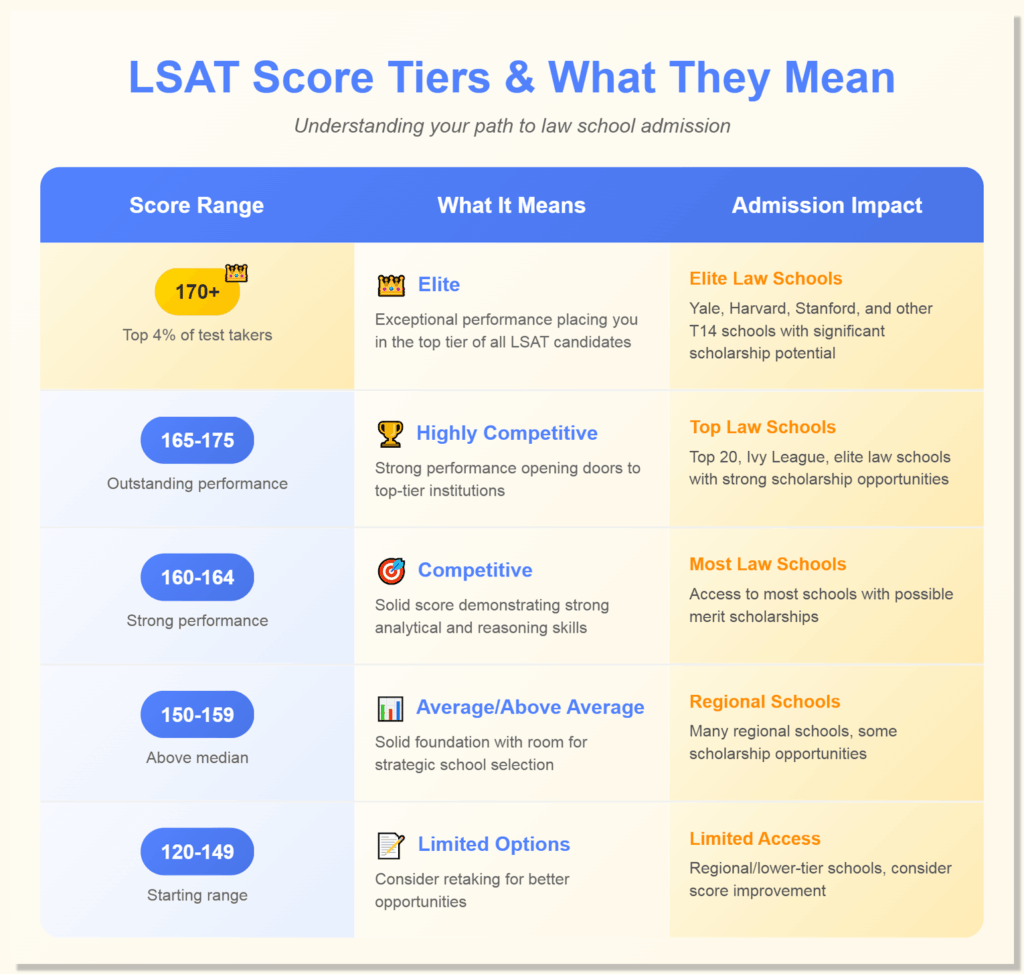
The LSAT, or Law School Admission Test, is scored from 120 to 180. Each number in this range is important, especially if you’re aiming for the highest LSAT score possible. Here’s what you need to know:
- Average LSAT Score: Most test takers land around 150, which is the median score.
- Good LSAT Score: A good LSAT score depends on your desired law school, but 160+ usually means you’ll be competitive at a lot of different schools.
- LSAT Score Ranges: Top law schools often look for scores in the 165–175 range, but other law schools may accept applicants who have lower scores, especially with a strong undergraduate GPA and an excellent personal statement.
- LSAT Score Percentiles: Your percentile score shows how many other test takers you did better than. For example, scoring in the 90th percentile puts you ahead of 90% of other test takers.
Scoring high isn’t just about bragging rights. It can mean scholarships and a better shot at your target schools.
How Law Schools Use Your LSAT Score
Law school admission is a bit like making a smoothie. Your LSAT score is the banana, but your undergraduate GPA, personal statement, and any other experience you have are the strawberries and yogurt. Schools use your LSAT score as a way to compare you to other standardized tests, and it plays a huge role in law school performance predictions.
- LSAT vs. GPA: Both are important, but LSAT scores help schools judge your chances of both academic success and bar exam success.
- Score Report: When you apply, law schools see your highest LSAT score and your score percentiles.
- Not the Only Factor: Your personal statement, resume, and recommendations matter, too.
What Does “Passing” the LSAT Mean?
Unlike the bar exam, there isn’t an official LSAT pass rate. But most law schools will set minimum LSAT score requirements or cutoffs for consideration. Here’s how the numbers break down:
- Top Law Schools: The median LSAT score for places like Yale and Harvard is around 173–174.
- 75th Percentile: Getting a score at or above the 75th percentile for your desired law school gives you a really good shot at admission.
- 25th Percentile: If your score is closer to the 25th percentile, you’ll probably need to boost it with a killer personal statement.
So, you can’t technically “fail” the LSAT, but if you score below a school’s median score, convincing them you’re worth admitting might not be easy.
How to Improve Your Chances: LSAT Prep and Practice
If you’re feeling like the LSAT is Mount Everest and you’re still at base camp, don’t worry. LSAT prep, especially when you take practice quizzes and make sure you understand the score conversion chart, can give you a leg up. Most first-time test takers see their scores improve with focused study and practice questions.
- Take full-length practice tests to get familiar with the format.
- Review your incorrect answers to spot patterns.
- Use LSAT prep resources from a variety of online options.
Remember, higher scores open more doors—and who doesn’t want more options?
Final Thoughts
It may seem like you need to be an accountant to decode LSAT scores, but understanding the LSAT pass rate and score ranges can make your law school journey a lot smoother. So whether you’re aiming for the highest LSAT score or you’d just be happy to land above the average, focus on preparation, know your target score range, and remember that law school admission isn’t only about one number. With the right prep and mindset, you’ll have a good shot at success in law school.
FAQs
There’s no official “pass,” but it’s a tough test. Scoring well will take solid reasoning skills, time management, and lots of practice.
135 is below the average LSAT score and the median LSAT score for most law schools, so admissions would be a challenge unless you have a stellar personal statement or GPA.
For a 170, you can typically miss about 10 to 14 questions, depending on the test date and the score conversion chart.
Yale’s incoming class has a median LSAT score of around 174, putting them among the highest LSAT scores in the country.
While Harvard’s median LSAT is about 174, some students with scores in the low 160s get in, but only because the score is paired with an exceptional GPA or personal statement.






![Princeton Review Coupon Code [Verified Discounts]](https://www.charlotteobserver.com/careers-education/wp-content/uploads/sites/8/2026/07/princeton-review-coupon-code-1024x768.jpg)