Did you know that certified management accountants earn 21% more on average than their non-certified peers? It’s true! And with salaries often in the six-figure range, 21% is a serious chunk of change to earn every single year just for passing an exam.
That being said, the CMA exam is no joke. I’m talking about first-time pass rates of 45%—less than half of all candidates.
However, there are some tips and tricks to help you succeed. As someone who’s been immersed in the exam prep industry since passing the four-part CPA exam, I have the first-hand knowledge to tell you what works and what doesn’t, but I’ve also done a ton of research. I can’t wait to share my findings with you so you can walk into exam day feeling calm, confident, and ready to crush it.
Key Takeaways
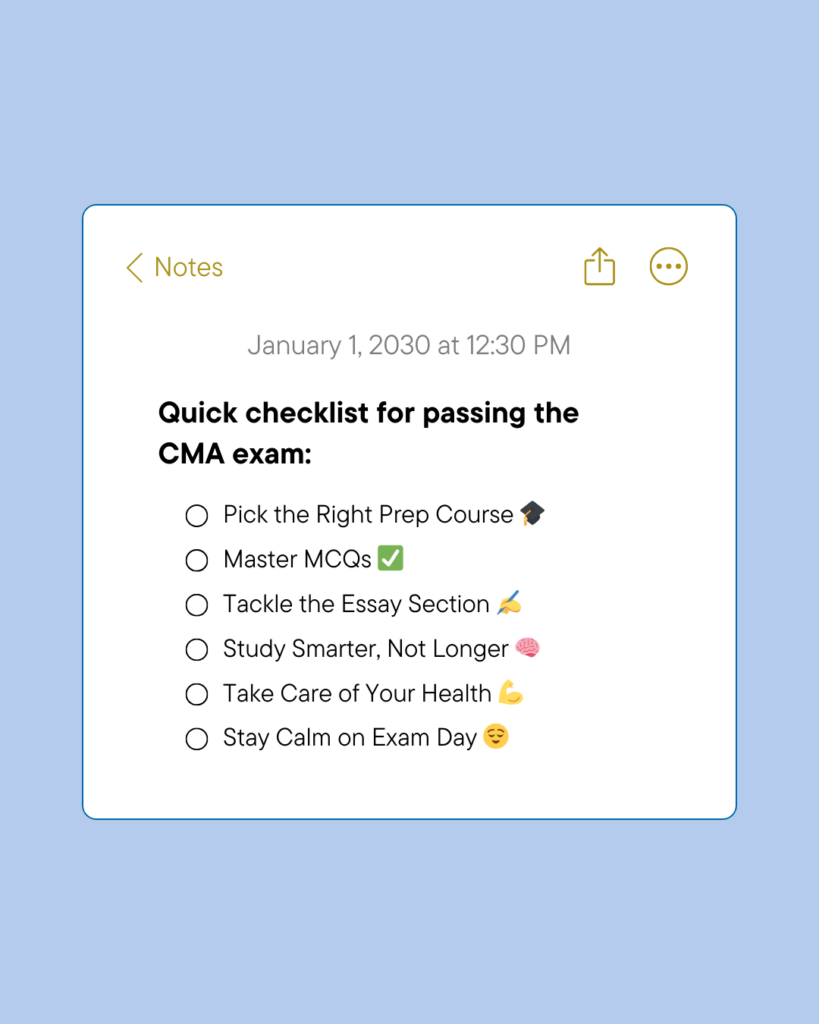
- Master the MCQs: Multiple-choice questions comprise 75% of your score, so focus on practice exams and elimination strategies to maximize points.
- Choose the Right Prep Course: Becker offers coaching support, Gleim has the largest question bank, and Surgent’s AI reduces study time.
- Study Smarter, Not Longer: The Pomodoro Technique (25 min study, 5 min break) improves focus and prevents burnout better than marathon sessions.
- Stay Calm on Exam Day: Arrive 30 minutes early, use deep breathing techniques, and skip tough questions so you can return to them later with fresh eyes.
- Take Care of Your Health: Sleep, exercise, meditation, and a balanced diet boost memory, focus, and stress resilience during exam prep.
Step 1: Understand the CMA Exam Structure
The CMA exam is broken into two parts, and each one covers a wide range of topics:
📌 Part 1: Financial Planning, Performance, and Analytics
This section includes technology and analytics, external financial reporting decisions, cost management, and internal controls.
📌 Part 2: Strategic Financial Management
Here, you’ll deal with financial statement analysis, risk management, decision analysis, corporate finance, and ethics.
Each part consists of:
- 100 multiple-choice questions (MCQs)
- Two essay scenarios
- A four-hour time limit
Your goal is to score at least 360 out of 500 to pass.
Should you take Part 1 or Part 2 first? It depends on your background. If you’re stronger in financial statement analysis, start with Part 1. If you prefer strategy and risk, go for Part 2. There’s no “right” choice—just pick what suits you best.
Step 2: Pick the Right CMA Prep Course
You wouldn’t train for a marathon without a plan, right? The same logic applies to passing the CMA exam. A prep course is your training guide, and choosing the right one makes all the difference.
There are several top-rated CMA prep courses, each with its own strengths. Becker, Gleim, Surgent, and CMA Exam Academy are among the most popular. Here’s how they compare:
| Course |  |  |  |  |
|---|---|---|---|---|
| Best For | Coaching & Instructor Support | Extensive Practice Materials | AI-Powered Efficiency | Guided, Step-by-Step Learning |
| Key Features | Live tutoring, structured study plan, video-heavy lessons | Largest question bank, in-depth answer explanations, adaptive quizzes | Adaptive learning, reduced study time, personalized review | Simplified approach, study roadmaps, video-focused content |
| Get Started | Start Now | Start Now | Start Now | Start Now |
Choosing is a matter of knowing what matters to you in a course. The key ingredient in picking your perfect prep, however, is to pick a course that fits your learning style and study goals.
What about the cost? Prices range from a couple of hundred dollars to $2,000+, but many providers offer financing or monthly payment plans.
💡 Pro Tip: Many courses offer free trials—try one before committing!
Step 3: Master Multiple-Choice Questions (MCQs)
Did you know that MCQs make up 75% of your CMA exam score? That means your essay section doesn’t need to be perfect—you just need to do really well on the MCQs.
How to Get More MCQs Right
Many test-takers struggle with MCQs because they overthink. Here’s how to avoid that:
1️⃣ Read the question carefully. Watch for tricky wording—words like always, never, and none can be traps.
2️⃣ Eliminate obviously wrong answers. If two choices say the same thing differently, they’re probably both incorrect.
3️⃣ Don’t second-guess yourself. Your first instinct is often right unless you realize you misread the question.
💡 Pro Tip: If you’re running low on time, answer every question—even if you have to guess. There’s no penalty for wrong answers, so leaving a question blank is the only guaranteed mistake.
Step 4: Tackle the Essay Section with Confidence
Let’s be honest—no one likes the essay section. But the good news? You don’t have to be the next Hemingway to get a great score.
The CMA essays are graded on content, not style. That means you don’t need perfect grammar or fancy language—just clear, structured answers that show you understand the material.
Example of a Strong Essay Approach
Prompt: Explain the purpose of internal controls and provide an example.
Bad Answer: Internal controls are important because they prevent fraud. A good example is when companies have security systems.
Good Answer: Internal controls are procedures designed to prevent fraud and ensure financial accuracy. Key examples include separation of duties, authorization policies, and reconciliations. For instance, requiring two employees to approve large payments reduces fraud risk by ensuring accountability.
See the difference? The second answer is structured, direct, and includes an example—which makes it easy for graders to award points.
Step 5: Avoid Burnout With Smarter Study Habits
Cramming for 8 hours a day might feel productive, but it’s actually one of the worst ways to study.
Better Study Techniques That Work
- Study in short bursts. Productivity experts suggest the Pomodoro Technique—25 minutes of focused study followed by a 5-minute break.
- Teach the material to someone else. If you can explain a concept in simple terms, you truly understand it.
- Mix up your study methods. Watch videos, take notes, use flashcards, and practice MCQs to keep your brain engaged.
💡 Pro Tip: Remember to take breaks. Your brain needs time to absorb information.
Step 6: Keep Calm on Exam Day
Even if you’ve prepared well, test anxiety can mess with your performance. But you can manage it.
Before the Exam:
- Get to the test center at least 30 minutes early to avoid last-minute stress.
- Eat a balanced meal—something light but filling. Avoid heavy carbs that make you sluggish.
During the Exam:
- Use deep breathing techniques to stay calm. The 4-7-8 method (inhale for 4 sec, hold for 7, exhale for 8) works wonders.
- If a question stumps you, move on and come back later. Dwelling on one question will only hurt your timing.
Most importantly? Walk in with confidence. You’ve put in the work—trust yourself.
Step 7. Don’t Forget Mental & Physical Health
Your brain works best when your body is taken care of. Don’t ignore self-care while prepping for the CMA exam!
💪 Move your body. Exercise boosts memory, so take a walk or stretch between study sessions.
💪 Prioritize sleep. Your brain needs 7-9 hours per night to retain information.
💪 Join a study group. Studying alone can be isolating—find other CMA candidates to keep you motivated.
💪 Eat brain-boosting foods. Healthy fats, lean protein, and complex carbs help with focus and retention.
💪 Practice meditation. Studies show that meditating can actually change your DNA, helping your body handle stress more effectively over time.
💡 Pro Tip: Studying in a new location (library, café, co-working space) can refresh your focus.
Final Thoughts: You’ve Got This!
Passing the CMA exam isn’t about being a genius—it’s about being prepared. If you:
- Pick the right CMA exam prep course
- Master MCQs and essays
- Stick to a strategic study plan
- Take care of your mental & physical health
- Stay calm and confident on exam day
Then, you’re well on your way to earning your CMA designation. The journey might be challenging, but the rewards? Totally worth it.
FAQs
The CMA exam is challenging, with a pass rate of 45–50%, but strong preparation and a solid study plan can greatly improve your chances.
Most candidates in the CMA Program need 12–16 weeks per part, studying 10–15 hours per week, but this varies based on experience and study efficiency.
You need a 360 out of 500 to pass, but since the exam is scaled, there’s no set percentage of CMA exam content you must get right.
Using a CMA exam preparation course, taking timed practice exams, and mixing video lessons, reading, and problem-solving is the most effective approach.
Yes, but it’s tough—most successful candidates use a structured prep course to stay on track, reinforce weak areas, and practice CMA exam questions.