‘Just so outrageous’: When a car gets booted in Plaza Midwood, who’s to blame?
AI-generated summary reviewed by our newsroom.
- Private lot booting in Charlotte remains legal despite mounting resident complaints.
- Enforcement companies set boot fees as high as $375 without city-imposed limits.
- House Bill 199 may regulate towing fees and booting practices if passed in 2025.
Stop me if you’ve heard this one before:
Someone searching for a place to park in Plaza Midwood finds a spot that mayyyy or may not be associated with the business they’re planning to patronize; they park; they leave their car; they go eat or drink or shop; and then they return some period of time later to find their vehicle outfitted with a wheel immobilizer (aka a “boot”).
A man approaches. Explains that the lot they’re standing in is in fact not associated with the business they just patronized. Says they’ll have to pay a fee in order for him to remove the boot.
To a certain degree, seems pretty straightforward. But it’s about to get ugly. Because that fee, it turns out, is $275.
Or $175. Or $375. It kinda depends on the enforcer. Whatever the amount, it’s enough to start an argument.
If this has happened to you in Charlotte — and it has happened to a LOT of people over the years, dating back to the early days of the population and development boom in the city, in the 2000s — you know precisely how vexing such a scenario can be.
You also know, all too well, that (spoiler alert!) this particular argument is virtually unwinnable.
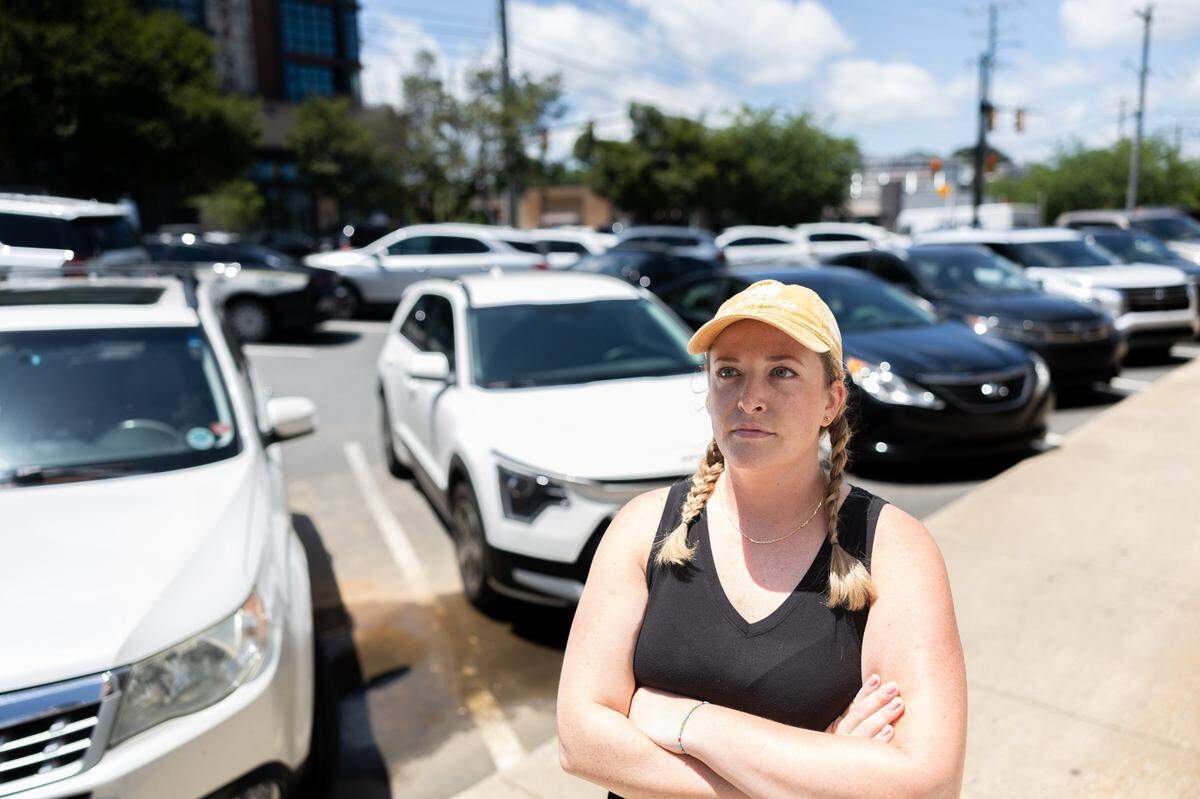
Friends Liz Beaumont and Jenn Kleine-Jaeger learned this hard lesson earlier in the month after celebrating Kleine-Jaeger’s birthday over brunch at Dilworth Tasting Room’s Plaza Midwood location on Central Avenue. They contacted me a few weeks ago to share their experience, their frustration and their desire to raise awareness about what they perceived to be “predatory” parking enforcement.
So today I’m going to use their story as a case study to illustrate for people who might be newer to Charlotte how easily this can happen, why after all these years it’s allowed to continue to happen, and the many factors that make these situations far more nuanced and layered than at first they might appear.
Missing the parking warnings
Beaumont has no problem admitting that she should have heeded the multiple warnings.
Upon making the brunch reservation for herself, Kleine-Jaeger and a third friend at DTR Plaza Midwood (at 1413 Central Ave.) for 11 a.m. on Sunday, June 1, she received an automated email confirmation that included the first: “DO NOT PARK at the adjacent parking lots as your car will be booted.”
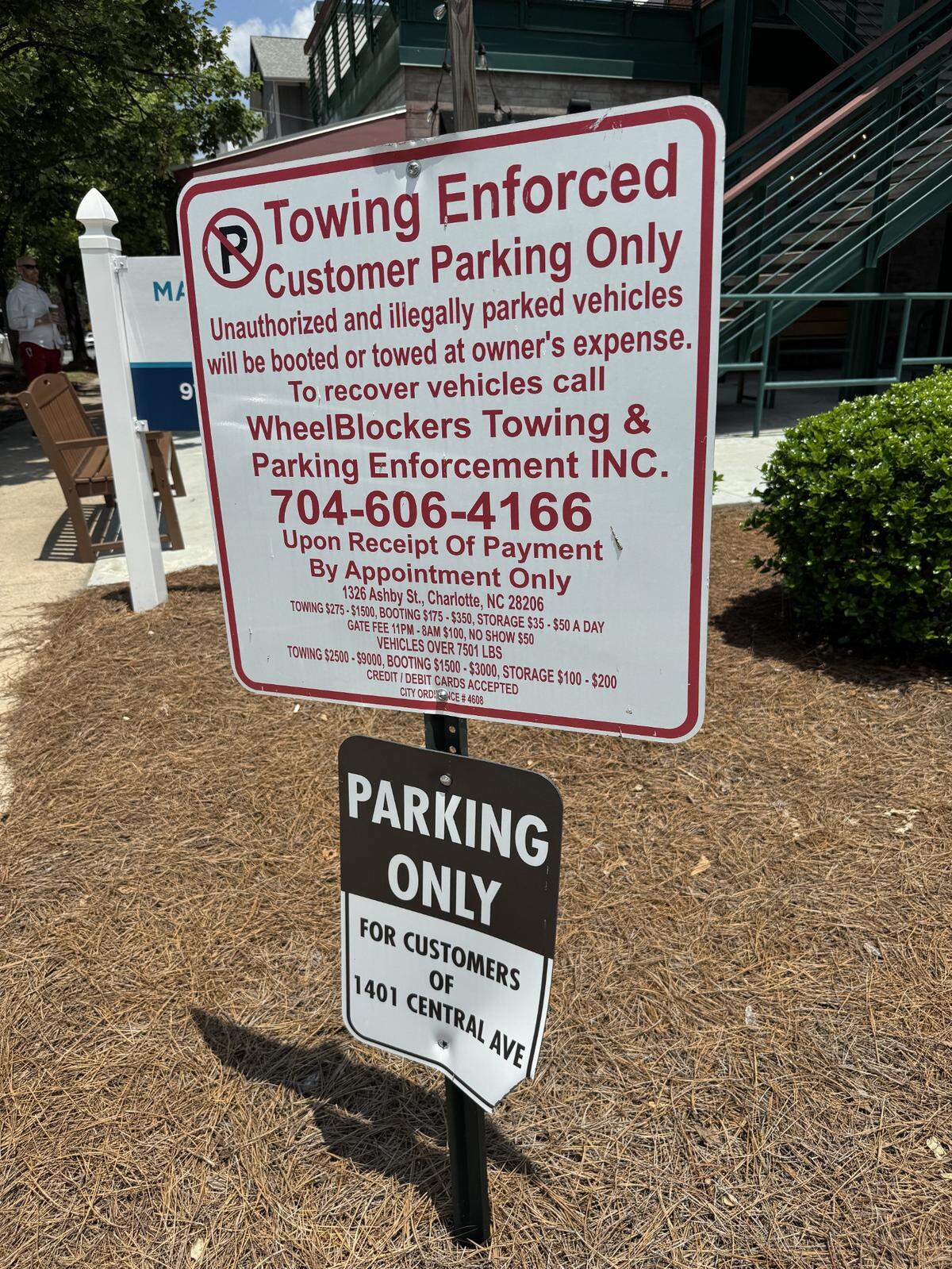
Upon pulling into the parking lot just west of DTR — at the adjacent complex at 1401 Central Ave. — Beaumont passed a signpost with two more: “Towing Enforced | Customer Parking Only” and “Parking Only | For Customers of 1401 Central Ave.”
Upon arriving at DTR, she pulled open a door adorned with a small poster taped at eye-level with the headline “Parking,” followed by the same cautionary sentence from her reservation confirmation.
Kleine-Jaeger never saw the restaurant’s email, but otherwise, same things.
Then after brunching, according to the two women:
As they walked out together, a man approached and asked Beaumont, “Is that your blue car?” She said yes. He said, “Well, there’s a boot on it.” She said, “What??” He replied, “Yeah, and if you don’t pay to remove the boot, your car’s gonna be towed.”
Beaumont went back into DTR to try to get clarity, basically, on whether this type of parking enforcement was legit (DTR said yes). By the time she returned to the lot, Kleine-Jaeger had discovered a boot on her vehicle, too.
On the “Wheel Blockers Towing and Parking Enforcement Inc.” citations placed under their windshield wipers, “275” was handwritten in the box on the form labeled “Boot fee.”
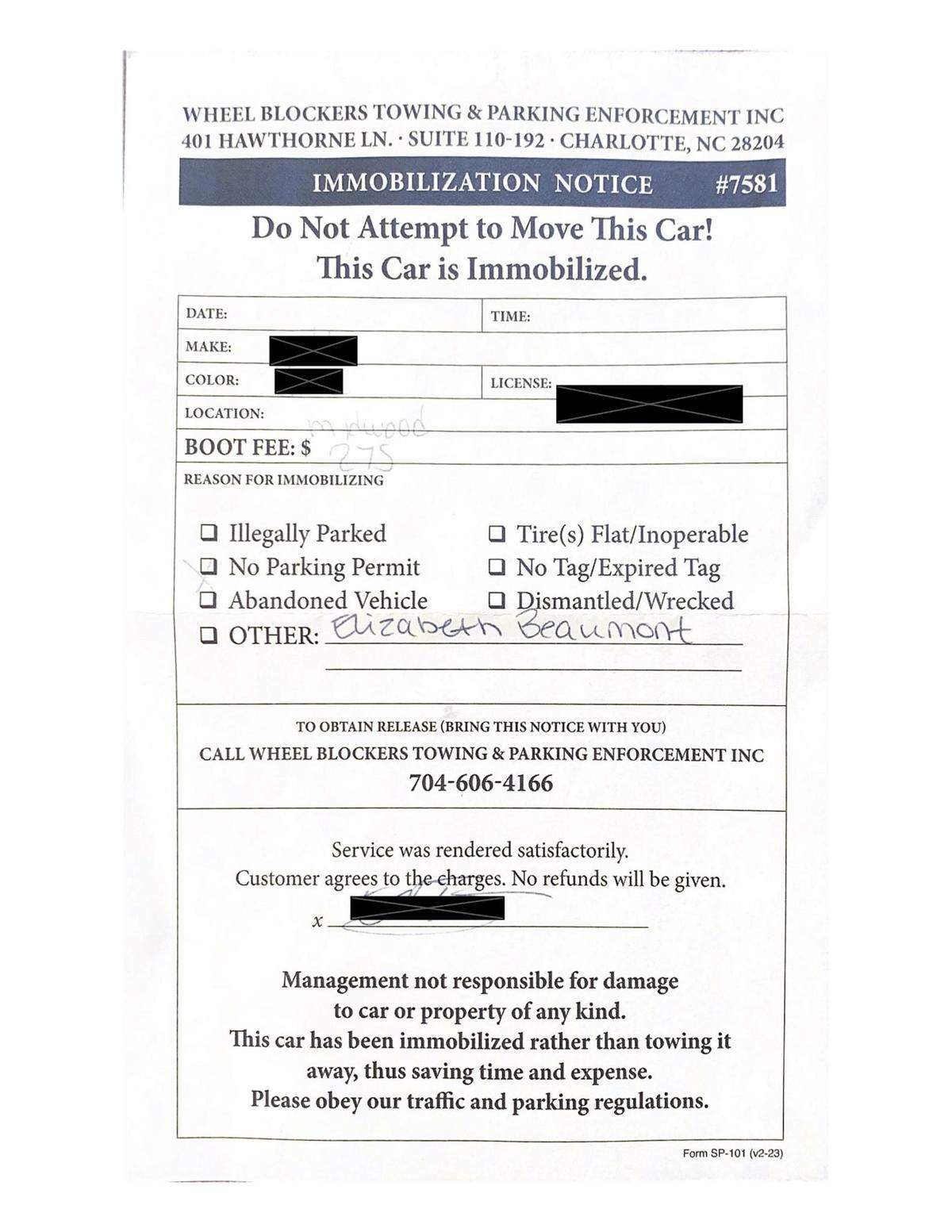
Beaumont and Kleine-Jaeger didn’t hide their irritation with the man, but ultimately took their credit cards out of their purses and consented to a charge of $275 each. After completing their respective transactions, the man removed the boots from the vehicles and everyone went their separate ways.
To a certain degree, seems pretty straightforward, doesn’t it? They’d been warned. They used spaces in a privately owned parking lot to patronize a business not associated with that privately owned parking lot.
But hang on — let’s go back and look at this situation a different way.
An argument with Wheel Blockers
Forget the fact that people who make online restaurant reservations probably often don’t read their confirmation emails, other than to make sure the date and time is right. (Beaumont says that’s what happened.)
Forget the fact that although, yes, there’s two signs at 1401 Central, they’re posted one atop the other at the entrance of a lot that comes very quickly after you turn off of Central; and forget that, because it’s a quick turn-in, you’re often trying to look ahead for cars backing out of spaces in the lot while also monitoring your rear-view for trailing motorists who might not be expecting you to decelerate into said turn off of Central. (Beaumont, again, says that’s what happened.)
Forget, too, the fact that if you’re talking to a friend on the way into DTR (like Beaumont says she was), or running late for the date (like Kleine-Jaeger says she was), you might miss the poster on the door.
Instead, focus perhaps on Kleine-Jaeger’s parking spot in particular — she parked against the building, in front of a sign affixed to the side of it that read “Please Pull Forward.” (Both women say if they’d seen signs like the ones at the entrance at or right near where they actually parked, they absolutely would have left the lot and parked elsewhere.)
Or, even more so, instead focus on Beaumont’s assertion that when they came out of the restaurant to find boots on their cars, she recognized the parking enforcer as a man who was sitting in a car watching her when she originally parked.
“With the windows down, and ... it just looked like an average person’s car,” she says. “It didn’t have any signs on it, or anything that said he was employed by a towing company. He wasn’t wearing any kind of uniform or anything. ... And I walked right past him. ... When I walked out of the front of the restaurant (after brunch), he was waiting on the sidewalk, and he goes, ‘Is that your blue car?’ Like, how would you just randomly know? ...
“Unless you saw me get out of that car.”
This, Beaumont and Kleine-Jaeger argue, is what qualifies the parking enforcement as predatory at 1401 Central, home to Midwood Smokehouse, Club Pilates and other businesses.
Beaumont says that during her brief argument with the parking enforcer for Wheel Blockers, he told her, “They have Pilates classes that are up here every hour, and people don’t have enough parking.” Her response: “Well, if you really needed parking spots, I could have moved my car if you told me. But obviously, the objective isn’t to have spots open, it’s to make money, because my car sat here for an hour and a half, and you put a boot on it instead.”
Then there’s the matter of the amount of the fee. “275,” handwritten.
For frame of reference, if you fail to pay a parking meter in uptown, the City of Charlotte can write you a ticket that costs $25. An illegally parked vehicle with three or more unpaid parking tickets in 90 days is subject to being booted.
How much to remove the boot? $50.
Says Kleine-Jaeger: “When he told us that it was $275 to get the boot off, I’m like, Oh, my God, that is just so outrageous. I mean, maybe if it would be $275 to tow my car away, and then I have to go pick it up — but just to get a boot off, can you just charge something a little bit less outrageous?”
On that sign they both missed at the entrance, it does say booting fees there can range from $175 to $350.
Per City of Charlotte: It’s legal
Strange as it may seem, and shady as it can sound to some, this is the bottom line: These particular parking enforcement practices are legal.
The Charlotte-Mecklenburg Police Department would not make a spokesperson available for an interview; but in a June 4 email sent to Beaumont and Kleine-Jaeger from CMPD officer Kelvin Moore, he explained that the towing/booting company employee was not required to inform them that they were in violation of parking rules when he first spotted them.
“In fact, one may see that as counterproductive for the towing/booting company, as they make their money booting violators,” Moore wrote to the women “It is not lost on me that this may appear to some as ‘predatory’ however, it does not violate the City’s Ordinance governing booting.”
He also noted that the company can charge whatever they want for boot removal. “I, personally, understand the implications of such an unexpected expense, but unfortunately, the City of Charlotte has not defined what is exorbitant in these instances.”
(A support specialist for the Charlotte City Council confirmed they had been contacted by Beaumont and Kleine-Jaeger, and shared a separate email response from CMPD’s Moore. However, attempts to reach Danté Anderson, the Council member who represents the district that includes Plaza Midwood, were unsuccessful.)
As for Wheel Blockers and Raleigh-based Chartwell Property Group, which owns the building at 1401 Central, it should be said: Wheel Blockers isn’t the only towing/booting company enforcing private-parking-lot rules in Charlotte (though it’s certainly one of the largest), and Chartwell is far from the only property management company that contracts with companies like Wheel Blockers.
I’m just using them for the purposes of this exercise. And Wheel Blockers, at least, firmly stands its ground.
A dispatcher for the company who identified himself as Richard but declined to give his last name told me over the phone: “We don’t make any of the parking rules. We follow the parking rules of the property manager. We just enforce them. Obviously, people … are a little upset because, you know, they get their car towed. But, I mean, that’s what has to happen. ... You can’t have anybody parking anywhere they want to, or companies are gonna start losing out on money because their customers aren’t gonna have anywhere to park.
“The people that we do tow for, they’re extremely happy and pleased with our services.”
He referred me to a company email address for further inquiries, but I got no response. Meanwhile, no one at Chartwell was immediately available for an interview.
According to the Better Business Bureau, 98 complaints have been lodged against Wheel Blockers in the past three years.
An end to ‘predatory’ booting?
In the wake of her ordeal, Beaumont took to Nextdoor to share her story. It generated dozens of responses, several of which weren’t particularly sympathetic.
“There is something wrong with people that think they can trespass on people’s property and that they have the right to do so,” one commenter wrote. “I’ve never been towed or booted. That’s because I don’t park illegally. Imagine that!”
But there also were a number of people who said they had similar and sometimes scarier experiences.
I spoke by phone recently with one of them: Jennifer, an attorney who lives in Plaza Midwood but asked that her last name be withheld for fear of retribution. She says she parked directly across Central from Midwood Smokehouse in roughly 2019, walked over to the restaurant, saw a sign on the door that said, “Do not park across the street or you will be towed,” and immediately returned to her vehicle — which already had been immobilized by a boot.
Jennifer says she’d been away from the car only for about a minute.
She says the man claimed his credit-card reader was broken and could only take cash (this, by the way, would qualify as a violation of the city ordinance). She informed him she was going to use her phone to record video of the interaction, but did not, after she says he threatened to take her phone and break it.
Then, she says, she asked him what the fine was, and he told her, “’Cause I don’t like your attitude, it’s gonna be $180.” (Prices have apparently gone up in the past six years.)
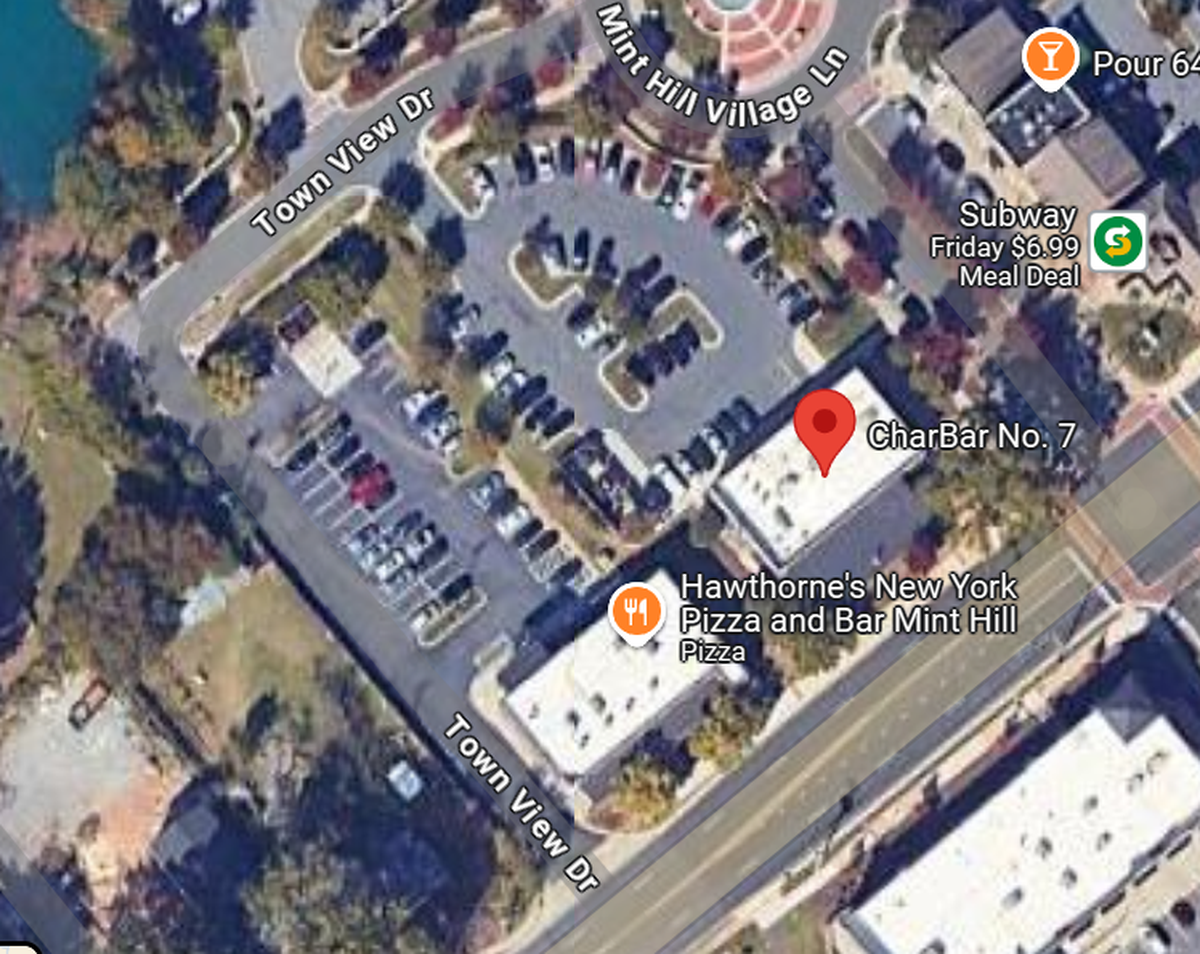
When she told me this part, I remembered an encounter my friend Matt Decker relayed to me in late 2023 involving a boot that got put on his vehicle after he parked in a Mint Hill lot he believed to be part of the same complex as the CharBar No. 7 restaurant.
I asked him to refresh my memory. This is the gist:
Matt says he was inside CharBar for less than 30 minutes, because it turned out to be too loud for his dad. When they came out to find the vehicle booted, the towing company employee told him the lot belonged to Hawthorne’s NY Pizza & Bar, which is in the adjacent building.
A discussion over what was initially presented as a $250 fine escalated into a heated argument. Matt says the towing company employee then told him, “OK, now it’s $3,000.”
The Hawthorne’s manager got involved, Matt says, and the matter ultimately was settled for about $300 — after the towing company employee insisted on payment via either Discover card or cash (towing companies are supposed to accept at least two major credit cards) and failed to provide any sort of receipt (which companies are required to do upon request).
Both Matt and Jennifer used the same word to describe their situations: “a shakedown.”
But there’s at least some hope that things could swing in consumers’ favor.
House Bill 199, which is currently slogging its way through the North Carolina legislature, seeks to limit predatory towing practices and regulate towing companies.
The bill would establish a new Towing and Recovery Commission, which would issue permits to towing companies and set maximum fees for towing and booting. It also could potentially revoke those permits, for operating in bad faith, effectively making it illegal for those businesses to continue operating.
Of course, the bill could easily die on the floor.
So, in the meantime, the best protection against being booted in places like Plaza Midwood is to be vigilant; to look for signs on parking-lot entrances, and signs on the doors of businesses; to assume you can’t park there, until you’ve verified that you can, in a way that doesn’t require you to get very far away from your car.
Because at present — as Liz Beaumont, Jenn Kleine-Jaeger, Jennifer, Matt and so many others have learned the hard way — once that boot goes on, there’s only one way it’s going to get taken back off.