Is SCREENX worth the hype? I put Charlotte’s newest movie experience to the test
Movie theaters have spent much of the past decade trying to answer the same question: What can they offer that your living room can’t?
Recliners solved a comfort problem. IMAX made the picture bigger. Dolby Cinema made it look and sound better. D-BOX added seat movement. 4DX goes a step further, shaking your chair, blasting you with wind and occasionally making you wonder whether you’ve wandered into an amusement park ride.
And then there’s SCREENX, which recently arrived at AMC Concord Mills and takes perhaps the strangest approach yet.
Instead of making the picture bigger, it tries to make your world bigger.
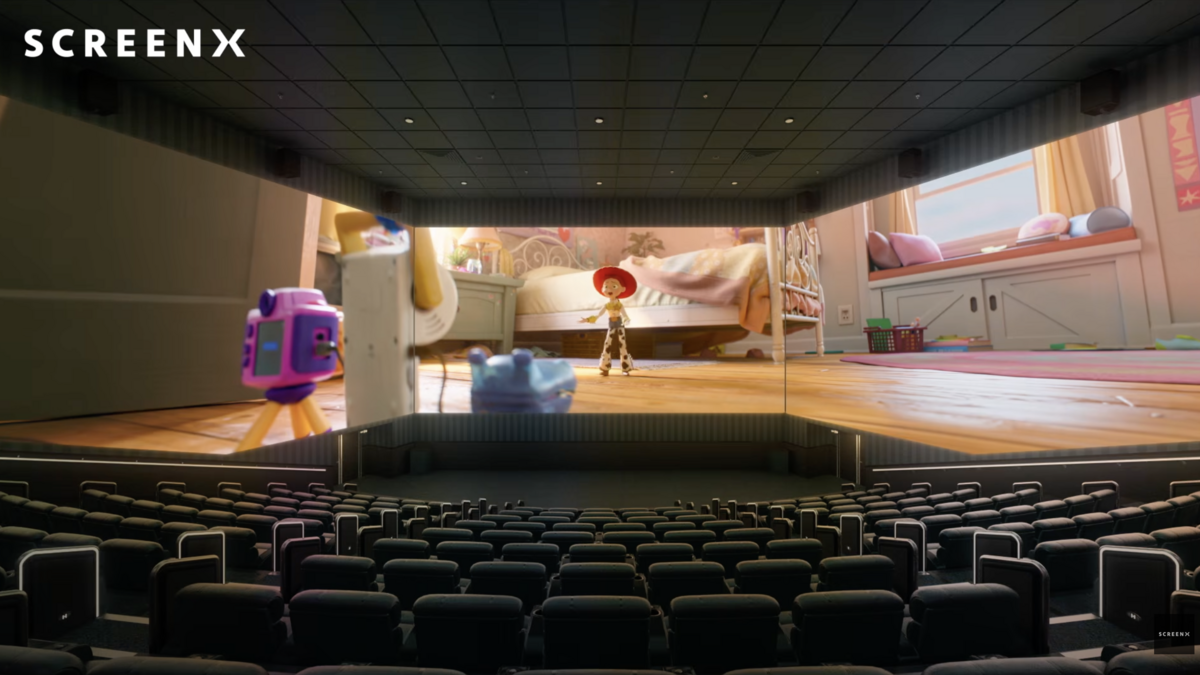
The format, which debuted in South Korea in 2012, projects selected scenes onto the theater’s side walls, creating a 270-degree panoramic viewing experience. You won’t find it attached to every release; it’s reserved for movies with worlds big enough to spill beyond the edges of the screen — animated adventures, action blockbusters and fantasy epics.
AMC Concord Mills is the first theater in the Charlotte area to offer it.
I have to admit: I was skeptical.
Not because I doubted the technology. But because we’ve reached the point where every new premium movie format promises to revolutionize the theatrical experience. At some point, “immersive” starts sounding less like a description and more like a marketing department’s favorite adjective.
So I recently went to see Pixar’s “Toy Story 5” — notably the first Pixar film designed specifically for SCREENX — wondering whether I’d be watching the future of movie theaters... or simply the latest gimmick.
Before the movie even started, the auditorium hinted that this wouldn’t be a typical experience. The side walls weren’t walls at all. They’d been transformed into projection screens, wrapping from floor to ceiling around everything from ceiling-mounted projectors to exit signs and even the fire alarm pull stations.
Then the previews started.
Nothing.
Every trailer played normally, as if the side walls didn’t exist.
But from the moment the movie began — with Buzz Lightyear waking up on the sandy shores of a deserted tropical island surrounded by dozens of identical, unopened Buzz dolls in shipping containers — the side walls sprang to life.
And immediately, I found myself as interested in figuring out the illusion as I was in watching the movie.
It reminded me of videos I’ve watched from inside Las Vegas’ Sphere (which, sadly, I still haven’t experienced in person). Not because SCREENX comes anywhere close to that level of sensory overload, but because both seem to inspire the same instinct: You spend part of your brain trying to locate the edges of the illusion.
How, exactly, are they doing this?
Then something unexpected happened, gradually, as the first act of the film progressed: I stopped studying the technology.
I didn’t fully realize it until after, but the side walls weren’t begging me to look at them. They were quietly asking me to stop thinking about the edges of the front screen. They were functioning less as additional screens than as peripheral scenery, expanding the world around the main image rather than competing with it.
In other words: SCREENX isn’t trying to get you to watch three screens. It’s trying to engage your peripheral vision.
One sequence beneath a bed stretched the room seamlessly across the full panorama, making an ordinary bedroom suddenly feel enormous. Later, a wide-open pasture featuring Jessie, Bullseye and a horse towering over them became a visual highlight, with tall grasses swaying across the side walls and making the landscape seem to continue well beyond the theater itself.
And a stylized, watercolor-like fantasy sequence became so dazzling that, for a moment, it almost felt as though someone had turned the house lights back on.
But SCREENX isn’t perfect.
The side projections rarely matched the sharpness of the main screen, sometimes even appearing slightly dimmer, and every so often, the illusion cracked. In one scene, a deer poked its head in from the top right on the main screen, but the adjacent side projection didn’t pick up the rest of its body where its head cut off, reminding me that I was looking at three canvases as opposed to one seamless and enormous one.
Oddly, my biggest criticism wasn’t about image quality. It was about absence: The panoramic effect isn’t used throughout the movie.
To be fair, that’s intentional; SCREENX designers have said limiting the expanded image helps avoid overwhelming audiences.
But as a viewer, I experienced something different.
As the movie wore on, I became accustomed to the expanded world. So when the side walls suddenly went dark, I noticed their disappearance more than I noticed their arrival.
I missed the side walls when they weren’t engaged.
Despite those nitpicks, I genuinely enjoyed the effect. When it works, it works really, really well. I’ll even give the marketing department this one: It really is immersive. When it’s firing on all cylinders, you stop noticing the technology altogether and simply accept the world as being larger than the front screen.
As for the question of whether the experience is “worth it”... that depends.
It’s the same value proposition moviegoers have to consider when it comes to IMAX or Dolby Cinema. The premium ticket costs about $5 per ticket more than a standard showing, which doesn’t sound like much until you’re buying four tickets, four drinks and four tubs of popcorn.
I wouldn’t claim, by the way, that the enhancement is inherently “better” or “worse” than IMAX or Dolby Cinema. They accomplish different things. IMAX emphasizes scale. Dolby focuses on picture and sound.
SCREENX, meanwhile, is chasing immersion in a different way, trying to convince your brain that the world extends beyond the frame. Sometimes it succeeds brilliantly. Sometimes the illusion breaks.
But after spending 102 minutes with it, I came away convinced of one thing: This isn’t just another marketing gimmick. It’s a genuinely different way to experience certain movies.
Now, would I choose to pay the premium it asks for at every single opportunity? Probably not.
Would I gladly spend five more dollars again for a movie designed with the format in mind, something that I thought was going to be visually sumptuous to begin with?
Absolutely.
Look, SCREENX won’t be for everyone, and it won’t be worth the premium for every film.
But if its goal is to remind audiences that seeing a movie in a theater can still feel fundamentally different from watching one at home, it’s succeeding.
I certainly didn’t expect to spend the drive home wishing the side screens had been utilized more.