Charlotte dentist ran 7 marathons on 7 continents in under 6 days. How? And why?
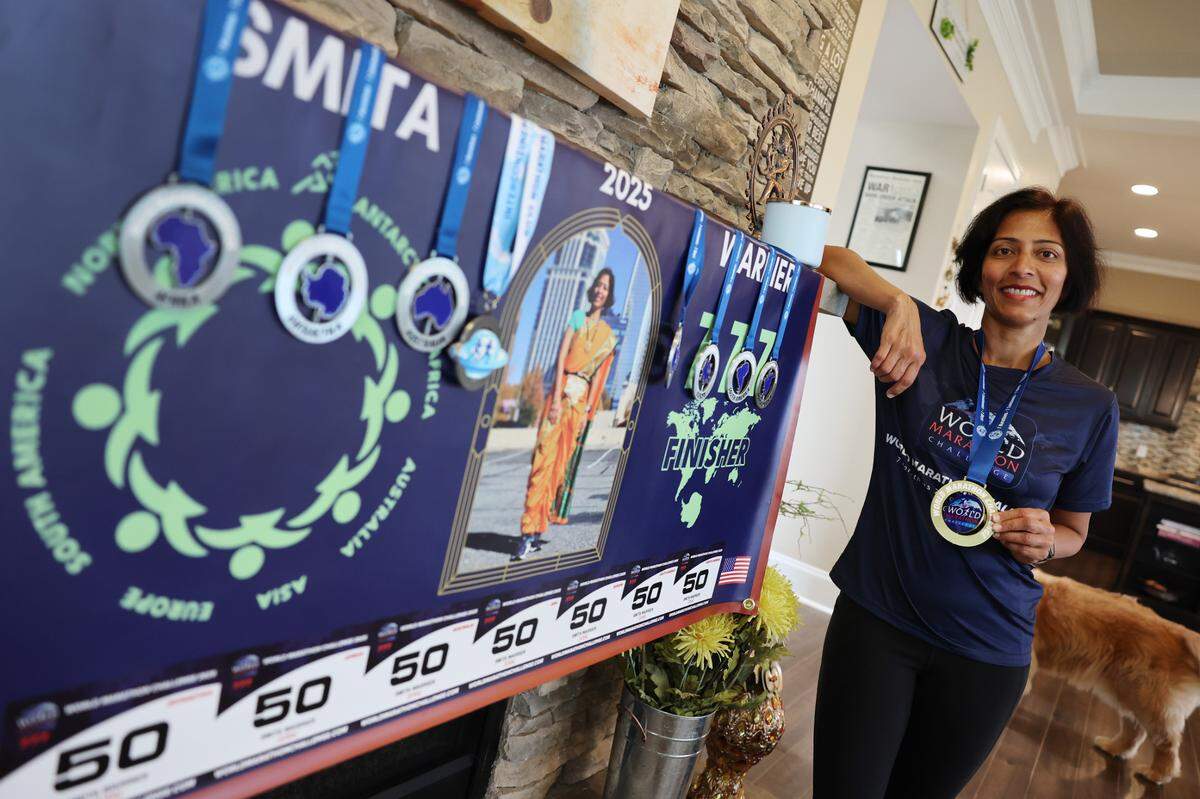
It wasn’t the seven marathons that nearly broke Waxhaw resident Smita Warrier. She trained for them smartly, and even at 50 years old was able to continue her long streak of avoiding running injuries during the races.
It wasn’t negotiating the travel between the seven continents either; a tourism company handled the logistics, meaning she didn’t have to.
And it turned out that accomplishing both the considerable athletic feat and the complicated logistical puzzle within the allotted seven days was — relatively speaking — easy enough. In fact, Warrier and her fellow 2025 World Marathon Challenge finishers (49 in all) were able to complete the event’s seven marathons on seven continents in less than six.
So what was the toughest challenge she faced?
Finding something she could eat, as a vegetarian, after finishing those first few 26.2-mile runs on those first few continents.
The upfront cost of the experience was nearly $50,000, says Warrier, a dentist who owns a practice in Ballantyne. But “weirdly enough, it didn’t cover the food right after the race.”
Runners had to fend for themselves with food they’d packed themselves or by hitting a nearby restaurant; meals included in their trip weren’t provided until all participants were finished and they were back in the air. “And even on the plane, they didn’t have any options for me at all (initially),” she says. “That was a huge challenge.”
Here’s an example of how this played out: After Marathon No. 3 — run on a loop course at Nedlands Rugby Club in Perth, Australia — club members presented runners with a big spread of non-vegetarian food, little of which she could stomach. Then after Marathon No. 4, held on a course in Expo City Dubai, the only sustenance being handed out was cut-in-half bananas. The venue was ringed by ample restaurants, but when Warrier finished, around 11 p.m., they were all closed. (I’ll explain the odd hour in a minute.)
Says Warrier: “I was, I guess, dumb not to take my own food.”
On average, by the way, a runner burns more than 2,500 calories during a marathon.
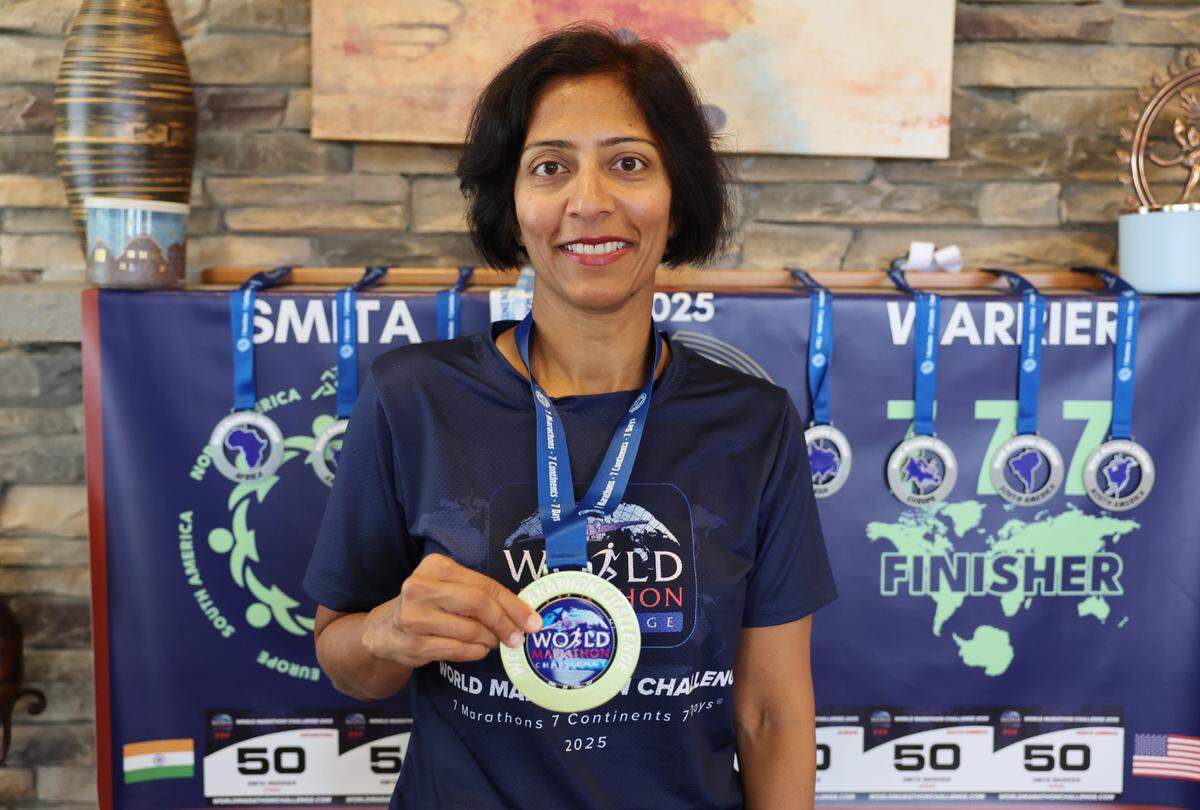
Warrier says the person in charge of the food on the chartered airplane finally had ample food she could actually eat after Marathon No. 5; and, re-energized, she powered through two more marathons to become the first woman of Indian origin to finish the eighth annual World Marathon Challenge.
I wasn’t aware of her Feb. 4 feat until recently, but as an avid marathoner myself, I just had to hear how and why she did this.
Here she is, in her own words, edited for clarity and brevity.
Deciding to run the World Marathon Challenge
We moved from India to the U.S. in 2000. I was a dentist in India already, and I did the international program at Tufts University in Boston. Once I graduated, my husband and I wanted to move someplace warmer. We’ve been in Charlotte since 2004.
I’ve always been active. But I didn’t start running until after we came to North Carolina. I don’t think running was a thing in India when I was growing up.
I have two boys — they’re 19 and 16. After I had my 16-year-old in September 2008, I gained a lot of weight, and I felt like I needed to do something. I found out about a triathlon training program at the Y, and I’m like, I don’t know how to swim, so this is the perfect way to do it. The day before his first birthday, I did the race. It was fun, and I met someone there who told me about a running group. She said, “They’re training for a half marathon. You should join.” I said, “Sure.” It started off as a way to get healthier, but the social aspect of it is amazing. You meet so many cool people, and you make such great friends.
I had only run three marathons prior to 2024. My first one was the Marine Corps Marathon (in Washington, D.C.) in 2013. Then I ran the Charlotte Marathon in 2022 and the Hilton Head Island Marathon in 2023. (That said, she also completed 50-kilometer races in 2020 and 2021, and a 100-kilometer event in 2021.)
When I first heard about the World Marathon Challenge (near the end of 2023), it was because a friend sent me a screenshot of the race, and I was like, “Okay! Never heard of this, but let’s do it.” ... The challenge of it definitely piqued my interest. I’m always looking to kind of push myself and explore out-of-the-box ideas. I was like, Why not?
Fundraising for Sakhi for Girls Education
Then I showed it to my husband, and he said, “No way. That’s crazy. You’re gonna injure yourself, and you will never be able to run again. Don’t do this to yourself.” But, I mean, I always have crazy ideas, and I always break down his resistance. So, soon enough, he was good with it. He’s only always afraid for my safety, but he’s also my biggest cheerleader.
I told my training partner we should do it together. He briefly considered it, then he’s like, “No, it’s too much money, too much time.” My family didn’t go either, because you have to pay the same amount whether you’re running or not.
But since this is such a unique race, I decided to use it as a platform to do some good as well. So I used it as a fundraising effort for Sakhi for Girls Education, which helps girls in India who because of crushing poverty don’t have access to education, and shows them you can have a role model that looks like you who aspires to do hard things and gets them done. It’s based in Mumbai, India. That’s where I grew up. I came from a middle-class family, and I know firsthand how much of a difference education can make.
Training run mileage for seven marathons
I did a good, solid training plan for six months. I think I topped out my weekly mileage at probably 91 miles, when I ran seven half-marathons (13.1 miles) in one week. And over Thanksgiving, I did three marathons back-to-back on a loop in our neighborhood, which is pancake-flat. I wanted to do four in four days, but I got sick. I think I had walking pneumonia. So I ran three and I said, “This is good enough. If I can do three under these conditions, I think I’ll be okay.”
I turned 50 in December, and “50” was my bib number, coincidentally. They were assigned in alphabetical order, and more than 50 people were originally registered. Because I’m “Warrier,” I ended up as “50.” Which was perfect, since this was a birthday gift to myself.
It’s an Indian name. There’s a whole community of Warriers. Our names are supposed to denote what jobs we had, but it’s weird; we have nothing to do with fighting or being a soldier. ... I love Scrabble and words, so I had started a Scrabble team in my kids’ school, when they were in elementary school, and I made up a shirt that said “Word Warrier.” Everyone tried to tell my son that he had spelled it wrong.
Before the race, we met up in Cape Town (South Africa) three days in advance. I fell into a group with three other women. We went and saw penguins together, did some sightseeing. We had a good group. Then we flew to Antarctica to start the race, and from that point on you don’t get to sight-see at all.
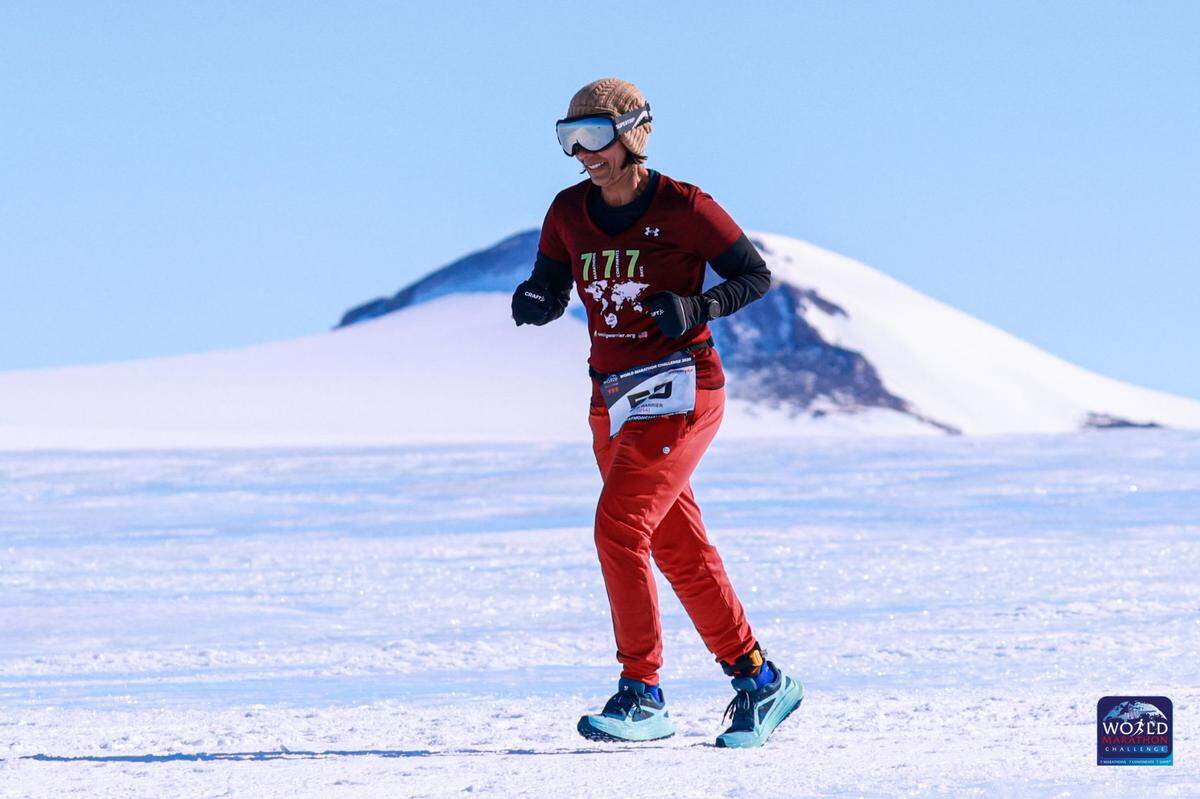
None of the races are sanctioned races. We just run wherever they could set up loop courses. Antarctica was 10 loops, so it was a 2.6-mile triangular loop, and it was kind of like “mowed” ice — there was a light dusting of snow on it, and there was blue ice in certain places, which made it really slippery. But running in a place like Antarctica, you feel blessed. It is special.
After that, it was a constant hustle. We had eight hours to finish each marathon, and in Antarctica the last person finished in seven and a half. It was a chartered plane, so as soon as everyone finished, we went back to the plane and took off.
I tell people my superpower is that I can fall asleep at the drop of a hat ... and it was such a blessing. Because literally, after a race, you have, like, half an hour — or an hour tops — to shower, get on the bus, get back on the plane. And I would fall asleep pretty much instantaneously. That really helped me recover and recharge for the next one. (“The next one” would start as soon as they arrived at the course, which explains why the runners were sometimes starting and/or finishing at night.)
We flew (to and from Antarctica in an old) cargo plane. No windows. But it was very cool. The seats were more spacious than a regular economy flight, then in the back there were Porta Johns bolted onto the floor and a huge open space for baggage. People just threw their bags on there and slept on the bags instead of staying in their seats. (After Marathon No. 2 in Cape Town, they switched to a chartered Boeing 757 for the rest of their trip.)
From 16 degrees in Antarctica to 76 degrees in Cape Town
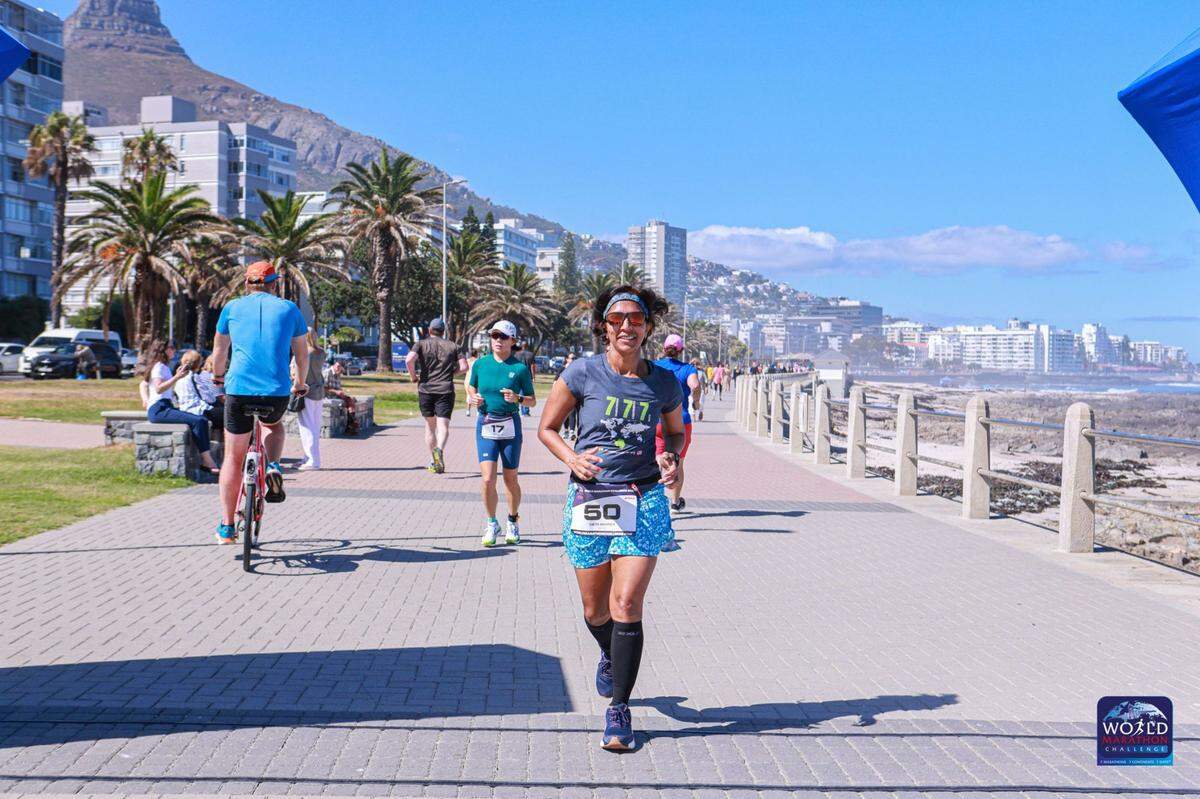
The second marathon was back in Cape Town, and I loved the course there. There were paragliders that came and landed on a field right in the center of our loop. The only tough thing was that it was a warm race, especially right after Antarctica. Antarctica was like 16 degrees, then 11 hours later, we were running in Cape Town on no real sleep or food — and Cape Town was like 76 degrees. Sixty degrees warmer.
It was a 15-1/2-hour flight from there to the next race in Australia, but it was one of my favorites. A dental-school friend, who I hadn’t seen in 28 years lives in Australia, came to see me at the start line. He FaceTimed a bunch of our dental classmates in India, and everyone was rooting for me over the phone. The race was at night, so it was cooler. We were running along the water, and there were fishermen in the water. They had these green lamps to attract the fish, I guess. It was beautiful, very peaceful. It was also my fastest of the seven (at five hours and 21 minutes).
From there we flew 14-1/2 hours to Dubai in Asia — which just looked very built-up, with nothing natural there — and then Madrid in Spain, where we ran on a Formula One racetrack that was hilly. It was 11 loops, and there were two hills on each loop. So there were 22 hills. I had never trained on a hill.
Next was Brazil in South America. It was 95 degrees, so it was brutal. The loops were near these glass high-rises, so when you ran this way, this arm was burning because of the light reflecting off the glass buildings. Then you turned around and the other side of you was burning. Everyone was suffering. I changed my intervals completely. For the other races, I had been doing 4-1/2 minutes of running, then half a minute walking. In Brazil, I began doing 2-1/2 running and half a minute walking. Even that was so hard. The only thing that kept me going is thinking, If I just walk the whole thing, it’s going to take me that much longer. It was my slowest of the seven (a 6:02 finish).
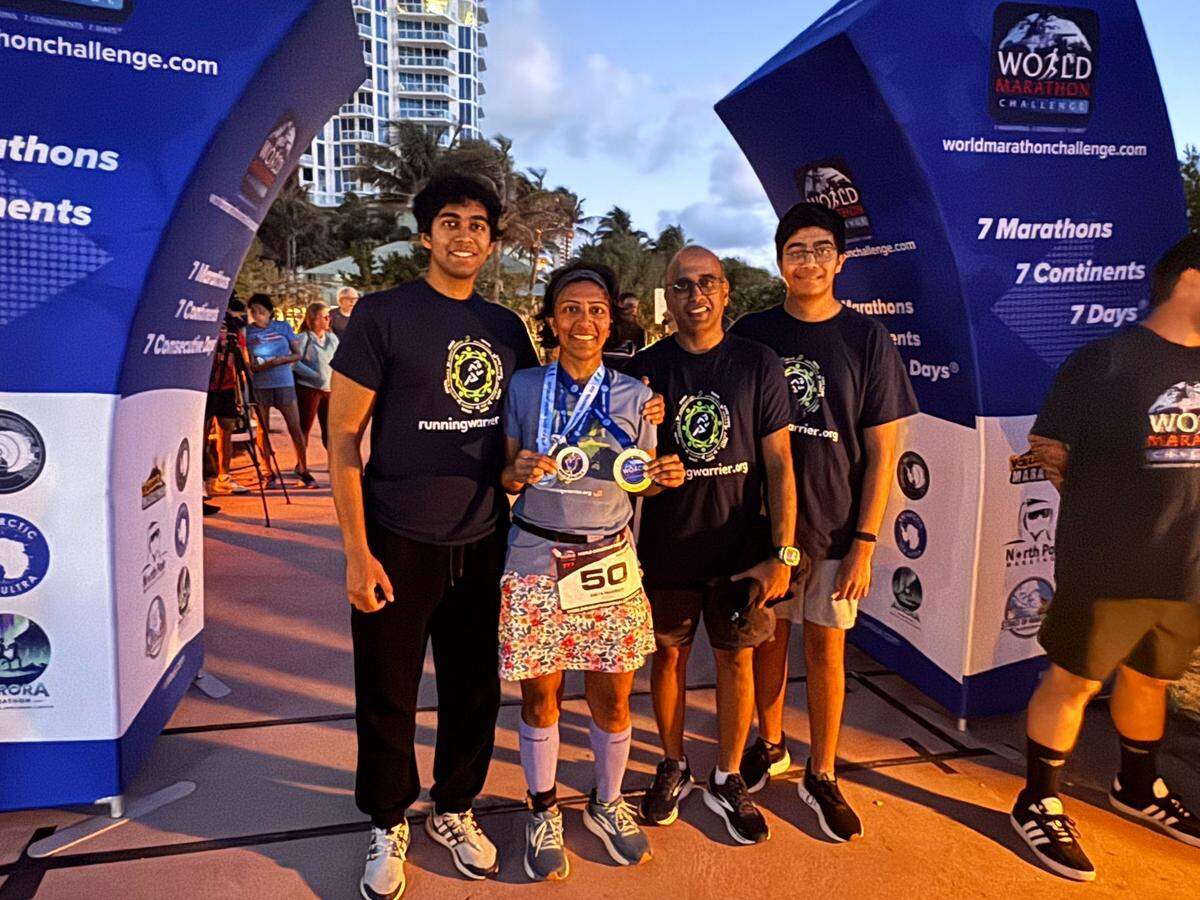
My family came to see me finish in Miami, as did my best friend. She ran so many of the half marathons I did in training. She was just amazing. It’s a community effort. Even though I ran it, I really think it’s a group effort. So many people supported me and helped me in different ways. And I am right now at around $20,000 raised.
The goal was to do 183.4 miles of running in seven days. (The last runner finished to mark the end of the event) in five days and about 22 hours. Since I’ve come back, a lot of people are like, “So you actually did it!? You finished? You did all of them?” It’s hard to wrap your head around it — 183.4 miles of running, 28,000 miles of flying. It sounds crazy.
It’s a lot of money for not really having seen anything. If you’d told me, when we were in Brazil, for instance, “This is Brazil,” I would believe you — but I would have had no idea otherwise. You’re just running loops, then you’re done and back on the bus. But I still would heartily recommend it to anybody who wants to do it. I don’t want to call it “life-changing,” but it’s way up there, for sure. I learned a lot about myself. You really don’t know what you’re capable of until you’re challenged with it.
It was also a very, very warm, tight-knit group. It would have been great to go with a friend, but I think going alone opened me up more to then making new friends. I met the most amazing people. That’s why I’m now hoping to do the the 100th Comrades Marathon (a 56-mile race in South Africa) in 2027. One of the guys running the World Marathon Challenge was saying, “Oh, I’ve done Comrades 10 times,” and we were all like, “Oh! We want to do this. Let’s do it!” It’s supposed to be extremely challenging.
I don’t know if I can succeed at that race. But I’m sure gonna try...
-
For more about Smita Warrier’s recent journey, visit runningwarrier.org. Her fundraising page, which is still accepting donations, is here.
This story was originally published April 9, 2025 at 6:00 AM.