How a former big-time Charlotte radio host reacted to losing a foot: ‘It is what it is.’
It’s been 14 months since John Hancock retired from WBT-AM (1110), the Charlotte radio station that helped turn him into an icon, so he’s had plenty of time now to get used to not sitting in a sound booth.
He’s had just one month, meanwhile, to get used to sitting in a wheelchair.
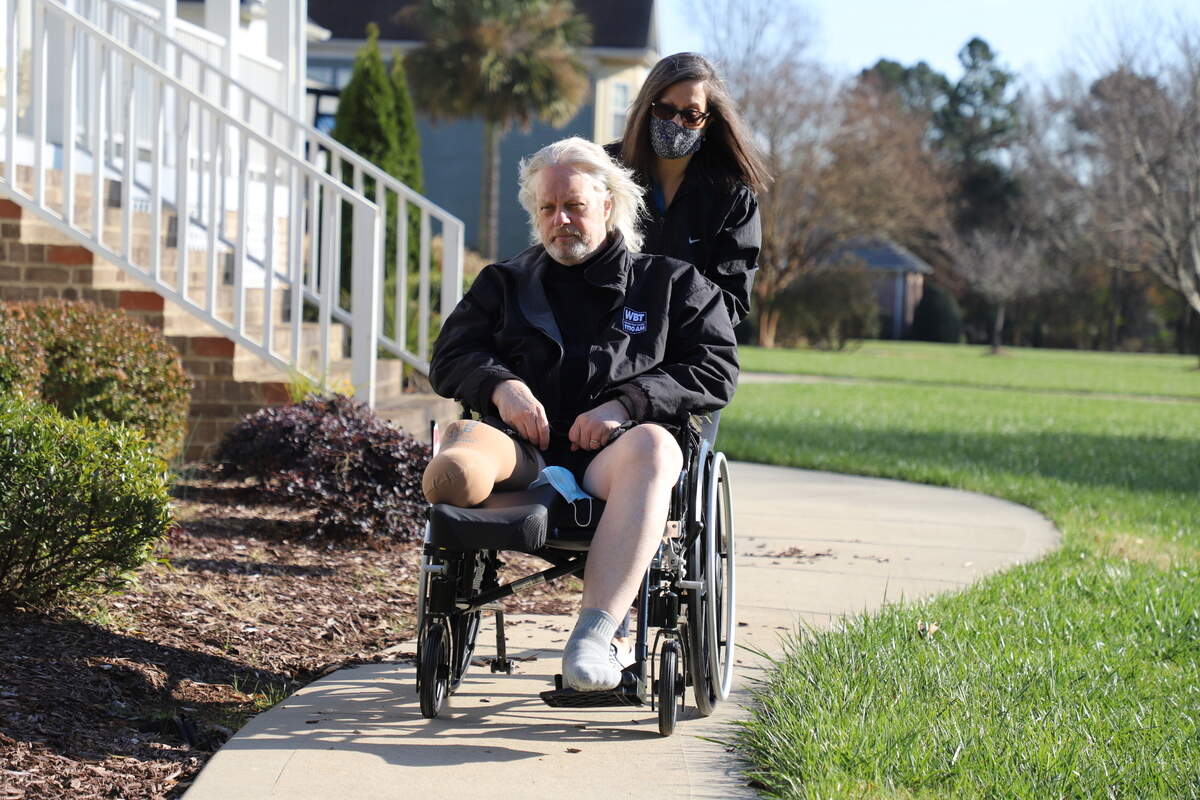
On this afternoon, Hancock, 68, is sitting in that wheelchair in the middle of the living room of the house he shares in Belmont with his wife, Susan, and a visitor asks him what thoughts go through his mind when he looks down at where the lower part of his right leg used to be.
It doesn’t take him long to come up with an answer, using his famous voice to let out a stream of seriocomic consciousness that sounds a lot like the stuff he used to say on the air:
“It is what it is, yeah. I’ve never seen this part of it,” he says, leaning forward in his chair and gesturing to indicate that he’s talking about the very bottom of the stump. “And I guess I could put a mirror out there and take a look at it, but Susan’s seen it and she doesn’t freak. And everybody else says it looks good and so on and so forth.
“But I don’t know, for some reason or another, this angle’s just fine. I don’t need to see the —” Hancock then cuts himself off and restarts: “Susan the other day said, ‘It looks like a — like when you go to the meat counter and they got all these little pieces of meat in there and stuff.’ Eh, OK. Well, that’s all I needed to know.”
He’s not always trying to make light of his situation, and the fact that last month he had his foot amputated in a Gaston County hospital, one day after he was told that it needed to come off.
He has, however, been consistently trying to make the best of it.
How did it come to this?
About 3 1/2 years ago — back when he was still cruising along as host of his popular, long-running, 3-6 p.m. talk show on WBT — Hancock found out he had Type 2 diabetes.
For many, Type 2 diabetes is manageable, and doctors felt Hancock’s case was, with anti-diabetic medication but also by losing weight through physical exercise and eating more healthy foods and less sugar.
At least for awhile, he says, he did great. He bought magazines targeted toward diabetics and he and Susan cooked all kinds of recipes published in them, he got on the treadmill, he went from 225 pounds down to about 190, and he even strived for additional accountability by talking about it on the radio.

“I can remember being on the air and saying, ‘Diabetes is the best thing that’s ever happened to me,’ ’cause it was kind of a wake-up call,” Hancock says. “But then over time, just like weight loss and so on and so forth, you get to your ideal weight and then slowly but surely, you put on five pounds. Then you put on 10 pounds. Then you put on 15 pounds and — so I did the same thing. You cheat, and then you cheat, and then you cheat, and then you cheat and you cheat and cheat.”
But the cheating didn’t catch up with him until sometime over the summer, and he didn’t realize it had caught up with him until it was too late.
It started with swelling in his leg and his foot. He says he saw multiple doctors, but they didn’t seem overly concerned. His right foot continued to swell in the weeks after, to the point where the arch went out instead of in. “It was like walking on a rocking chair,” Hancock says.
During a visit to his hometown of Estes Park, Colorado, in late September, he was walking gingerly. By his granddaughter’s third birthday on Oct. 10, he was limping. Soon after that, what he originally thought was a blister had formed on his foot. Two weeks later, it had burst and was determined to be an ulcer.
That’s also around the time he started experiencing cold chills and stopped being able to hold food down.
The first 12 days of November were a nightmare, based on the notes Susan Hancock was keeping to document her husband’s medical condition. To sum up, he kept seeing doctors, the doctors — she felt — kept under-reacting (he even went to the ER once, though they just gave him antibiotics and sent him home), and he just kept getting sicker.
On Nov. 11, Susan wrote: “It’s gotten to the point where all John does is lay around, either slumped on the living room couch or lying in bed.”
On Nov. 12, he saw yet another doctor, this time a wound care specialist, who basically said his condition was obviously worsening and serious, but didn’t give the Hancocks any sort of definitive answer. Susan ended an entry in her notebook by repeating: “This is not going to end well. This is not going to end well. THIS IS NOT GOING TO END WELL.”
Then came Friday the 13th, and, finally, a breaking point.
‘We should take the foot’
Susan Hancock decided she couldn’t take it anymore. So she called her adult son, Matt, to the house, and together staged what was “pretty much an intervention.”
“Oh, just give me one more day to sleep,” John pleaded with her.
Susan scoffed. “It’s always ‘one more day.’ I don’t care if you think you need to go to the emergency room or not,” she said, matter-of-factly, “but that’s where we’re going.”
They saw multiple doctors upon being admitted at CaroMont Regional Medical Center in Gastonia, but they say the one they felt best about was the one who told them this: “You’ve got an infection there, and it’s a really dangerous bacteria. Maybe you could go to Charlotte and find some doctor that says, ‘I can save it.’ But —”
Then he said the words John and Susan both admit they’d been thinking they might hear, but that still took several seconds to process.
“I think we should take the foot.”
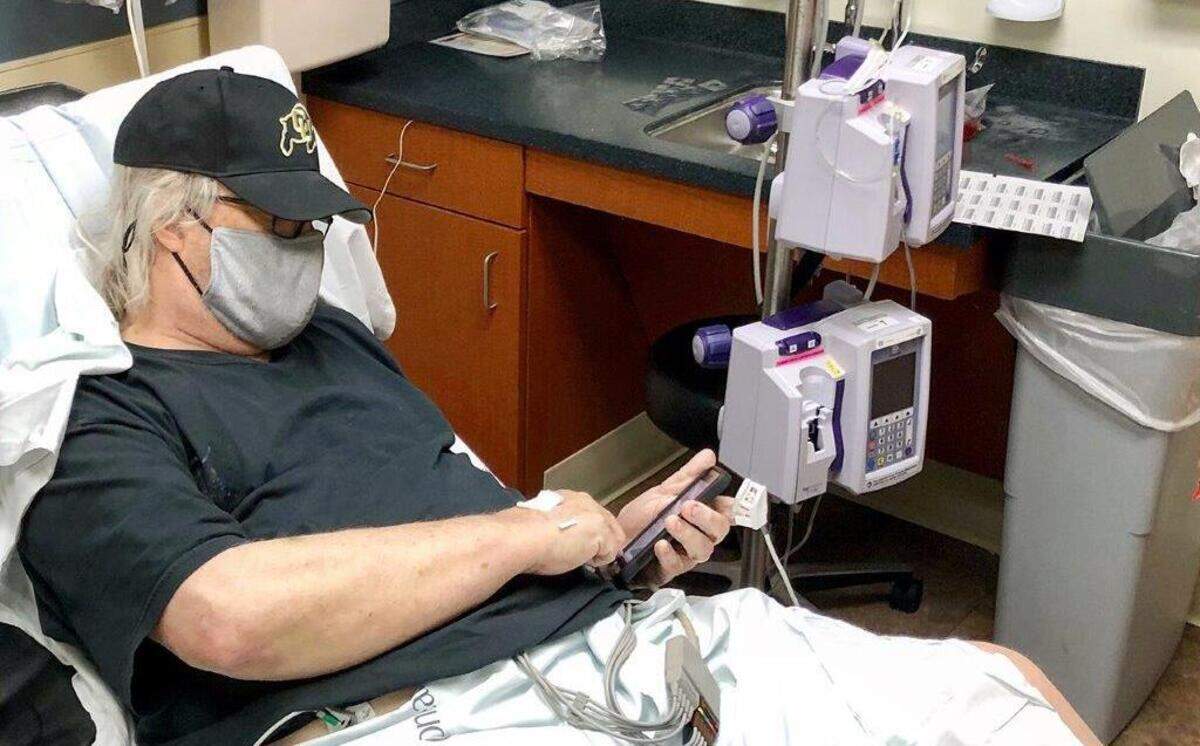
And if you are familiar with John Hancock, you can appreciate the wry, opinionated thoughts that were circulating in the former talk show host’s brain during those several seconds.
“I’d known this guy 10 minutes. ... I don’t want to disparage Gaston County,” he says now, “but I’m in a Gaston County hospital, thinking to myself, ‘I wish I was at Cedars-Sinai.’” At the same time, Hancock admits he’d been aware of CaroMont’s award-winning track record — and that he just had a good feeling about the guy.
Susan felt the same way. “In fact,” she says, “it was almost like I was waiting for somebody to make this decision. And he didn’t beat around the bush. He came flat-out and told us, ‘This is what we’re gonna do.’ It was a relief, because we finally had an answer.”
So after several seconds of contemplation — or maybe of just getting used to the reality of an idea they’d only thought of in theoretical terms before — they both nodded and said, “OK.”
A day later, John Hancock was lighter by one foot.
‘I’m not looking for excuses’
He would actually have two surgeries.
The first, on Nov. 14, would take off his right foot. The second, four days later, was a revision surgery (common in amputations like these) to improve the stump for prosthetic fitting.
After 10 days at CaroMont, he was transferred to Atrium Health Carolinas Rehabilitation in Charlotte, where he spent another 12 days before his discharge on Dec. 4.
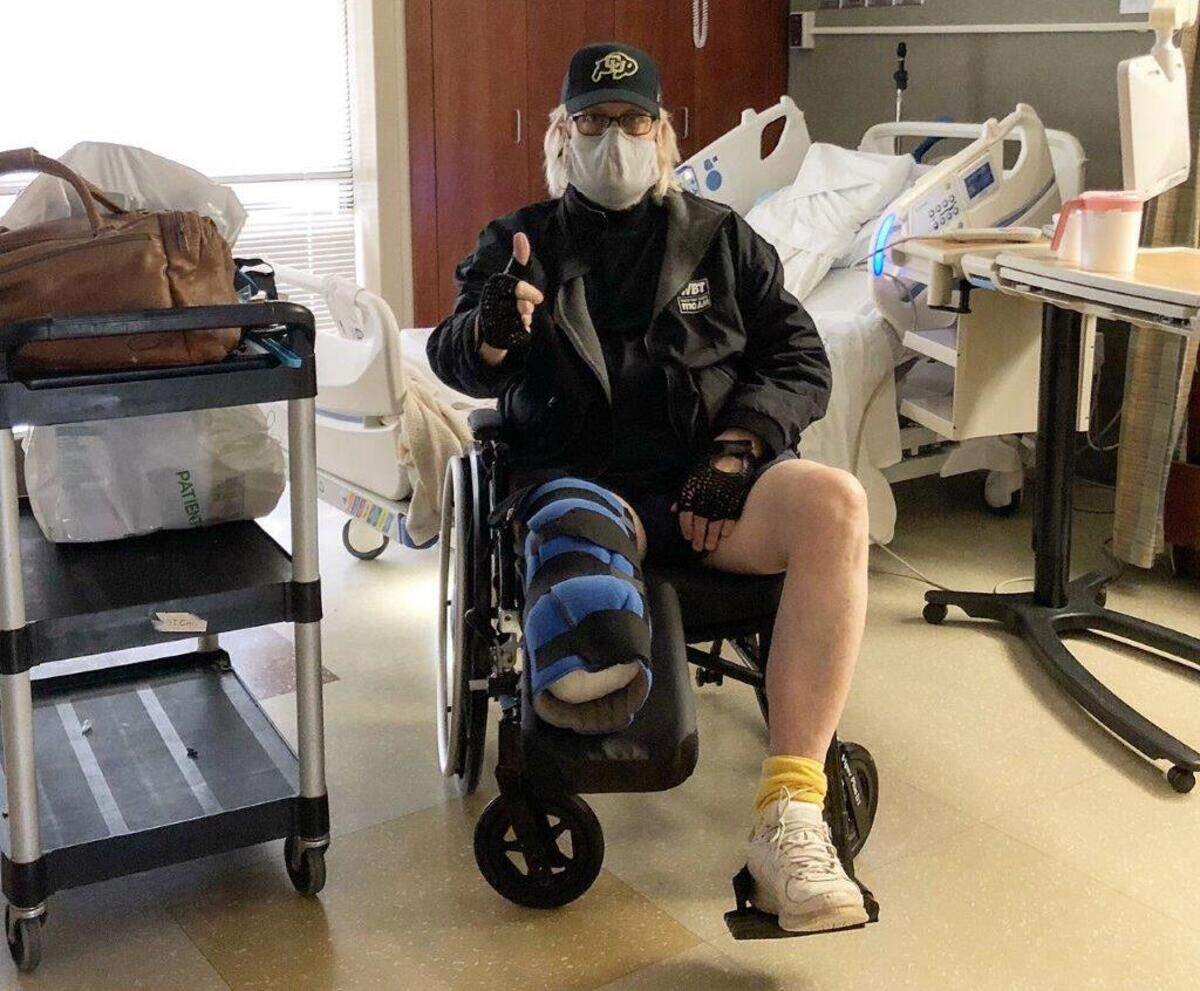
Since returning home, activities related to his care and recovery — none of which is glamorous and most of which, Hancock says, can be pretty undignified — have been all-consuming.
Susan is constantly filling out paperwork or navigating insurance issues or supervising care-related logistics, including a revolving door of home health nurses and occupational therapists and physical therapists. There are leg exercises and arm exercises. It’s still a struggle for him to get in and out of the shower, or to use the portable commode. He had a reaction to an antibiotic that gave him nasty gastrointestinal issues, and now he’s having bladder problems, so he’s self-catheterizing.
Yet he says the pain from the actual surgery has been remarkably manageable (without the help of prescription pain medication, which he says he only took for three days); and when asked about any sort of emotional pain, he just shrugs.
“I don’t think either one of us are playing the pity game,” Hancock says.
“My best friend from high school wrote me and said, ‘Why did this have to happen to you?’ And I wrote him back and I said, ‘Kenny, I had two great parents, grew up in one of the most beautiful places in the country ... I’ve had an incredible life. Met big names and had lots of experiences, and I had a great career. I still have more to go. I found the girl of my dreams. Why did all that have to happen to me?”
As for whether a greater sense of urgency from doctors early on might have led to early treatment that could have saved his foot, he shrugs again.
“I’m not looking for excuses,” he says. “Fact is, if I had been more diligent about diet and the diabetes, we probably wouldn’t be where we are today. To dwell on anything else, or to look to blame others, is not something I can do and maintain a very positive attitude. That positive attitude is getting me through this.”
It’s also helpful for him to think of this not so much as a situation that should have been dealt with earlier, but one from which he was lucky to escape with his life.
A life he hopes is back to normal soon.
What the future holds for Hancock
One of the big keys to realizing a return to normal life will be when he can get into a prosthesis, which has already been ordered and he hopes to be wearing by the middle of January.
He’s been told over and over that once he is up and walking again, he’ll eventually have a very similar quality of life as he had before the surgery.
When he’s fully regained his mobility, he plans to march back into a doctor’s office and get Cochlear implants, which he hopes will solve the growing hearing problems that have hampered him in recent years and continue to worsen — and which Susan cracks will, in tandem with the artificial limb, qualify him as a bionic man.
Meanwhile, though he remains officially retired, at some point this winter, Hancock is looking forward to returning to the part-time voice-over work he’s done with longtime clients who specifically want him to record the pitches for their radio commercials. He also has been talking about the possibility of doing a regular hour-long commentary radio show.
So all of these things are helping motivate him to keep up with the physical therapy. And to keep him away from the candy.
“Did you tell him about the Butterfingers?” Susan says, as they sit in the living room, which is devoid of a Christmas tree this year because they wanted to leave the space open so he could maneuver more easily in his wheelchair.
John laughs.
“When I was in the hospital, she ransacked the house, and in my file cabinet back there she found a bag of Butterfinger candy bars. It was Halloween. I love Butterfingers. When I came home I opened up my file cabinet and my Butterfingers were gone,” he says, laughing again. “So there’s nothing left in the house for me to cheat on.”
“Yeah,” Susan says, “he’s not gonna bring another bag of candy bars in here. ... I control what comes in the house now until he can get to a grocery store, and that’s gonna be a long time coming.”
It doesn’t take long, frankly, for their visitor to get the sense that John owes Susan for — if nothing else — preventing him from becoming his own worst enemy. And for anyone who might not get that sense, she’s happy to make it clear.
“I have a list of things when he’s healed that I want,” says Susan, his wife of 26 years, who can be just as entertaining to listen to as her husband. “He knows about it. He doesn’t know what that list has on it, but, yeah, it’s things that I want when he’s healed.
“Somebody referred to it as ‘the co-pay.’ One of his nurses. It’s the co-pay: What you owe me,” she says, and now she’s laughing, too. “It’s not bad, hon. It’s not bad.”
John chuckles as he shifts in his wheelchair and rubs at his legs, one of which is now 15 pounds lighter than the other.
“I told her, if she’d have just let me go,” he says, looking at her lovingly, “she could have had the whole empire.”
This story was originally published December 18, 2020 at 3:39 PM.