
Charles Randolph-Wright stands at the top of his game
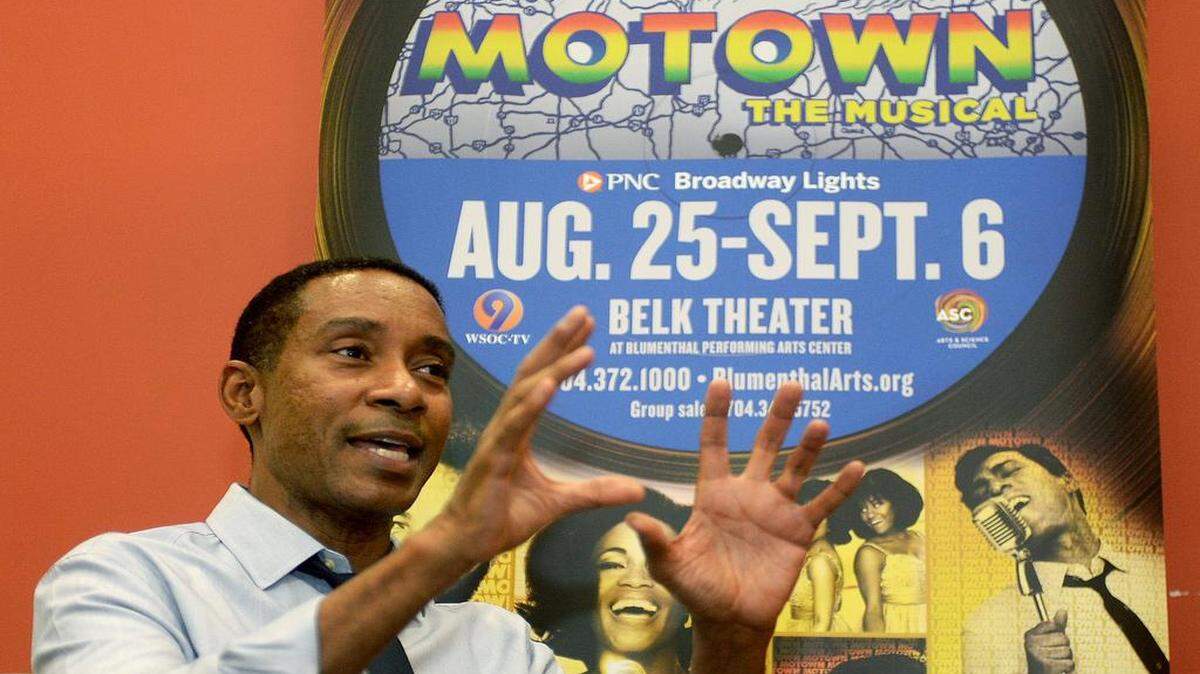
The odd thing is not that Charles Randolph-Wright bolted from Switzerland, abandoning future collaborator Stevie Wonder to attend an elementary school reunion in York County.
The odd thing is, both places made him equally happy.
“I went from the Four Seasons Hotel in Geneva to the Holiday Inn Express in Rock Hill, and one world was as exciting as the other,” he says. “It was beyond my expectation how genuine our relationships were after all these years. Being with classmates reminded me what I’d had to do to get to work with (Stevie).”
That’s Randolph-Wright: A ceaseless traveler who gets his mail in New York City, has directed across North America – including “Motown: The Musical,” whose national tour comes to Charlotte’s Belk Theater Tuesday – yet hangs onto the South Carolina house his father built by hand more than half a century ago.
He went back there to work on “Born for This,” a musical he’s co-writing with composer BeBe Winans about the Winans siblings’ journey from Detroit to this region. “It was very grounding,” he says. “I experienced the heat again and heard the crickets, and that changed how I was writing.
“The person I am was shaped by what I experienced here. I bolted as fast as I could (in the 1970s), but it’s still a part of me.”
He turns 59 Wednesday and stands at the top of his cultural game.
He’ll be co-writer and executive producer of the NBC miniseries “Freedom Run,” an adaptation of Betty DeRamus’ 2005 book “Forbidden Fruit: Love Stories From the Underground Railroad.” Wonder will also be an executive producer and will write music for a Broadway version of that story.
Randolph-Wright directed “Motown” for its New York run in 2013-15 and its current tour. He’ll prepare it for London in January, which means postponing “Born for This” until an Atlanta premiere in April at Alliance Theatre. (Rock Hill’s William Ivey Long, who has won six Tonys, will do the costumes.)
Forceful side, softer side
If the writer-director had theme music, it would be the frenzied “Sabre Dance.” Yet in person, he exudes not only restless enthusiasm but a sense that he’s in control of a hundred variables. Listen to Motown founder Berry Gordy explain why he put Randolph-Wright in charge of his onstage story:
“My intuition. His confidence. He told me I had to hire him. He convinced me he was the only person who could translate my vision of the Motown experience like it happened.
He told me I had to hire him. He convinced me he was the only person who could translate my vision of the Motown experience like it happened.
Berry Gordy
“‘I was bred for this position,’ he said. ‘I’m from the South, and my mom looooved Motown and played it all the time. It’s in my blood. I studied your book. I’m your man.’
“A little surprised at his overzealousness, I chuckled and said, ‘Wait a minute. You’ve never even done a Broadway show before.’
“He said, ‘So? Neither have you.’ I couldn’t wait to hire him.”
Yet that confidence conceals a vulnerable side. “If people really knew Charles, they would know he’s not as strong as he’s made him out to be,” Winans says. “He has this facade of ‘People don’t bother me,’ and he has learned how to put up walls when he needs to. But he’s a loving guy who can be hurt easily by what people say.”
Martin Damien Wilkins, the National New Play Network producer in residence at Actor’s Theatre of Charlotte, has seen all sides of the man who has mentored him for 13 years. He has assisted Randolph-Wright on multiple productions, so he wasn’t surprised to get a call last fall.
Could Wilkins pull off a “Born for This” workshop at ATC? Nothing formal, just some private rehearsals so the authors could see how it flowed. Maybe Stephanie Mills, the Grammy-nominated singer who lives in Charlotte, could play the Winans’ mom. (She did.) Could it be underway in a couple of weeks?
It could. And when Randolph-Wright arrived, he worked so efficiently that the hastily assembled company pulled off a staged reading.
“That’s the extraordinary thing he can do,” says Wilkins. “I’ve seen him get the first act of a (full-scale) production on its feet after two weeks of rehearsals. He’d observe something that wasn’t going the way he wanted – he has such an eye for detail – and come back to it later. As quickly as we moved through the process, he trusted the show to find its footing.
He’s interested in everyone’s ideas in the room.
Martin Damien Wilkins
“He’s interested in everyone’s ideas in the room. I assisted him at Arena Stage in 2004 on ‘Señor Discretion Himself’ (Frank Loesser’s last, unfinished musical), and he always wanted to see my notes on the show.”
Role model for followers
Randolph-Wright has guided the 36-year-old Wilkins since 2002. Both had graduated from Duke University, one generation apart. Both were black men raised in the South who worked in a predominantly white theatrical world.
“When I learned what he’d accomplished, I was an intern at Charlotte Repertory Theatre, wondering ‘What comes next?’ His career felt like a possible (path),” says Wilkins.
“I saw him as a mentor – he once introduced me as ‘my child’ – and that developed into a personal friendship. He asks about my family life, my dating life, not just professional concerns. When my mother passed away eight years ago, he was there with kind words. But he was also saying, ‘You don’t look well. Are you eating?’”
Until this summer, the loss of a mother was one experience they hadn’t shared. Ruth Johnson, Randolph-Wright’s parent and an activist for racial equality in western York County, died June 25.
“I knew something was wrong when the tragic event in Charleston happened and she didn’t call,” says Randolph-Wright, thinking of the June 17 shooting at Emanuel African Methodist Episcopal Church. “If she were still healthy, she’d have been going up the pole in Columbia to take down that (Confederate) flag.”
After her death, he told the Rock Hill Herald that “My mother was the one great influence on my life, the one who had that profound vision for me – and so many others.” It was not a vision where middle-of-the road work held any value.
Before I started grade school, my mother told me to bring home an A or F. I can still hear her saying, ‘A C is average, and there is no average in this family.’
Charles Randolph-Wright
“Before I started grade school, my mother told me to bring home an A or F,” he said a few years back. “I can still hear her saying, ‘A C is average, and there is no average in this family.’ The F makes you stronger. The F coerces you to continue and makes you get the A. You stop with a C. That thread has followed me my entire life.”
Taking roots with him
It followed him to Duke University, where he graduated in 1978, and to Broadway, where he played supporting roles in the original “Dreamgirls.” He pursued an extraordinarily broad career, from directing a Portuguese-language “They’re Playing Our Song” in Rio de Janeiro and São Paulo (no, he’s not fluent) to staging one-person New York shows for Tony-winners Bea Arthur, Brian Stokes Mitchell and Patina Miller.
But not until he met BeBe Winans did he find the project that brought him metaphorically back home.
If Randolph-Wright grew up listening to Motown music, BeBe and sister CeCe grew up not listening to pop hits from their hometown. (Their Pentecostal family disapproved.) Their lives changed when they came south during the rise of the PTL Club, became singers on Jim Bakker’s TV program in 1982 and leapt to fame as gospel performers.
Says Winans, “Charles and I were introduced at my favorite restaurant in New York, the Hillstone. He said one word that made me stop and look at him: ‘Pineville.’ I asked, ‘What do you know about Pineville?’ He said, ‘I was raised around there,’ and our worlds came together at that moment.” (Randolph-Wright did not say that his first paying musical job in this region had been four-a-day shows at Carowinds.)
Winans soon learned three things. First, “He’s a perfectionist. I am, too. But when I feel something is right, I move on. Charles stays put: ‘Well, I don’t know if it’s really, really right....’”
Second, “Charles treats you like family. He has become a Winans, and that comes from trust. A lot of people want your story because they can make a dime off it. He protected our story, which caused me to open up. He brought a lot of things out of me; he has a way of asking for more without pushing.”
A lot of people want your story because they can make a dime off it. He protected our story.
BeBe Winans
And third, he gets inside your head in a helpful way. After interviewing Winans, Randolph-Wright wrote death threats for the siblings into their narrative. Winans figured those were a dramatic liberty but didn’t complain. One night, he called Jim Bakker to chat about the script. Oh, no, Bakker assured him: White viewers had indeed threatened their lives, but ministry leaders had suppressed the bigots’ calls.
The mark of ‘Motown’
Producer Gordy had the same reaction to Randolph-Wright. They “worked so well together ... it was spooky at times. When I hired him, I already had a script I had been working on for some time. I would tell Charles a new idea I had, and he would say, ‘Check your email.’ It was there!
“He pulled together an amazing group of actors (who)... challenged me and pushed me to dig deeper, to tell this story as honestly as I could.”
Randolph-Wright remains proud that black theatergoers can see people who look like themselves in this socially conscious musical. (He won the Paul Robeson Award for social activism from Actors Equity Association in 2010, following the likes of Sidney Poitier and Harry Belafonte. )
“Motown” opened in St. Louis last fall, around the time a grand jury decided not to indict a white police officer for shooting an unarmed black man in Ferguson, Mo. The director invited 200 students from Ferguson and nearby Normandy to what may have been their first theatrical experience.
“Their teachers said this was the first time they’d smiled in months,” he recalls. “They had been told they didn’t matter, but this show was saying their dreams were possible.
“I told them, ‘I’m a kid from the woods who had a mom who told me never to settle for average. And now I’m living the life she told me I could have.’ ”
Toppman: 704-358-5232
‘Motown: The Musical’
WHEN: Aug. 25-Sept. 6 at 7:30 p.m. Tuesday-Thursday, 8 p.m. Friday, 2 and 8 p.m. Saturday, 1:30 and 7 p.m. Sunday.
WHERE: Belk Theater, 130 N. Tryon St.
TICKETS: $20-$134.50.
DETAILS: 704-372-1000, blumenthalarts.org.
Charles Randolph-Wright
Add these five projects to the ones in the main story, and you’ll understand the rise of his career:
1) “Guys and Dolls” (1999) – CRW directed Frank Loesser’s musical about gamblers and the Salvation Army for Arena Stage in Washington. The composer’s widow, Jo Sullivan Loesser, liked it and hired him to adapt “Señor Discretion Himself” (Loesser’s last, unfinished musical) for Arena.
2) “Preaching to the Choir” (2005) – CRW has directed just one feature for the big screen, this comedy-drama about two brothers – one a Harlem preacher, the other a rap star – whose lives take them in different directions, until they need each other.
3) “Blue” (2009) and “Cuttin’ Up” (2012) – Actor’s Theatre of Charlotte has done both of these CRW plays. The first is a loosely autobiographical story about a musician escaping a small town, the second a comedy with serious overtones about customers speaking out in a barber shop.
4) “Porgy and Bess” (2010) – The 75th-anniversary tour of the George Gershwin opera had more dignity and intimacy than usual, though it used a tiny 20-piece orchestra. He directed the production, which played Charlotte’s Belk Theater.
5) “Skindiver” – This science fiction musical has been gestating for a decade. CRW and Nona Hendryx (who wrote music for “Blue” and “Choir”) have adapted her 1989 album into the story of a woman who becomes an Internet star and gets accused of mass murder. It’ll premiere ... someday.
This story was originally published August 21, 2015 at 12:58 PM with the headline "Charles Randolph-Wright stands at the top of his game."