Think Pokemon Go, but in serious application: That’s what Charlotte professor is doing in #HomeCLT
By Page LeggettArts correspondent
Professors of urban planning aren’t always as in demand as Dr. Ming-Chun Lee. He’s become sort of a rock star of academia.
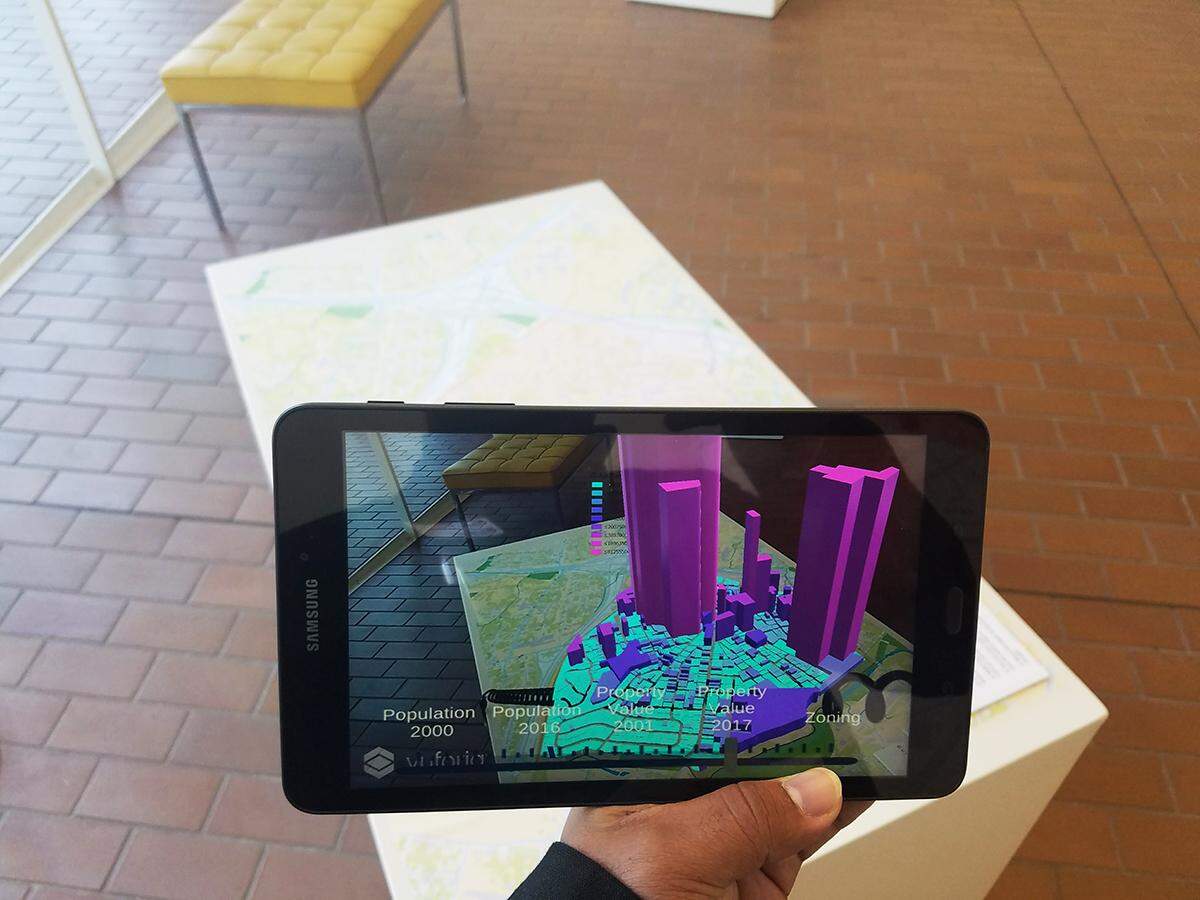
And his augmented-reality maps play a big role in “#HomeCLT,” which opens Feb. 27 at the Levine Museum of the New South. They help viewers see how neighborhoods in Charlotte have changed over time — in a three-dimensional and, organizers hope, intriguing and memorable way.
The UNC Charlotte assistant professor’s popularity soared, relatively speaking, last March at a symposium at UNC Charlotte Center City – maybe not a place you’d expect to find The Next Big Thing. “Urban Complexities: Equity, Economic Mobility and the Built Environment” was the surprisingly fascinating topic.
Tablets can show data in 3D with this augmented reality mapping. UNC Charlotte
One part of the symposium was an interactive installation called “Mapping (In)Equity in the Built Environment.” The exhibition — created by UNC Charlotte City Building Lab Director Nadia Anderson, associate professor of architecture and urban design, with Dr. Lee and several students — drew the attention of leaders at the Knight Foundation, the Levine and the public library, among others.
They were fascinated by Lee’s high-tech maps, which showed shifting patterns in Charlotte neighborhoods. Viewers used tablets and an app; when they held the tablet up to the map, 3D graphics sprang up on the screen.
And by looking at three sets of data — residents’ socioeconomic status, property values and racial demographics — as 3D graphics over three time periods (2000, 2010 and 2017), there appears to be “an almost perfect correlation” visually, Lee said, between having high income and high property value and being white in Mecklenburg County.
So Lee’s data-driven maps help illustrate the economic mobility issues that Charlotte faces.
“Data can be ‘viewed’ by the naked eye as ‘graphics,’ rather than numbers,” he said. “And through this visual process, information may be extracted in a more effective way.”
That was the big aha at the symposium: It’s one thing to read the data. It’s another to see it in 3D form.
That’s what the Levine Museum wanted for #HomeCLT. Lee’s maps, with others, and with video and still photography of residents telling personal stories, form the core of the exhibition.
His maps created “the most attention I’ve ever gotten from my work,” Lee said. “The Knight Foundation grant came out of nowhere.” He’s among five inaugural Fellows in the Niantic/Knight Fellows Program, a community engagement initiative led by the John S. and James L. Knight Foundation and Niantic Inc., proponent of AR technology and maker of the Pokémon GO game.
VR too, though
Clearly, Lee’s work can illustrate serious issues.
But not all of his work is that sober. His personal research interests are both AR and virtual reality (VR). “Both were developed at the same time, but VR got all the attention,” Lee said. VR takes you, for a time, out of this world and into another. AR allows you to remain in this world and see things in it that aren’t physically there.
“You can still see the world around you, but virtual objects show up in your field of vision, too,” Lee explained. “You see the real world but with virtual things merged in with it. You can experience that overlap from your phone or tablet.”
VR is an escape. AR can be a learning tool. “VR creates a virtual world that may be cut off completely from the real one,” Lee said, “while AR adds virtual objects over the real world and may trigger some … interaction between the two worlds.”
AR technology came into play last September at Open Streets 704, an event in which Lee used Pokémon GO technology to entice people to explore Charlotte on foot or on bike and build a sense of community. (It was the perfect project for an urban planner who wants to use technology to bring people together.)
There were PokéStops along the route. PokéStops are actual physical locations which Pokémon GO players can visit in person and “catch” Pokémon figures by playing the game. The Open Streets 704 event last fall had more than 15 such stops, including in Romare Bearden Park and Johnson & Wales University.
Maps put Lee on the – well – map, but his facility with AR and VR may ensure his staying power.
This story is part of an Observer underwriting project with the Thrive Campaign for the Arts, supporting arts journalism in Charlotte. Sign up here for the free e-newsletter “Inside Charlotte Arts.”
This story was originally published February 13, 2019 at 5:36 PM.