This is how some Bechtler visitors appreciate the art, even when they can’t see it
By Lawrence Toppman
The sign reads “PLEASE DO NOT TOUCH.” Next to it, Lisa Newth plants her hands on a weaving by Spanish surrealist Joan Miró.
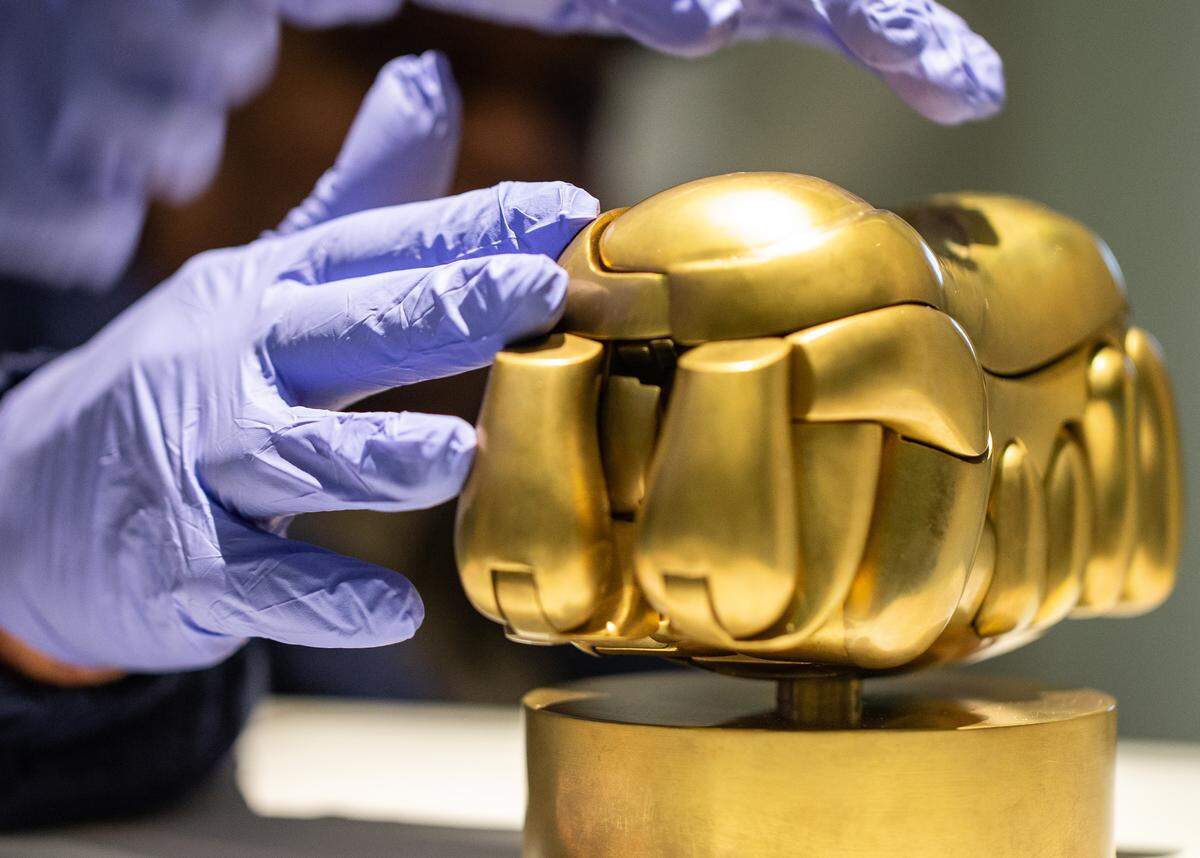
Granted, the Bechtler family used “Spanish Dancer” for a while as a rug and even spilled red wine on it once. But this visitor to the Bechtler Museum of Modern Art and two fellow tour members run their mitts all over it. They have already rubbed the interlocking brass parts of Miguel Berrocal’s “Romeo and Juliet” and will shortly stroke the rough edges of Alberto Giacometti’s “Seated Woman,” all while grinning members of the Bechtler staff stand by.
Lavender-colored latex gloves, the kind worn by curators when handling six-figure works of art, protect the pieces on these tours, which include at most half a dozen people. And how else could participants in the Bechtler’s Low to No Vision Program appreciate its collection?
For almost seven years, visitors with severely diminished sight have learned about art on tactile tours and made it in small classes, mostly through the Bechtler’s connection with Metrolina Association for the Blind.
The museum has pursued underserved audiences in jails, detention centers and schools. It has brought art into the lives of people with physical disabilities, learning disabilities and early stages of dementia. It hopes to start a program serving veterans with problems in the next fiscal year. (More of that in a bit.) So Low to No Vision fits perfectly into this expansionist philosophy.
And the participants are having a ball.
They’re wrinkling their foreheads at the feel of rough corrugated circles in Hoss Haley’s “Ripples,” hewn from the side of a salvaged steel tank. They’re laying sensitive fingers along the irregular stone surfaces of Katharina Sallenbach’s “Relief 1961.” (“It’s like someone was really bad at laying bricks and couldn’t get them even,” says pragmatic tour-taker Todd Hilbert.)
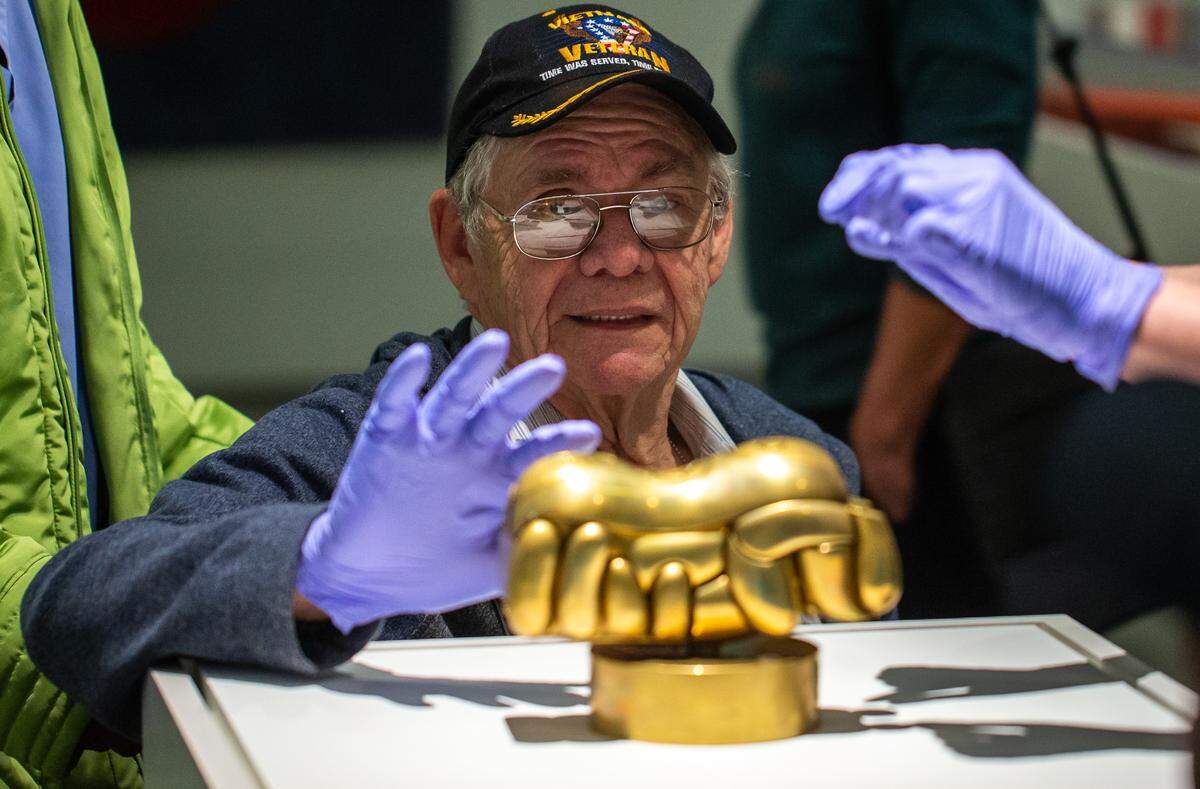
They gather details that sighted visitors may miss, handling not only the works but pedestals on which they sit. A tour leader dismantles “Romeo and Juliet,” though only partly: A Bechtler curator needed three hours to assemble the 16 pieces and had to watch a video in reverse to do it. As Newth, Hilbert and Oscar Lee handle the innards of this weighty little abstract sculpture, the guide explains that Berrocal made the unseen inner parts anatomically correct.
Todd Hilbert touches the sculpture “Romeo and Juliet” by Miguel Berrocal during a Low to No Vision tour at the Bechtler Museum. Joshua Komer For The Charlotte Observer
“The question is, how can people experience beauty in different ways,” says Newth, who had eye surgeries after juvenile diabetes and now mostly perceives contrasts in shapes or light and dark. “I’ve looked at this art with glasses, without glasses and by touching it, and I’ve noticed different things each time.
“This liberates your imagination. Children experience everything by touch, and we lose that as we get older. But we’re (more perceptive) when we don’t rely on one sense all the time.”
That’s been true outside The Bechtler since it opened in January 2010. Passers-by handle the mirrored legs of Niki de Saint-Phalle’s “Firebird,” posing for photos alongside one of Charlotte’s most iconic sculptures. The cantilevered front of the Mario Botta-designed building invites leaners and touchers.
The Low to No Vision Program brings that natural tendency inside. Those thin purple gloves let people record detailed information: A slightly elevated line in the fabric of “Spanish Dancer” is as apparent to the fingertip as the eye, though colors and dimensions need to be described aloud. Visitors follow just one rule: Once the gloves go on, they cannot touch their hair or faces, because they’ll transfer oil or sweat to the art.
Classes, on the other hand, seem to have no rules. Those take at most four participants, so impaired artmakers can get one-on-one information from teachers or volunteers about colors, sizes and shapes.
“Individuals with low to no vision can become isolated, especially if they have no family or no one to drive them around,” says Mykell Gates Jamil, the Bechtler’s associate director of education. “We’re giving them a space not only to make art but to socialize and have a good time.” (The Bechtler also provides materials for these classes.)
Todd Hilbert touches the “Romeo and Juliet” sculpture by Miguel Berrocal during a Low to No Vision Program tour at the Bechtler Museum. Joshua Komer For The Charlotte Observer
If you’d dropped in on one of the three-part winter sessions – ostensibly set up to make wind chimes, though one participant worked on a clay version of Noah’s Ark – you’d have seen what Jamil meant. Creators’ fingers and tongues worked simultaneously for two hours, as though impairment were inconvenient but hardly insurmountable.
A brain tumor took most of Meredith Stump’s sight at 11; she now perceives only light. Yet as she made foxes for her ark, she relied on her memory of colors and shapes. “You forget some things as you get older, like your mama’s face,” she explains. “But colors? Never. You can tell me something is turquoise with red polka dots, and I’ll know just what you’re talking about.”
She and the other two women in that class have made art much of their lives, studying at Charlotte Art League and other venues.
Retired social worker Mary Lee O’Daniel, who has a recessive form of retinitis pigmentosa and also perceives only light, designed her wedding gown and her daughter’s prom gown. “I really liked spreading gesso on a canvas, using paper, sand, seashells, even buttons,” she says. “But I never know what to do with the things I make. For me, the reason to be here is more the process of making them.”
Classmate Kasimu Pate was drawing, painting and making jewelry before pathologic myopia took most of her vision. She has hung out at the DIY incubator Area 15, contributed to shows at the Urban Ministry Center and Charlotte Art League and proudly informs you Lenny Kravitz wore one of her T-shirts – tie-dyed hot pink and black – onstage at a local performance.
“I have defined myself as an artist for a long time,” says Pate, who also writes poetry. “I do it both for the pleasure of making things and to have an end product to show. Art doesn’t mean the same thing to everybody. The most important question for me is, ‘When you see (what I’ve made), what does it mean to you?’ “
The Bechtler has taught people to ask that question in different ways for nearly a decade. It combats recidivism by training incarcerated people to express feelings through art; it helps people with dementia and their caregivers trigger healing memories through art.
It also unlocks creativity in students who may never have studied art in schools or come uptown for any reason, let alone to visit a museum. When they do, the Bechtler pays for a substitute teacher and hires a bus. Every kid in a participating school program gets a free BOS (Bechtler Outreach Scholar) membership good for themselves and their families.
Jamil says the museum, which already admits veterans for free, has been approached by the Veterans Administration to create a program where vets learn to convey what’s on their minds by studying or making art. That depends partly on money, of course — the Bechtler relies on grants and internal budgeting to cover outreach efforts — and staff availability.
The museum served 1,929 school and community members in fiscal year 2017-18, and at a low cost. A recent fund-raising email says $1,000 pays for a Jail Arts Initiative residency, $500 for a school classroom project and teaching artist, $100 for a tour by someone in the Low to No Vision or Museum Memories programs, and $25 for art supplies for a participant in any community effort.
“This museum has always had a large focus on outreach, and we hope to expand that as much as we can,” says Jamil. “We want to share the joy with everybody.”
This story is part of an Observer underwriting project with the Thrive Campaign for the Arts, supporting arts journalism in Charlotte.