
This powerful Passion concert in Charlotte will provide a unique sonic experience
Sometimes God whispers; sometimes God shouts.
Sometimes the Lord rolls the musical calendar back centuries, with sounds that hearken back to Gregorian chant. Sometimes he – or she, if you like – just rocks.
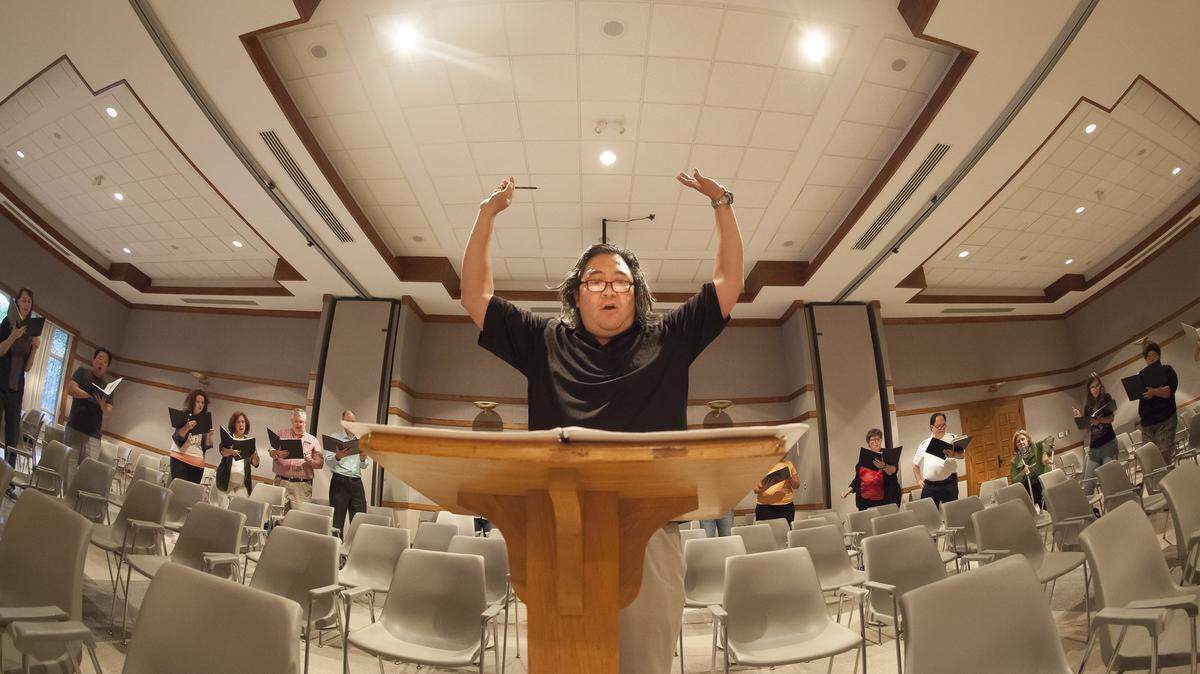
The proof will come in Vox’s April concerts. Director David Tang has paired an hour-long work by the world’s most popular living classical composer with a 40-minute piece by someone virtually none of us knows. One is a Passion – a setting of the end of Jesus’ life – and the other is simply full of passion, depicting Christ’s crucifixion.
Tang thinks Arvo Pärt’s “Passio” and Paul Carr’s “Seven Last Words from the Cross” will both be local premieres. Vox, the choral arm of the nonprofit Firebird Arts Alliance, will sing two concerts of the Pärt alone and two with both pieces; in the latter, he’ll substitute Carr’s “Seven Last Words” for the crucifixion portion of “Passio,” turning a soothing wave of sound into a tsunami.
“I think people who aren’t classical music listeners may enjoy this concert, if they’re adventurous,” he says. “It’s for people looking for a unique sonic experience and people looking for a profound spiritual experience centered around Jesus Christ’s self-sacrifice.”
Vox, now in its 12th year, traditionally does an Easter-related concert at this season: Bach’s St. John Passion, Brahms’ Requiem. This represents a double departure for the group, which will perform with five instrumentalists in the Pärt and a string orchestra, harp, organ and “pretty big battery of percussion” in the Carr.
“It’s a really different experience for the singers,” says Tang. “The rules are out the window with the Pärt: The score is laid out oddly, with the meter changing almost every bar and the number of beats in a bar having to do with the number of syllables in a word. The choral score is barebones, just four parts and a little bit of a cue to come in. I am transcribing a choral-vocal score like the ones we’re used to and reducing the vocal proportions to 16.
“The Carr will have 40 people. It’s got profound moments, too. He uses the (17th-century) poem ‘Drop, drop slow tears’ when Christ tells the thief ‘Today you shall be with me in Paradise,’ and it briefly takes on the thief’s perspective. But Jesus’ line to Mary “Woman, behold thy son” is shouted, and I haven’t reconciled myself to that. The challenge with this minor key music and aggressive articulation is not to be too aggressive.”
The classical music site Bachtrack analyzed more than 33,000 concert, opera and dance performances to determine the most played classical composers in the world in 2018. Pärt finished ahead of John Williams, Phillip Glass and all other living composers for the eighth year in a row. (He was 46th overall; the top three were Beethoven, Mozart and Leonard Bernstein, who slipped in ahead of Bach and Brahms in his centenary year.)
The Estonian composer, now 83, wouldn’t have made the top 200 in his youth, when his harshly atonal music offended officials in the Soviet Union. After converting from Lutheranism to Eastern Orthodox Christianity in the 1970s, he converted his composing technique to something he calls “tintinnabuli,” in which melodic and harmonic lines intertwine in slow, meditative paths. John Tavener, Henryk Górecki and Eric Whitacre sailed along in his wake.
“If you have heard a musical Passion, you’ll be used to angry crowds and vicious intense questioning in the trial with Pilate,” says Tang. “This is laid out smoothly: One critic said, ‘You can’t tell the difference between the crowd screaming “Crucify him!” and Jesus speaking quietly on the cross.’ The tonal center never shifts; just as in Gregorian chant, you have a limited number of pitches you’re allowed to use.”
The British-born Carr, who’s 25 years younger, cut his musical teeth at 20 on a samurai-sword film called “The Bushido Blade.” He has written film soundtracks and lived in Spain as an abstract painter but has spent most of the last decade writing classical music. He doesn’t believe in limits.
“Someone who sang this piece before told me, ‘People sing loud and high the whole time.’ It actually varies from triple piano to triple forte – it doesn’t exist much in between – and it’s challenging in terms of stamina, to figure out where to breathe during extended vocal lines,” says Tang.
“It’s well-written in a 21st-century (idiom): You go down a scale and slide into beautiful dissonances, very much in keeping with the way contemporary soundtracks use dissonance. It fits Mel Gibson’s ‘The Passion of the Christ’ in terms of intensity.”
Want to Go?
“Passio” performances are April 7 at 4 p.m. in St. Ann Catholic Church, 3639 Park Road, and 7 p.m. in Cathedral of St Patrick, 1621 Dilworth Road E. Performances of the slightly abridged “Passio” and “The Seven Last Words of Christ” are April 6 at 7:30 p.m. in First United Methodist Church, 501 N Tryon St., and April 14 at 4 p.m. in Sharon Presbyterian Church, 5201 Sharon Road. Details and ticket prices: voxfirebird.org.
This story is part of an Observer underwriting project with the Thrive Campaign for the Arts, supporting arts journalism in Charlotte.
This story was originally published April 2, 2019 at 1:24 PM.