
This dancer’s journey took her from war-torn Uganda to the Charlotte Ballet
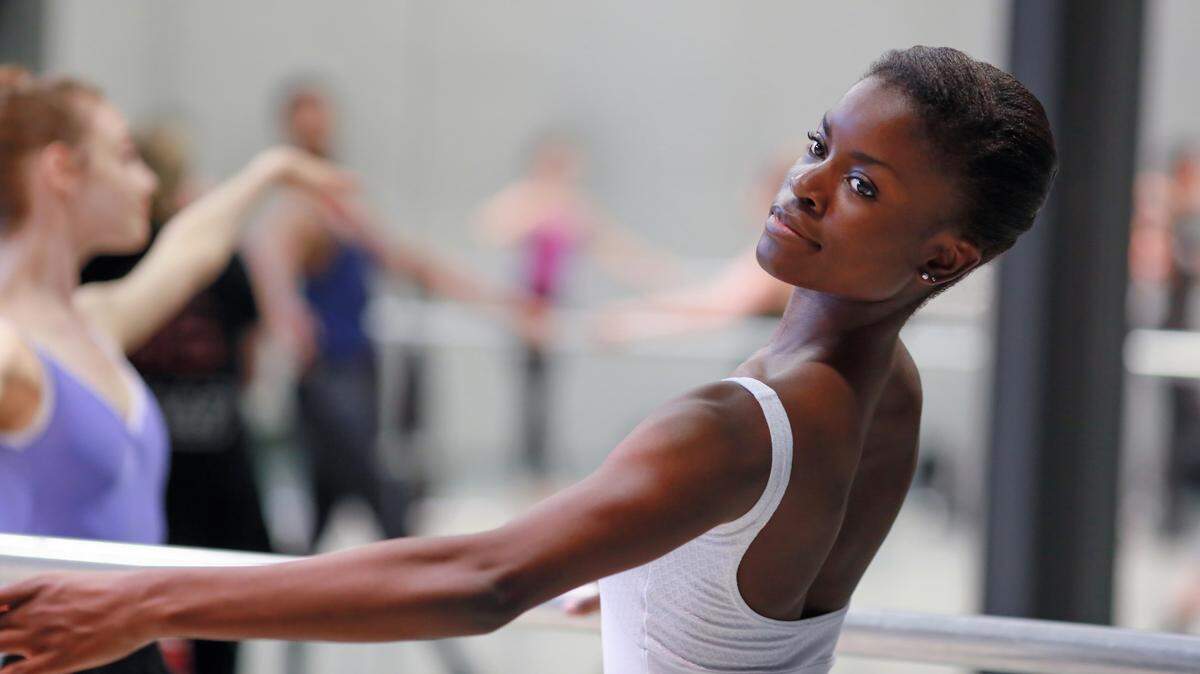
When she was 10 years old, Victoria Jaenson already knew what she wanted to be: a professional ballerina.
“People would ask, ‘Are there black ballet dancers?’ And I’d say, ‘None that I know,’ ” Jaenson said. “I looked at pictures of dancers and companies and videos, but didn’t see one (dancer) that looked like me.”
But Jaenson defied the skeptical remarks. Twelve years after first dreaming of becoming a ballerina, she now dances as a member of Charlotte Ballet II, a group of young dancers transitioning from students to professionals. She is one of a few black ballerinas nationally. In Charlotte Ballet’s Nutcracker, the holiday tradition that begins on Dec. 6, she will perform alongside members of the main company, second company and school.
Her journey to Charlotte began in her native Uganda, a war-torn country in central Africa. When she was 8 weeks old, she was adopted by Carol Jaenson, a former Vermont resident working for UNICEF. At 2 years old, she moved with her mother and brother Moses Jaenson to the Ivory Coast.
Three years later, her mother retired and the family moved to Guilford, Vt. Carol Jaenson was reluctant to raise two African-American children in Vermont because it lacked diversity. But she had always planned to return to a house she had built there, her daughter said.
The Jaenson kids were the only black students in their elementary school. Victoria Jaenson said they were “constantly teaching” other students about race and how to treat them.
“They’d never seen someone like us,” she said. ”And I didn’t really talk the first two weeks of kindergarten because I preferred to speak French.”
A beginning
When she was 8, Jaenson began ballet at the Brattleboro School of Dance. Because there weren’t other black ballerinas, she said she had to muster her own motivation. At times, she said staying optimistic was “very, very, very, extremely hard.”
At age 12, Jaenson had her first exposure to diverse dancers: a summer program at the Dancer Theatre of Harlem. The company, founded in 1969 by African American principal dancer Arthur Mitchell and Karel Shook, was one of the few that encouraged dancers of all races to train and perform. It remains as “one of the most democratic in dance,” its website says.
Jaenson said the students at the program made her feel comfortable and encouraged. She also had her eye on a particularly talented older student, Raven Barkley. Jaenson was impressed by Barkley’s intentional, exact movements. Jaenson said when Barkley danced, she seemed to fill the entire studio.
“I noticed (Barkley) that summer and thought, I want to work to be that good,” she said.
The Rock
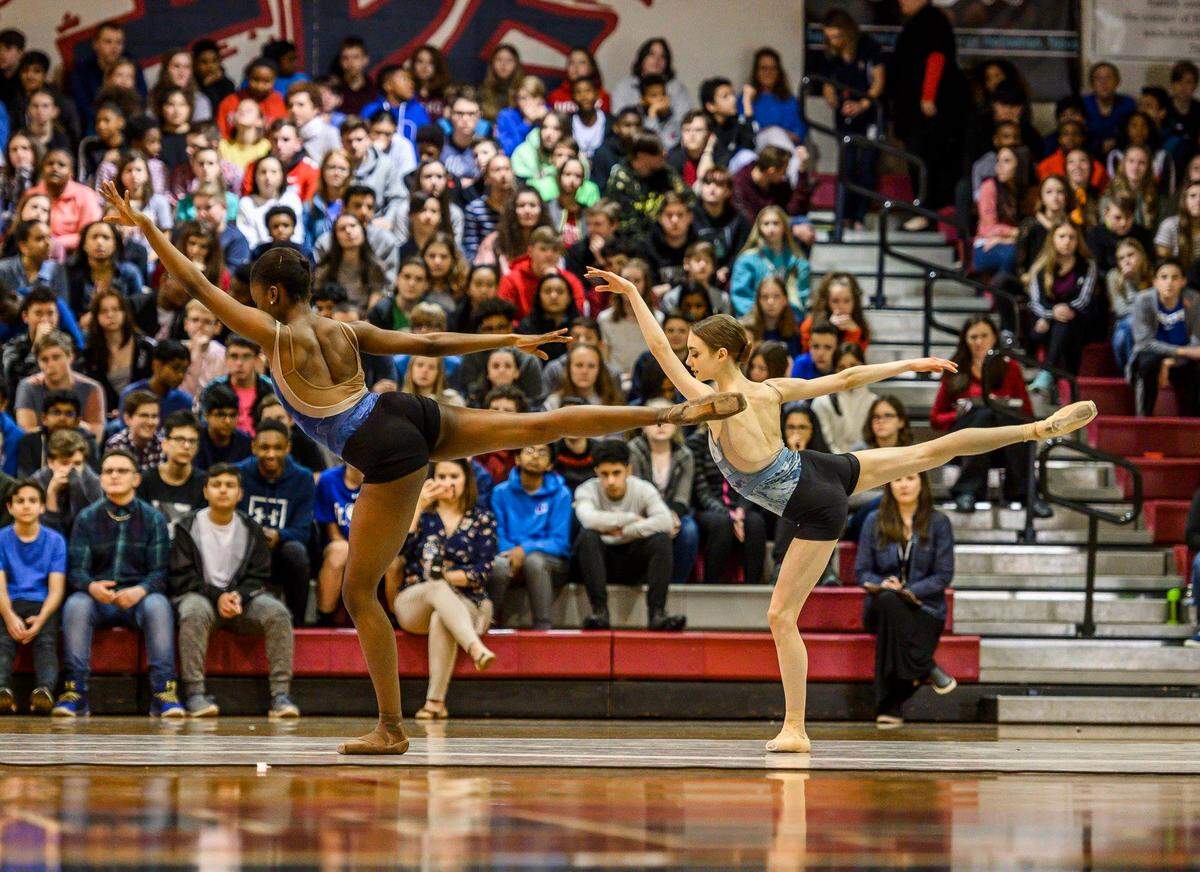
In her junior year of high school, Jaenson moved to Philadelphia to dance in the Rock School for Dance Education’s highest level. The school is acclaimed for training Sierra Leonean-American ballerina Michaela DePrince who was featured in the documentary “First Position.” But when Jaenson was there, she was the only black ballerina in their top level.
She was proud to represent diverse dancers.
“That makes me different, but not in a bad way,” she said.
In April 2015, Jaenson ran into another challenge. After numerous ankle sprains, Jaenson had developed a stress fracture in a bone in her foot. She finished the year on crutches.
For hours each day, she sat in front of the studio and watched the other students. It was disheartening. That summer, she had two pins put in her foot.
“It was very easy to think in the moment that I couldn’t catch back up,” she said.
She wasn’t fully back to dancing until that October. The experience gave her a new perspective.
“You won’t get back to the exact same place, but you’ll get back somewhere. I found different ways to work and rebuild my dancing,” Jaenson said.
Even once she was dancing again, it took a while to re-acclimate to pointe shoes and remember her intricate tendus and expansive grand jeté leaps. Part of the process, she said, was regaining the muscles in her legs.
Only one
Back on her toes, Jaenson would board buses at 6 a.m. on weekends to travel from Philadelphia to New York City for dance company auditions.
In February 2017, she boarded a bus to New York and an audition for the Charlotte Ballet. Jaenson was one of 200 auditioning dancers.
After initial cuts, she was one of 25.
Then, one of 16.
Following the audition, artistic director Hope Muir invited her to fly to North Carolina for a second-round audition for Charlotte Ballet II.
“I left not sure which way it was going to go,” Jaenson said. “Then, (Muir) offered (the spot) to another girl.”
Auditioning is stressful for dancers. Rejection can come from a number of factors — technique, expression, height. But for Jaenson, that stress had an added component.
“Is it because I’m black? Because I wouldn’t blend in with their company?” she said.
Despite the challenges ballet has presented for Jaenson — rejections, race and an injury — she didn’t let anything disrupt her plans.
“I was super determined to keep improving and dance as hard as I could,” she said.
Jaenson kept in touch with Muir. After Jaenson spent a year dancing at the University of Hartford’s Hartt School, Muir offered her a spot in Charlotte Ballet’s second company.
Now 22, Jaenson is in her second year as a Charlotte Ballet II member, dancing under second company director Mark Diamond.
“She’s very elegant and well spoken — someone I can depend on a lot,” Diamond said.
Coming to the Charlotte company, Jaenson said she felt very welcomed. And she was particularly excited about dancing alongside a familiar face from her days at the Dance Theatre of Harlem: Raven Barkley.
Diversifying the ballet community has been a slow process, Jaenson said. But she feels eager to represent her race and country. Now, when people ask if there are any black ballerinas, she’ll tell them they’re looking at one.
“I don’t know if I will ever meet another Ugandan-American who dances ballet,” Jaenson said. “It’s something I’m proud of sharing.”
This story was originally published December 17, 2019 at 6:00 AM.