
Former Observer reporter details hunt for Nazis in America in gripping new book
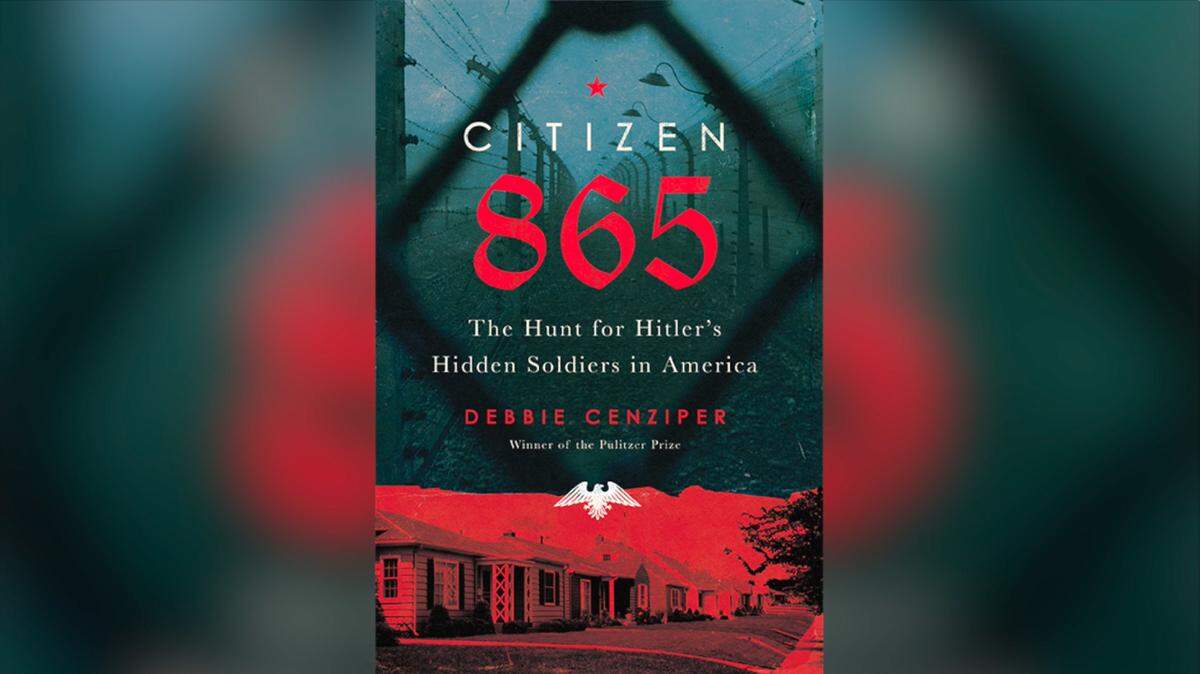
I have read fictional thrillers far less gripping than a new non-fiction book about the hunt for Nazi war criminals in the U.S. The book is “Citizen 865: The Hunt for Hitler’s Hidden Soldiers in America,” and the author is Pulitzer-winning investigative reporter Debbie Cenziper, a member of the Charlotte Observer’s investigative team from 1997 to 2002.
Using false identities, many of these Nazi fugitives settled in the U.S. after the war, starting businesses and families in neighborhoods where no one suspected their pasts. This book is the story of the Justice Department’s Office of Special Investigations’ (OSI) search for two of these people and its efforts to bring them to justice.
Cenziper, whose many awards include the Robert F. Kennedy Award for reporting about human rights, now directs investigative journalism at Northwestern University’s Medill School of Journalism. She is based in Washington, D.C., where she also writes for The Washington Post.
Question. You’ve written about corrupt affordable housing developers (this series won Cenziper a Pulitzer in 2007), dangerous breakdowns in the nation’s hurricane tracking system (this series was a Pulitzer finalist in 2006) and marriage equality (her book, “Love Wins: The Lovers and Lawyers Who Fought the Landmark Case of Marriage Equality,” came out in 2016.) What prompted you to write about the hunt for Hitler’s soldiers living in the U.S.?
At a New Year’s Eve party in Maryland, I met a lawyer from the Justice Department. Over a long conversation, she described a little-known unit deep inside the criminal division that had spent more than three decades hunting for Nazi war criminals in the United States. Though I had spent about ten years on staff at The Washington Post, I knew very little about the unit or its mission.
I left the party that night struck by the fact that Nazi perpetrators were still living on U.S. soil more than seven decades after the end of the war – how was that even possible?
And I wanted to know more about the prosecutors and historians inside the Justice Department who had spent years probing some of the darkest moments in modern history. It wasn’t just a matter of interviewing survivors and witnesses, but also killers who described mass murder in the most clinical terms. I couldn’t imagine how the DOJ investigators were able to go home at night to ordinary lives – to spouses, children, parents, baseball games, anniversary trips. I very much wanted to tell their stories.

Q. The investigations you write about mostly focus on Trawniki, a Nazi training camp in occupied Poland, where Jakob Reimer (Citizen 865) and about 5,000 other SS recruits were trained to round up and slaughter the Jews of Poland. Why is it we’ve heard so little before about Trawniki?
First, it’s important to know that the Trawniki training camp, in every sense, was an SS school for mass murder. On the grounds of an abandoned sugar factory in the tiny Polish village of Trawniki, recruits like Jakob Reimer were trained, armed and then deployed on deadly missions across occupied Poland. Without the men of Trawniki, there is no way the SS could have murdered 1.7 million Polish Jews in fewer than 20 months.
After the war, the Trawniki men ditched their uniforms and identity papers and scattered across Europe. We know now that more than a dozen came to the United States by lying about their activities and whereabouts.
For years, western scholars knew the Trawniki camp had trained men for guard duty at SS-run killing centers. Critical details, however, were on Nazi rosters and records buried in the archives of Communist countries. Cities such as Kiev, Moscow and Prague did not open their archives to western investigators until Communism collapsed in the late 1980s. Once Justice Department historians were finally able to mine the archives, the story of Trawniki came into focus.
In the end, the Justice Department significantly expanded the record of Holocaust history — and identified a series of Trawniki men hiding in plain sight in American cities and suburbs.
Q. How difficult would you imagine it to be to convince non-Jewish citizens, such as the ones rounded up to be trained at the Trawniki camp, to believe that Jews should be extinguished? What kind of brainwashing effort does this require — to become, as you call them — foot soldiers of the Final Solution?
I don’t think much brainwashing was involved. Trawniki recruits came from Eastern Europe, with a long history of anti-Semitism. Others were captured Soviet soldiers pulled from German POW camps. There, they had faced starvation, disease and death. Once recruited by the SS, they were given meals, wages and medical attention.
Jakob Reimer — the most trusted Trawniki man found on U.S. soil — received paid vacations, four service medals and the promise of citizenship in Nazi Germany at the end of the war.
It wasn’t a bad life by wartime standards. Some Trawniki men did desert the unit, but Reimer and many others faithfully stayed on to serve the Reich until the very end. It may not have been the life they chose, but it was a life that allowed them to survive (and perhaps even thrive) during the war.
Q. Juxtaposed with the story of the hidden Nazis, Reimer and John Demjanjuk, is the captivating story of the Jewish teenagers Lucyna and Feliks, who fall in love in the ghetto of Lublin, Poland, and survive, managing through luck and pluck to escape Europe after the war and make their way to America, where he practiced medicine and they raised a family. How do you account for such super human wills to survive, though beaten down and bone tired?
I stayed up until 2 a.m. one night listening to the videotaped stories of Feliks and Lucyna. I hung onto every word. Throughout his life, Feliks often said that he and Lucyna weren’t any smarter or stronger than anyone else on the run from the Nazis. They were just in the right place at the right time during essential moments.
They also had parents who made a series of strategic, heart-wrenching decisions to keep them alive. It didn’t hurt that Feliks and Lucyna loved each other very much — I think that gave them a reason to go on after their families were murdered. I just had dinner a few weeks ago with their children and grandchildren. “Where once there was nothing,” Lucyna liked to say, “now there is a family of 11.”
Q. I cannot get enough of reading about the Holocaust. It’s a morbid fascination with how human beings can treat other human beings with such horrific cruelty and degradation. As you worked on this book, did you come any closer to understanding what possessed the Nazis to engage in such willful evil?
I wish I could answer that, much like I wish we could adequately make sense of the hate crimes and violence that we’re seeing both here and abroad. It’s horrifying and unthinkable. The historians at the Justice Department spent their entire professional careers trying to understand the past to help build a better future. Given current events, I sometimes ask myself whether they were successful.
Q. At any time in the process of researching and writing this book did you waiver about whether these hidden Nazis — whose acts, though dastardly, took place decades ago and who were now likely in their 70s and 80s — should, in fact, be stripped of their US citizenship, deported, tried and possibly imprisoned?
The historians and prosecutors at the Justice Department faced that question year after year. They were prosecuting people who looked like ordinary Americans, men in their 60s, 70s and 80s who married American women, went to church, earned pensions, lived quiet lives. In the Jakob Reimer case, the judge urged the Justice Department to leave that “poor old man” alone.
The people at the Justice Department often asked: Does the passage of time excuse mass murder? How many years did we search for Osama Bin Laden? Why should it be any different for those who participated in the Holocaust?
Trawniki men violently liquidated the Jewish ghettos, participated in mass shooting operations and guarded labor camps, concentration camps and killing centers — where Jews were forced off trains and sent directly to their deaths in gas chambers. After the war, these men slipped into America with a visa that should have gone to a survivor or war refugee.
In the eyes of the Nazi hunters, the men took something that they shouldn’t have been granted in the first place. Why should they be allowed to grow old here, alongside survivors as well as war veterans who had crossed an ocean to free them?
Q. What is your secret to making investigative journalism read like a novel?
Details and dialogue. I see my sources as characters, events as scenes. I do a massive amount of online and on-the-ground research. I traveled to four countries to retrace the steps of Feliks, Lucyna and the historians and prosecutors at the heart of this book. I talked to Polish historians about the way people dressed and ate in the 1940s. I reviewed hundreds of old photos in the United States and Poland to build a better sense of place. I used emails, court transcripts and videos to re-create dialogue.
As a newspaper reporter, I learned early on how to write in a concise way. Space (at least in print) is at a premium — and readers move on quickly. In writing nonfiction, I’ve learned to let the story breathe more, to slow things down. It is a different kind of writing and it took me quite a while to get into the rhythm of it.
Q. What did you learn about human nature during the research for and writing of this book?
So many things. In telling the stories of Feliks and Lucyna, I was particularly moved by the many acts of courage by non-Jews in occupied Poland. Without them, there is no way Feliks and Lucyna would have survived the war. It made me think hard about empathy, compassion, risk and selflessness.
I was also inspired by the work of the Nazi hunters. As an investigative reporter, I pick stories about theft, corruption, mismanagement, waste. I am proud to say I got my start at The Charlotte Observer, learning and growing under the late Frank Barrows, an incredible mentor and guide.
As a nonfiction author, I pick stories about people who move and inspire me. It’s been a nice change of pace. In this book, I focused on men and women who, despite great odds, managed to hold Nazi murderers and collaborators accountable for their crimes decades after the end of World War II.
It’s the reason I like to say that Citizen 865 is a story about darkness but also about light.