
This Charlotte artist wants to foster inclusive dialogue through Levine Museum murals
Two years ago, a pair of Davidson College students were accused of posting racist and anti-Semitic comments, which led to calls for change from the campus community. For artist and 2020 Davidson College graduate Makayla Binter, it wasn’t enough.
A Charlotte resident, Binter was tired of hearing familiar rhetoric after any type of racial or hate-infused incident.
“The same student leaders coming up to the microphone saying how tired they were,” said Binter, 22. “The same student leaders saying we need change; we need action. It’s stuff I’ve heard before but never actually seen put into place.”
In the summer of 2019, Binter decided to address the issues by painting murals on two 6-foot-by-5-foot double-sided wood panels and displaying them in a prominent location on the Davidson campus. Her vision: provide a way to foster dialogue in an inclusive environment.
She applied for a grant from Projects for Peace, a program supporting grassroots initiatives started by college students and received $10,000 for the project.
What she didn’t know at the time was that the panels would travel throughout Charlotte, be viewed by audiences at the Levine Museum of the New South and be repainted to embody new ideas and express other artists’ views.
Designing the panels
It was important to Binter to include the Davidson College community in the development of the mural panel project.
She asked Adelle Patten, a senior studio art student at Davidson, and Stewy Robertson, a 2015 Davidson graduate, to help paint the panels. She surveyed faculty, staff and students about what topics to cover in the panels and four emerged: classism, colorism, homophobia and racism.
Binter also requested feedback from the campus community about the preliminary drawings she sketched based on her research of Davidson’s history.
The panels took three weeks to paint with acrylic and spray paint. Blackboard paint was mixed in so that the community could interact anonymously with the art by writing on the panels with chalk.
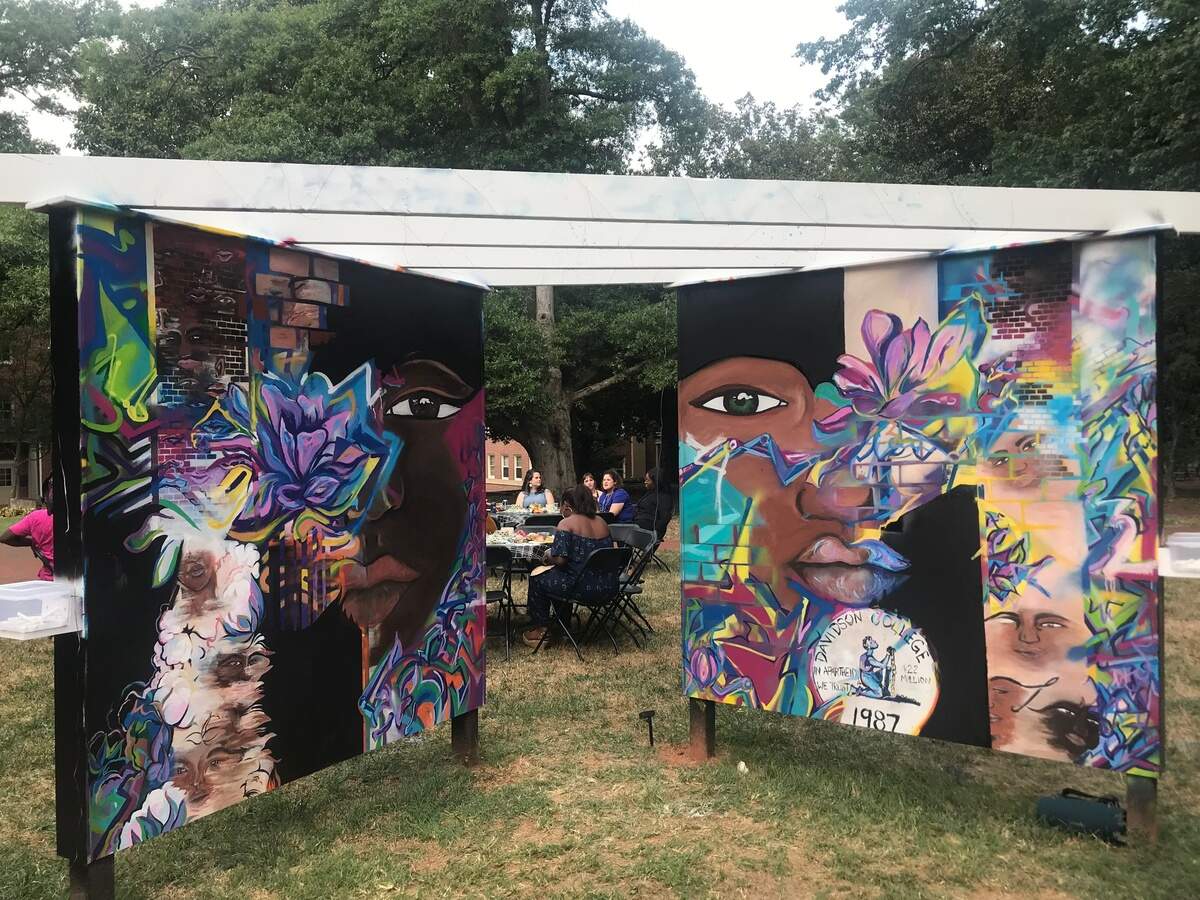
The history of the campus was incorporated into the works, specifically when women and Black men were able to attend Davidson and how enslaved people played a part in building the campus.
“There are Black people’s faces fading in and out of the bricks and pillars,” Binter said. “That history has been washed away but is remembered by the people who look or investigate or are descendants of those enslaved people.”
Flowers are prominent throughout the panels, honoring the Magnolia trees on campus but tying them back to singer Nina Simone’s rendition of Billie Holiday’s “Strange Fruit.”
Last fall, when Davidson students returned to campus, the panels stood in front of the Chambers Building, one of the main academic buildings on campus.
Binter curated a showcase with a poetry reading and a dance performance to introduce the panels to the community. A music playlist and a list of books were made available for community members to learn more about each of the topics.
“I wanted to make sure people could enter the conversation however they saw fit,” Binter said. “A lot of the feedback that I got was about people wanting different ways to engage in the conversation. I wanted to give as many examples as possible.”
Reimagining the panels
When the exhibit at Davidson College was finished in May, Binter reached out to Eric Scott at the Levine Museum of the New South. Binter proposed bringing the mural panel project to the museum.
“It was an easy yes,” said Scott, director of exhibits and programs at Levine. “Her work seemed to fall right in line with what we were launching with a new program called, ‘What’s It Going to Take.’ She wanted to use these panels as an opportunity to address the emotions and frustrations and different experiences of people in Charlotte by inviting them to contribute their artwork to these panels.”
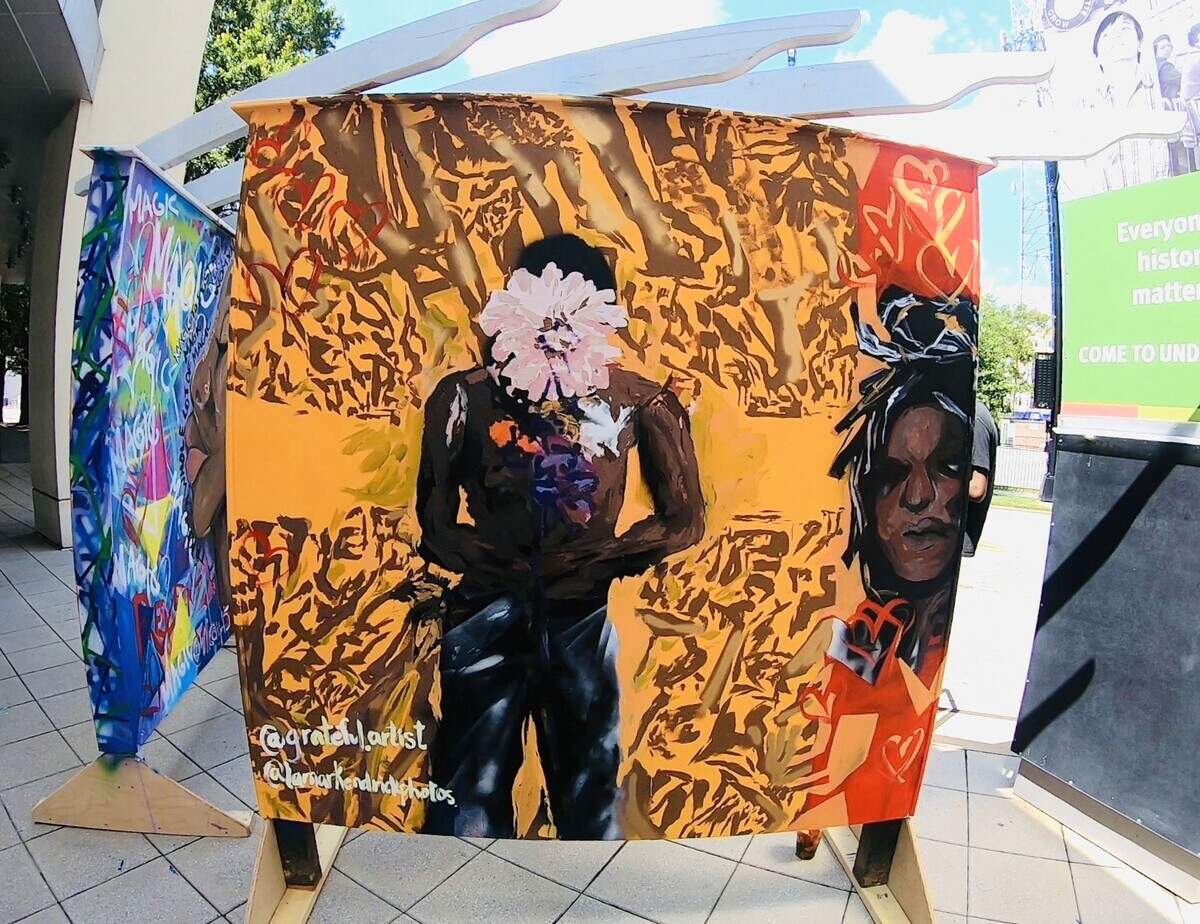
On July 3, Binter and three other artists — Patten, Matthew Clayburn and Lord Phly — painted live on the front porch of the Levine Museum. Binter raised $1,000 through GoFundMe to pay the artists.
“We had a fun painting day showcasing not only our emotions but depicting images of empowerment and perseverance that we felt during this time,” Binter said.
Patten painted a version of local photographer Lamar Kendrick’s self-portrait where he is holding flowers in front of his face. Patten added a border of abstract fists and people marching and protesting.
She attributes a change in her practice to Binter’s influence and the mural panel project experiences. Her work with digital art had previously focused on graphics and structure.
“She’s inspired me to make art that confronts issues of social injustice,” Patten said. “I’m more passionate about unearthing what’s not commonly known about social injustices.”
Hard to ignore
Binter grew up in Rochester, N.Y. She studied biology and studio art at Davidson and teaches high school art and biology at Charlotte Country Day School as part of its Hearst Teaching Fellowship.
She’s currently working on the West End Youth Mural with funding from the 8 80 Cities and the John S. and James L. Knight Foundation.
Binter and artists Tyrice Adams, DeNeer Davis, Michael Grant, Ricky Singh and Frankie Zombie are creating a mural on the outdoor basketball court at the West Charlotte Recreation Center. Each artist will mentor a group of students, guiding them through the creative process.
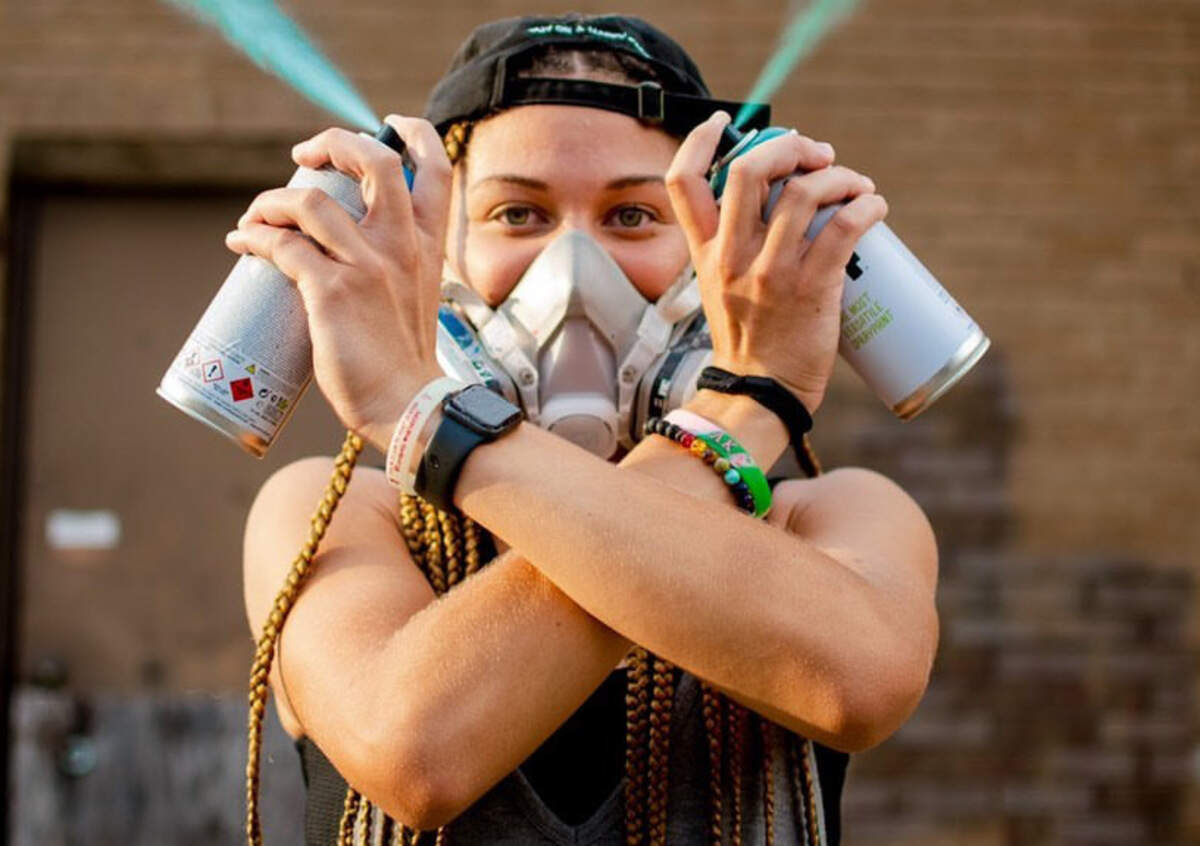
The mural panel project lives on. Another iteration will be on display at Charlotte Country Day this year. The panels will be a segue for students to enter difficult conversations, Binter said.
The panels will also be repainted by high school art students. Students will examine the school’s past, present and how do they, as students, play a role in what they want the school’s future to become.
“Looking back, I think the panels did exactly what they needed to do.
“ It provided a safe space for Black students and people of color to write their responses, their words and their experiences,” Binter said. “I thought about it as the project would provide visualization and representation all the time, something that would be terribly hard to ignore, like the subjects are for the people who live them.”
This story is part of an Observer underwriting project with the Thrive Campaign for the Arts, supporting arts journalism in Charlotte.
More arts coverage
Want to get more arts stories like this delivered to your inbox? Sign up for the free “Inside Charlotte Arts” newsletter at charlotteobserver.com/newsletters
You can also join our Facebook group, “Inside Charlotte Arts,” at https://www.facebook.com/groups/insidecharlottearts/