
‘Timelessly relevant.’ Artist Tommie Robinson’s 50-year legacy in Charlotte.
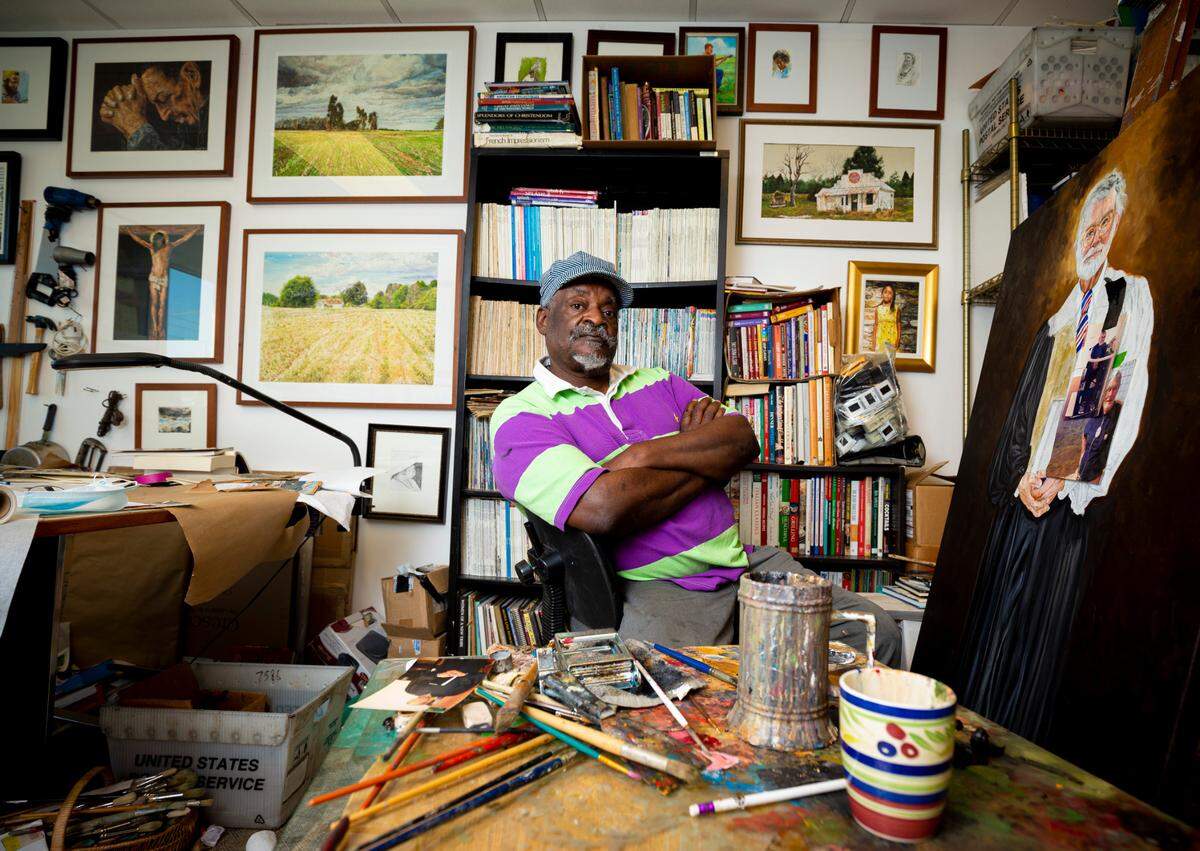
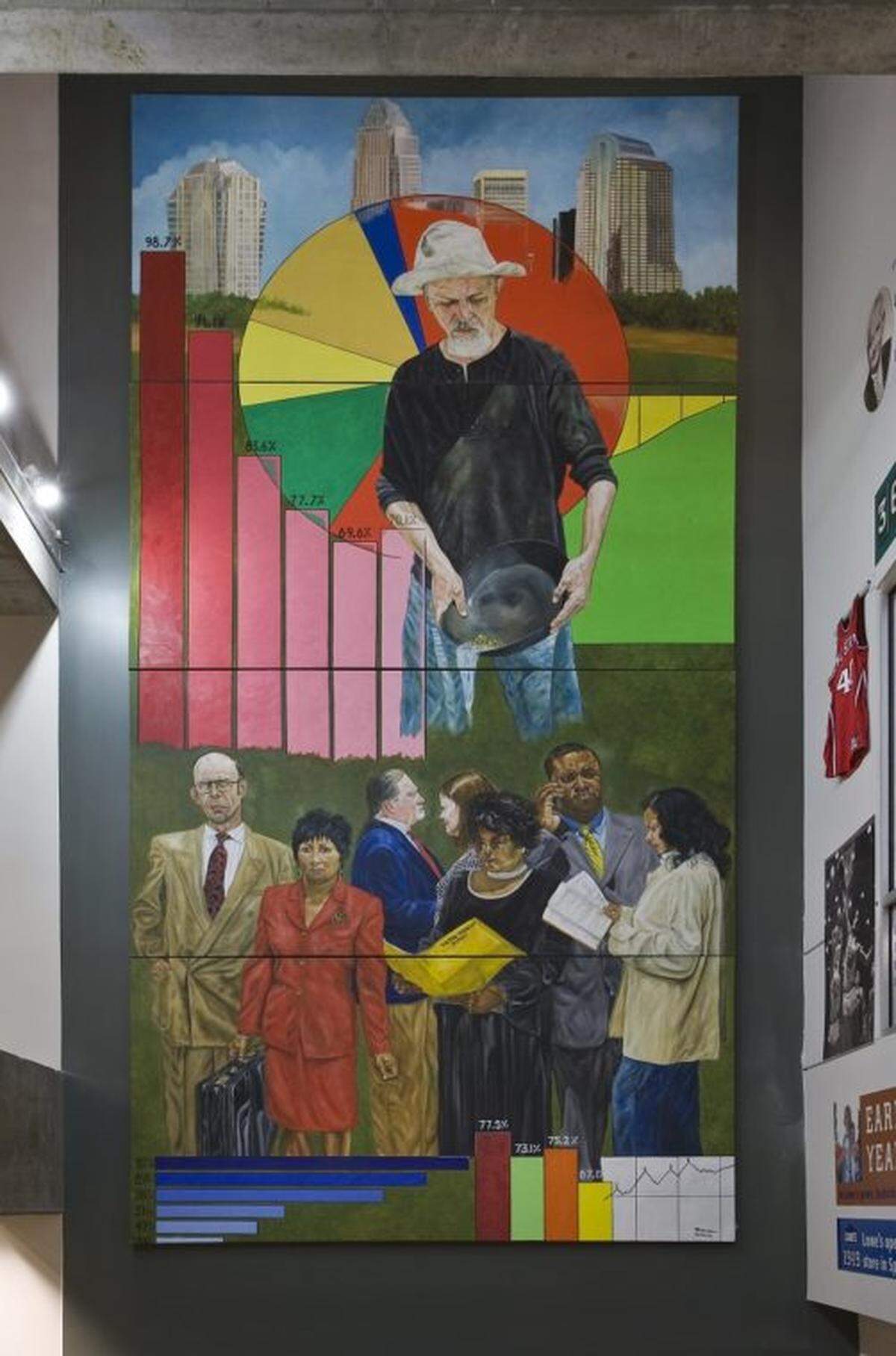
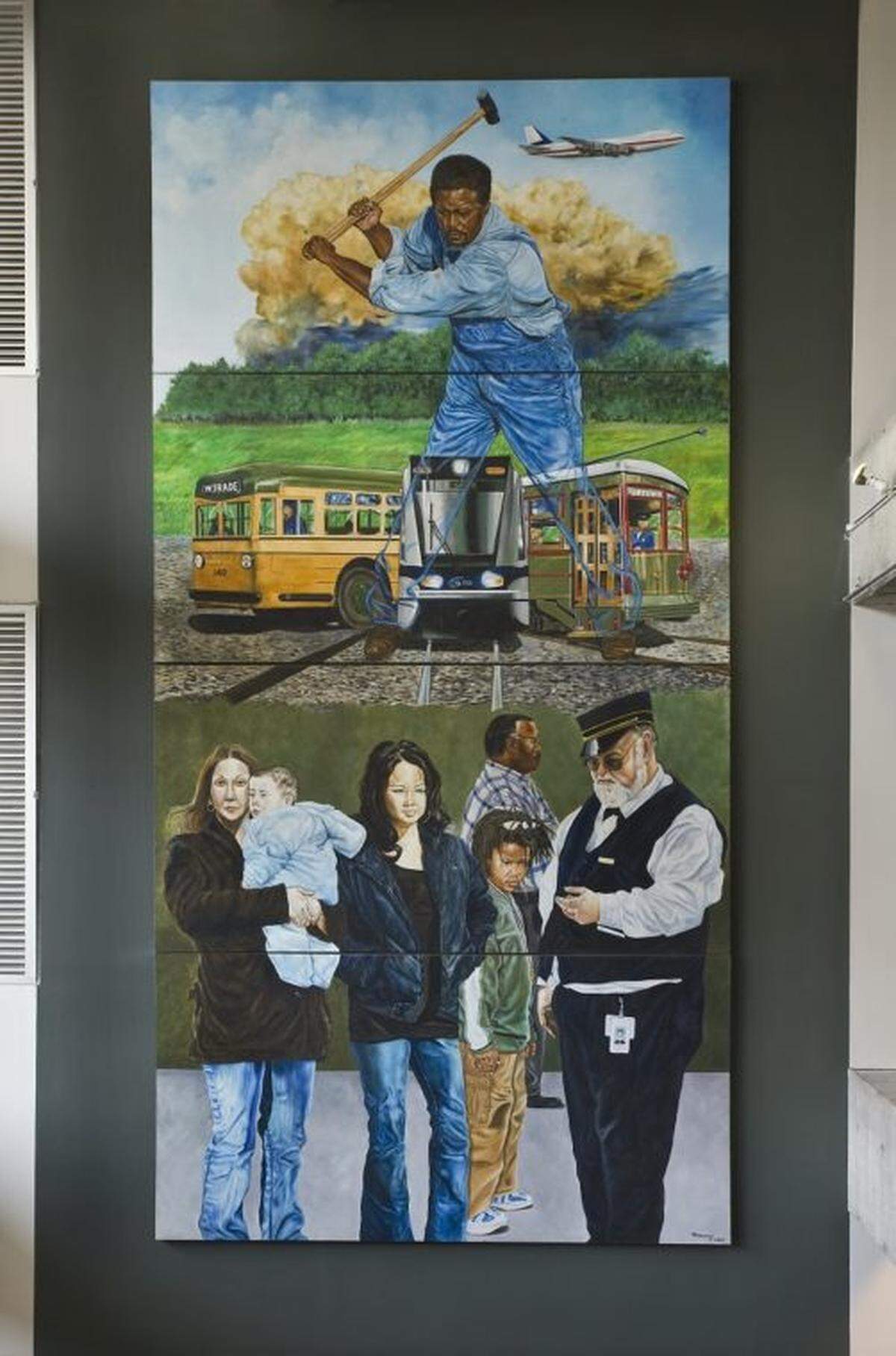
Charlotte artist Tommie Robinson’s legacy is etched into the bones of Charlotte. Examples from his 50-year career are seen across the city, from large-scale murals in the Spectrum Center to triptychs at Friendship Missionary Baptist Church casting parishioners in scenes from the Gospels.
Chances are you’ve seen one of his pieces.
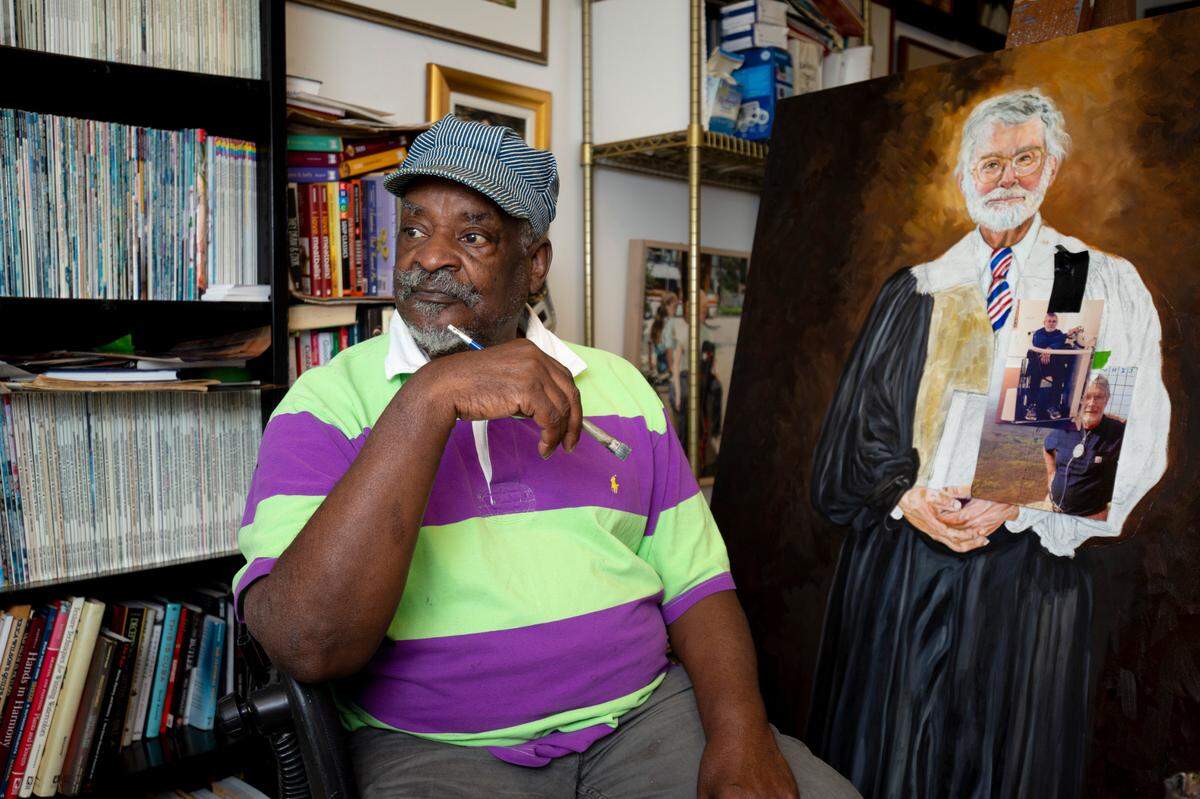
When his latest commissioned project is completed, Robinson will make history as the first Black artist whose portrait of a judge will hang in the Mecklenburg County courthouse. The portrait of longtime Chief District Court Judge James Lanning is scheduled to be installed in December. Lanning died in 2015.
“As Charlotte has grown as a city, Tommie Robinson has been part of that growth in the way he depicts the city,” said David Taylor, CEO of the Harvey B. Gantt Center for African-American Art + Culture. The Gantt Center has dozens of Robinson’s works, spanning several decades and subject matter, from Black life in Charlotte to ecology.
“He depicts Black culture in a way that’s timelessly relevant,” Taylor said. “He’s been able to do it such a long time, the hard way. He didn’t have the doors of major institutions opening up initially, but he had the support of the community, which saw itself in his work.”
The hard way
As a boy, Robinson always loved to draw, but at age 7 his father’s death was a catalyst of pain. To cope, Robinson began working on his first real portrait. He was 12 before he finished it.
He credits his mother with believing in him before he was able to believe in himself. She would bring home paper dry cleaning bags, then at night after dinner let him cut them up and draw on them. She even allowed him to draw on the walls of his bedroom.
“My mother was one of the hippest ladies you’ll ever see,” Robinson said in a recent interview. “I loved (drawing), I loved mixing colors and learned it wasn’t mixing, but the molecules got next to each other and fooled the eye. She encouraged that desire to learn in me.”
As a teen, though, he wasn’t really aware of art history, techniques or aesthetics. He began to rectify that via the bookmobile, which would come to Black neighborhoods because the main library didn’t allow entry to African-Americans.
“I checked out every art book they had on drawing or painting,” Robinson said. “The white woman who ran it noticed and asked me to show her my art. She started sneaking me in early Saturday mornings and I’d hide in the reference section between the big books. Then when I was done they’d let me out of the back door.
At 17, Robinson joined the Army and was sent to Europe. Fellow soldiers would pay him to paint portraits of their wives and girlfriends. Robinson churned out one a night, earning more money than his commanding officer. He remained in Germany for a few years after being discharged, soaking up more art experience at the cathedrals and the Louvre.
Life as a full-time artist
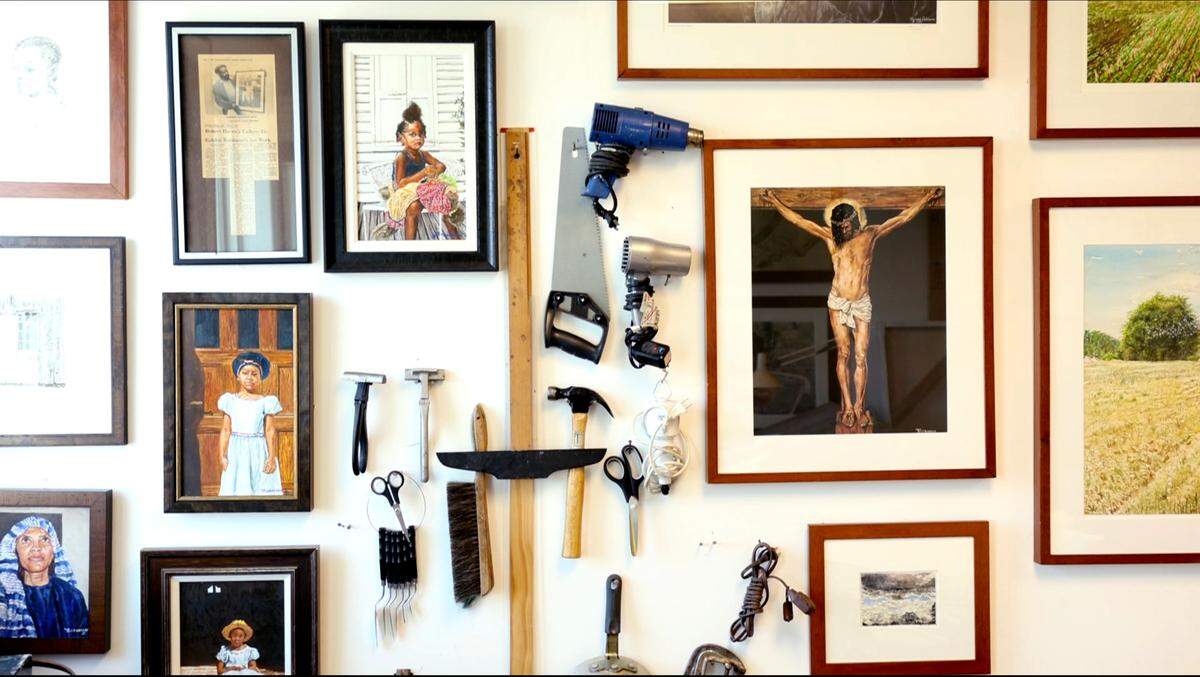
Upon returning to Charlotte at 22, he still didn’t believe he could make a living as an artist. But drawing and painting was his compulsion.
“I had 23 jobs in two years,” he said. “I had to be an artist.” He enrolled in art classes at Central Piedmont Community College, where he was hired as a visual arts teacher. He got his first studio at age 24 and began life as a full-time artist.
Robinson spent the next 50 years in various studios, taking large-scale commissions that afforded him space in between to develop a personal style that captured and illuminated everyday people, including the indigent.
“You can find art in anything, poverty has nothing to do with it,” he said. “In fact poverty produces some of the better art.” Robinson began painting homeless Charlotteans because his studio was downtown and he used to see them all the time.
“They were my friends,” he said. “They knew me well. I’d talk to all those folks, sometimes give them some money to buy some wine. It’s not that much difference between us.”
Robinson was sometimes mistaken for being homeless himself. “Once, a rookie police (officer) stopped me. This is back when I was in my 30s and I used to drink, I’ve since quit for 25 years. Anyway, he didn’t think I belonged there. Another policeman pulled up in his car and told him, ‘That’s Tommie Robinson, the artist. He makes more money than you do.’ ”
Social justice
Always a figurative artist, Robinson drew inspiration from community members, the environment and social justice.
His work has been featured internationally, in state museums and at the Gantt, Mint Museum and Urban League of Central Carolinas.
Last year, he completed two paintings in Second Ward High School Gymnasium: “We Too, Shall Rise” and “Go Tigers!” They embody the spirit of Charlotte’s first all-Black public high school, now a community rec center.
Robinson will be the first Black artist to paint a portrait of the judge that will hang in the Mecklenburg County courthouse.
To Robinson, that says more about Mecklenburg County than his art or the quality of Black artists. “People are excited but, I mean, it’s 2020,” he said with a laugh. “Not 1820 or 1920. It’s 2020.”
Robinson is torn between support of Black Lives Matter demonstrations and cynicism that American society will substantively change. He’d rather see Black people finance their own properties and manufacturing than put so much energy toward eradicating racism.
“We’re taking on the burden of making it a just society, and meanwhile everybody in America has more than we’ve got,” he said. “When we’re out demonstrating, everyone else is progressing.”

Work ethic
One thing Robinson is known for is an incredible work ethic. From the start, he worked at his craft seven days a week. Now 73, he only started taking Sundays off two years ago. His studio is more than a place of work, it’s a sanctuary where he reads, listens to music, finds privacy and rests his mind.
It also functions as a salon of sorts, where he meets with peers, muses and younger artists seeking to learn. Nothing irritates Robinson like hearing natural talent praised in place of hard work.
“I’m an artist, and I’m tired of people saying it’s a gift from God,” Robinson said. “Nobody knows the hours I spent on the floor trying to perfect perspective.”
‘A good role model’
Sunya Folayan, a textile weaver and multi-disciplinary artist, counts Robinson among her mentors.
“I have found him to be very supportive of me as a woman in the arts,” she said. “He knows a lot of history, reads all the time and is very knowledgeable about his medium. He stresses the importance of creating a body of work, whatever the medium is. “
Prominent Charlotte abstract artist Juan Logan has known Robinson for 40 years.
“I think Tommie’s been a good role model in terms of what it takes, a sense of loyalty and dedication to the cause,” Logan said. “You have to work at it constantly. We say we’re artists, but to lay claim to that you have to put in the work. Saying so doesn’t make it so.”
Logan has watched Robinson’s work evolve over the years, and appreciates the subtle pushes in his work.
“Tommie is constantly refining his craft,” Logan said. “It’s all about your involvement; it won’t happen looking at an empty canvas. You have to invest yourself in it. And he’s done just that.”
Leaving a legacy
Robinson is working on a series of paintings featuring Black women. But unlike most artists who turn toward feminine subjects, his models are mature women.
“I think older women are just as beautiful, so I ask my friends,” Robinson said. “We don’t see the beauty in us a lot.”
One of Robinson’s favorite muses is Wanda Hairston, a 58-year-old tax preparer. She met Robinson waiting tables over 30 years ago. Robinson has dozens of paintings, drawings and sketches of her, spanning her 30s, 40s and soon her 50s.
“She’s just a beautiful person,” he said. “She knows my process and she loves it because she’ll be around for 500 years.”
Hairston said she’s only seen one fully completed painting of herself, in a gallery.
“It was like an ah-ha moment, seeing my painting,” she said. “Like somebody hearing their song on the radio or seeing their picture in a magazine. Tommie painted me how he saw me. It was a subtle picture. Seeing yourself on a canvas that someone took the time to paint, there’s no words for that.”
Still, “the painting is not for you, it’s for the artist,” Hairston said, adding that Robinson pays her to sit. “I asked him if he would give me my sketches in his will. He said he’ll think about it.”
Robinson is determined to create the most complete body of work he can, and that drive is what draws him to his studio at Hart Witzen Gallery and Studios on North Tryon Street for 10-12 hours a day, six days a week.
“He often talks about leaving a legacy,” Taylor said, “but he’s already built one that we can see.”
Justice
What: SouthEnd ARTS presents its first curated “Justice I” art exhibition, a virtual event that will be available on Facebook Live, IGTV, YouTube, and the SouthEnd ARTS website. Charlotte artist Tommie Robinson is the keynote speaker.
When: 7 p.m. Oct. 2
Cost: Free
Details: southendarts.net
This story is part of an Observer underwriting project with the Thrive Campaign for the Arts, supporting arts journalism in Charlotte.
More arts coverage
Want to see more stories like this? You can join our Facebook group, “Inside Charlotte Arts,” at https://www.facebook.com/groups/insidecharlottearts/
You can find all of our arts season preview stories in one place: https://www.charlotteobserver.com/topics/charlotte-fall-arts-2020