
Artificial intelligence museum exhibit offers view into machines’ minds — and our own
We’re surrounded by artificial intelligence, our unblinking, untiring, unseen sidekick.
Siri, Alexa and rest of their invisible harem dispense on demand the sum knowledge of mankind in soothing tones. Our phones check traffic to plot the shortest route to our destination or identify the nearest deep-dish pizza joint. Netflix and Amazon anticipate our desires and propose available goodies.
Artificial intelligence, “AI” for short, has shot us into a magical age, an era of personal genies granting whims in a snap.
“AI is all around us, being used in ways we can’t imagine,” said HP Newquist, computer historian and developer of “Artificial Intelligence: Your Mind & The Machine,” a new exhibit at Discovery Place that traces the history of thinking machines and the quirky path they took into our lives.
The museum reopens Friday, after a mid-January closure to follow COVID-19 health recommendations in Mecklenburg County. (Discovery Place Kids will reopen Wednesday.)
AI in history
Notions of artificial intelligence — and the creatures it powered — have been around since ancient times, Newquist said. Greek mythology tells of Talos, a big bronze brute sent by the gods to protect Crete. He’d stomp around the island thrice daily and, at every glorious opportunity, hurl boulders at pirates.
There’s a tale about philosopher and math whiz Rene Descartes (“I think, therefore I am”) that has him building an automaton named Francine about 1625. He took the robot to sea only to have the astonished captain pitch it overboard when discovered. Back then, it was considered bad luck to have women aboard ships, or at least it was for Francine.
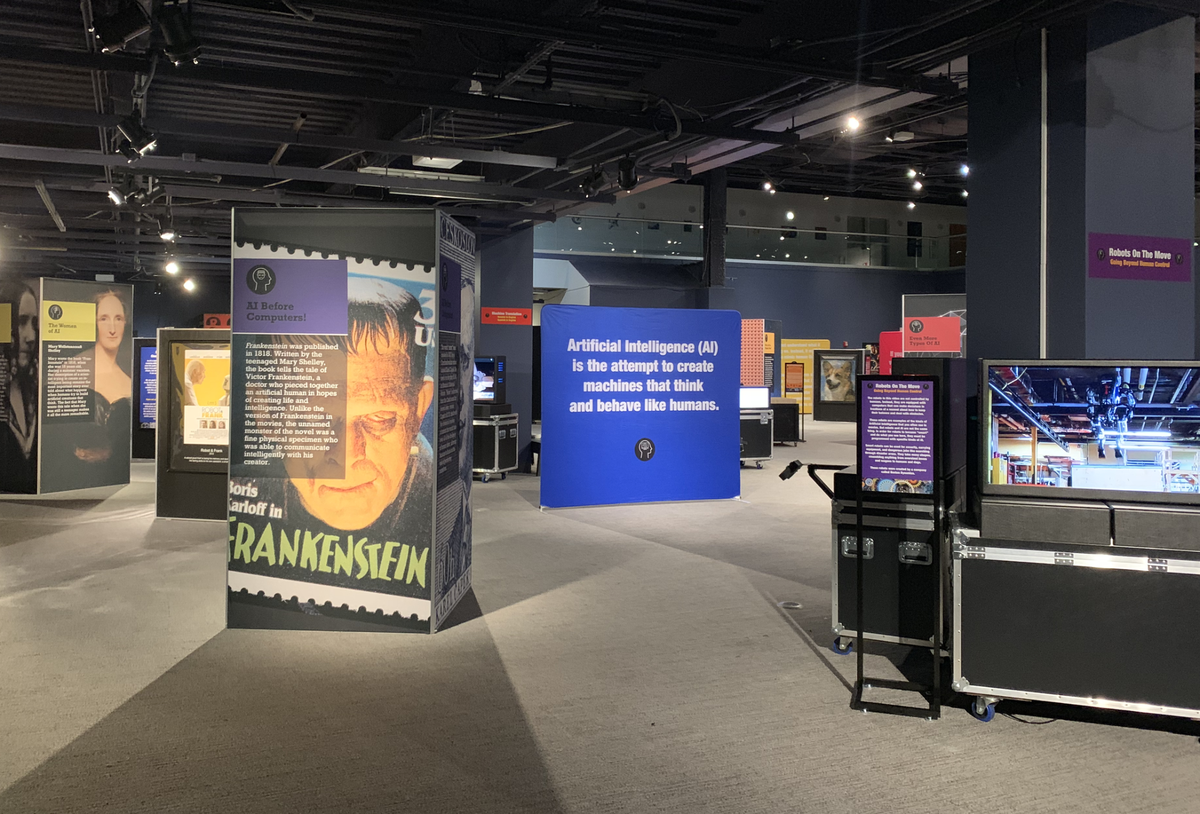
But it was the imagination of women that has been pivotal in the development of AI, the exhibition shows. It was Mary Shelley, who in 1818 penned the novel “Frankenstein” that envisioned a brilliant scientist who created a being from cadaver scraps and a thunderbolt, and hey, what could possibly go wrong?
Then came Ada Lovelace, the first computer programmer. In the 1840s — yes, the century is correct — she figured out how to plunk algorithmic logic into a math machine the inventor Charles Babbage had conceived.
It was Fei-Fei Li, a Chinese-born scientist and now a Stanford University professor, who sparked a giant leap in AI a decade ago, when she trained neural networks to scan the Internet and recognize images of dogs and cats and later other objects.
Facial recognition, driverless cars and robots that can navigate difficult terrain followed. “At the core of AI,” Newquist said, “is machines making decisions.”
In the mind of AI
In the exhibit, you can virtually ride in a self-driving car and see the streetscape as the computer perceives it — here’s a truck, here’s a car, here’s a pedestrian. (Oops, maybe not — maybe just a poster of a person on an advertisement.)
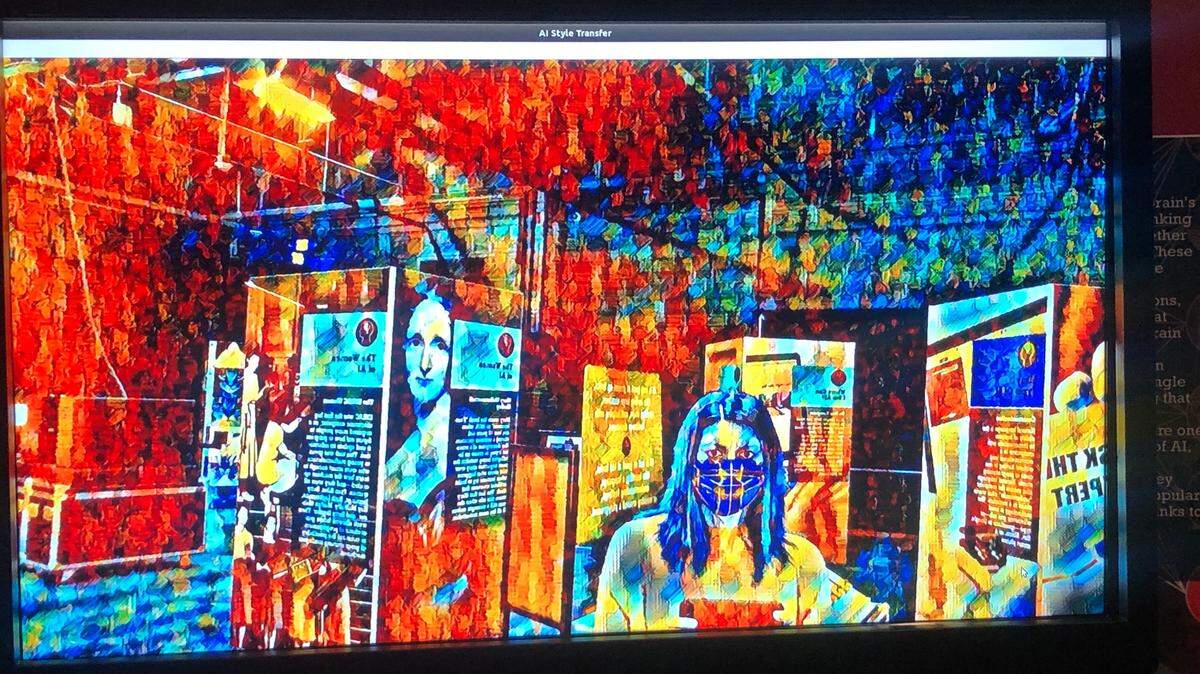
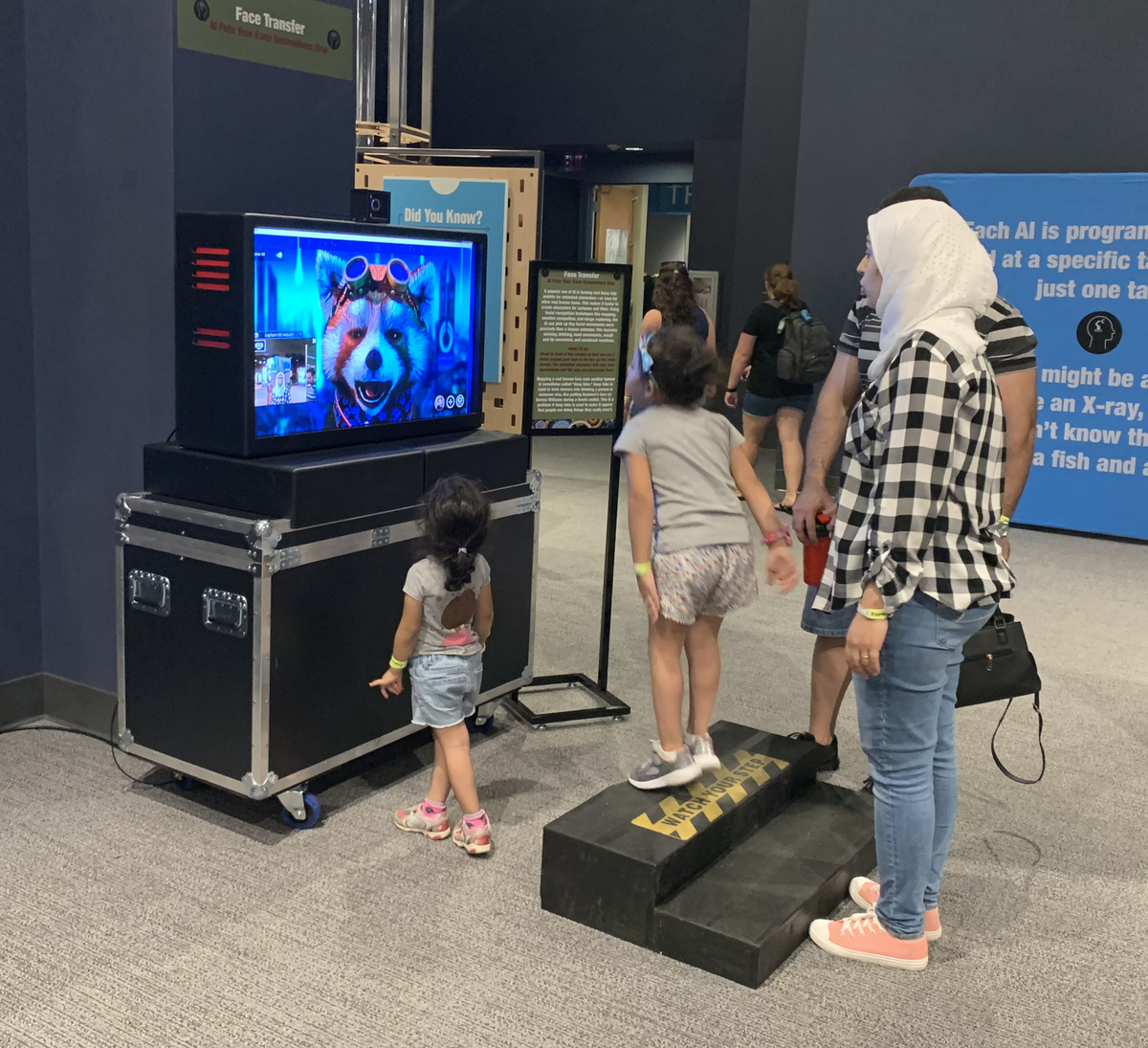
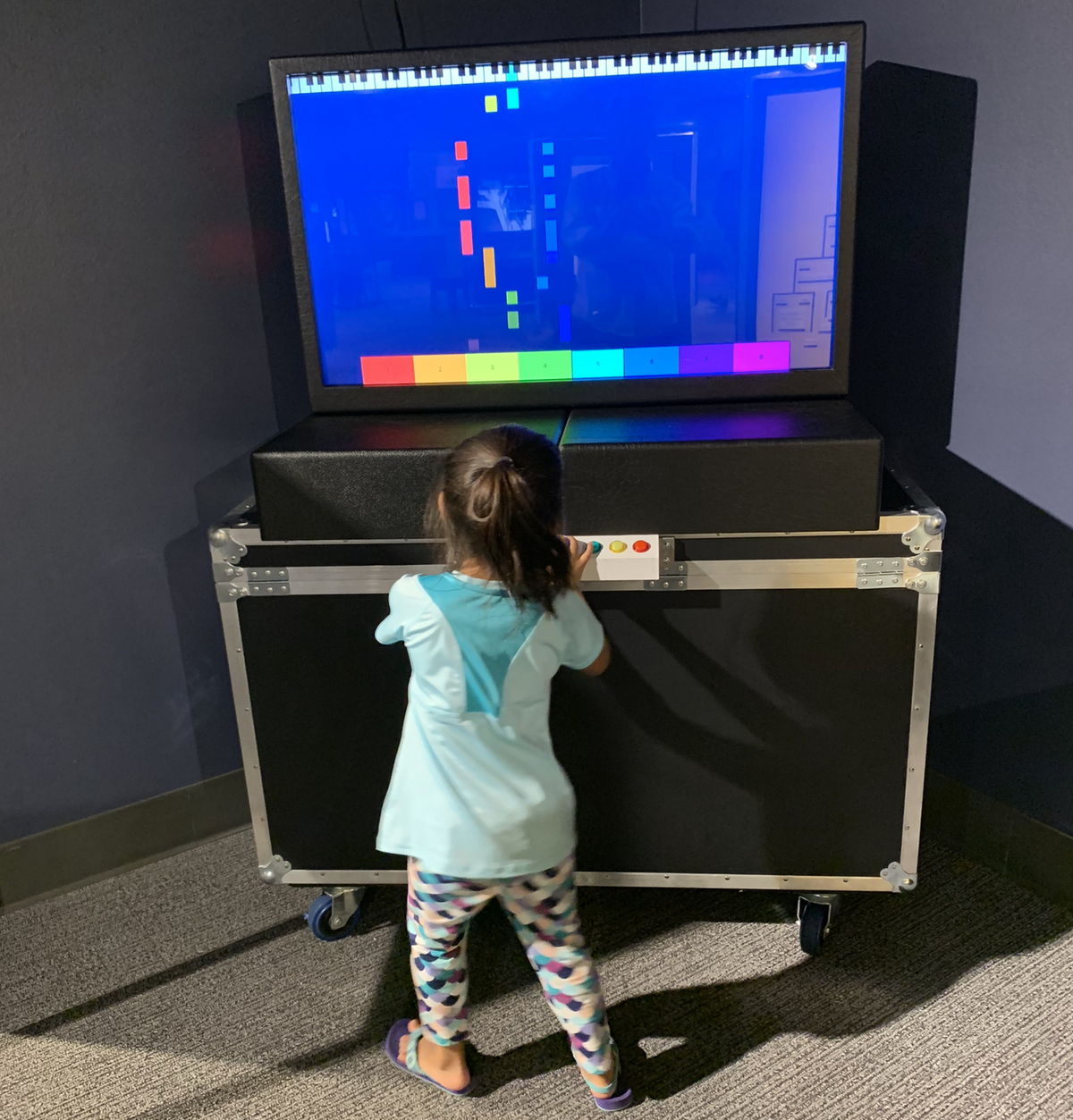
There’s a simple piano you can play while the computer jumps in and makes your random notes sound like Mozart. There’s a camera that snaps a selfie of you and presents the image as though it were painted by one of the grand masters.
And then there’s a digital iris that scans your face, measures your features and produces a facial recognition breakdown. But here’s a good reason to wear your COVID-19 mask — the computer just can’t figure out what kind of creature you are if it can’t see anything below your eyes.
Computers are excellent at blowing off optical illusions. They use pattern recognition and the various tricks artists play on our eyes fail to fool the digital mind. A variety of illusions confront and confuse the visitor, but the computer aces every test.
Still needs improvement
In one area, AI remains amusingly clunky — the ability to understand nuance in language.
Internet-based language translation was one of the earliest and most widely used forms of AI. Taking dictation, correcting spelling and grammar or translating words is still a work in progress three decades later, though improving all the time.
But AI can’t match humans’ ability to detect subtle variations that instill meaning even in simple conversations. Visitors are given the sentence, “I didn’t eat your candy last night,” and told to repeat it, emphasizing different words each time.
“Interpretation depends on which word you stress,” Newquist said. “I didn’t eat your candy last night. But what did I do with it? Maybe I hid it or something.”
This is important, Newquist said, for people who fear technology to realize. AI is good at doing taxes, diagnosing patterns of illness or obeying traffic laws. Yet it can’t match the human brain — even little ones — in navigating relationships.
“AI is good at adult stuff like calculation,” Newquist said. “But it’s bad at stuff a toddler can do, like understanding emotions and recognizing that cats don’t fly.”
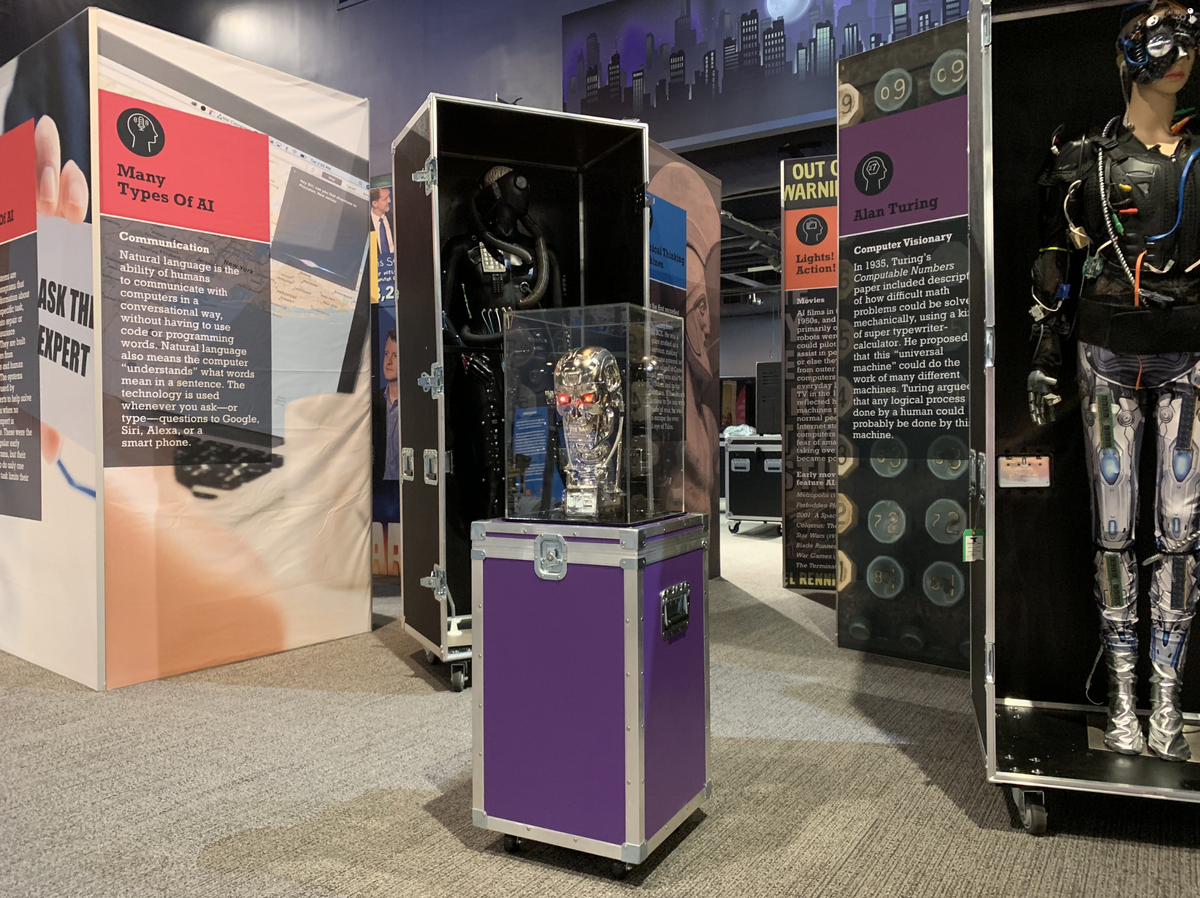
This revelation stands in contrast to some of the dark threats “Your Mind & The Machine” poses with poster references to movies about nefarious computers, including “2001: A Space Odyssey,” “I, Robot,” “Blade Runner” and “Robo Cop.” A Hollywood prop brings the visitor face to face with the punchiest of rogue robots — the metallic head of “The Terminator.”
We’re good, for now
Newquist believes we will live in harmony with thinking machines for a long time to come. Don’t worry. Progress has its limits.
“We’re pretty far away from machines understanding things the way people understand things,” he said. “Getting AI to understand the world like we do won’t happen for many decades.”
Part of that, Newquist said, is simply the awesome efficiency of that gelatinous mass in your cranium.
A flashlight bulb uses about one watt of energy. Your brain uses 24. To get a computer to do what your brain does would require about 20 million watts.
That’s a power bill that’s quite, well, unthinkable.
“Artificial Intelligence: Your Mind & The Machine”
What: An AI exhibit that lets visitors explore smart machines and learn about the concept of man-made intelligence.
Where: Discovery Place Science, 301 N. Tryon St. Discovery Place Science is open Friday through Monday, 9:30 a.m. to 4:30 p.m. The first hour is open to members only.
When: Through Aug. 22
Cost: Exhibit is free with membership or entry fee, which is $19 for adults and $15 for children. Admission is available by reservation only at DiscoveryPlace.org.
This story is part of an Observer underwriting project with the Thrive Campaign for the Arts, supporting arts journalism in Charlotte.
More arts coverage
Want to see more stories like this? You can join our Facebook group, “Inside Charlotte Arts,” at https://www.facebook.com/groups/insidecharlottearts/