
The man behind the Gantt Center’s design is now featured in an exhibit at the museum
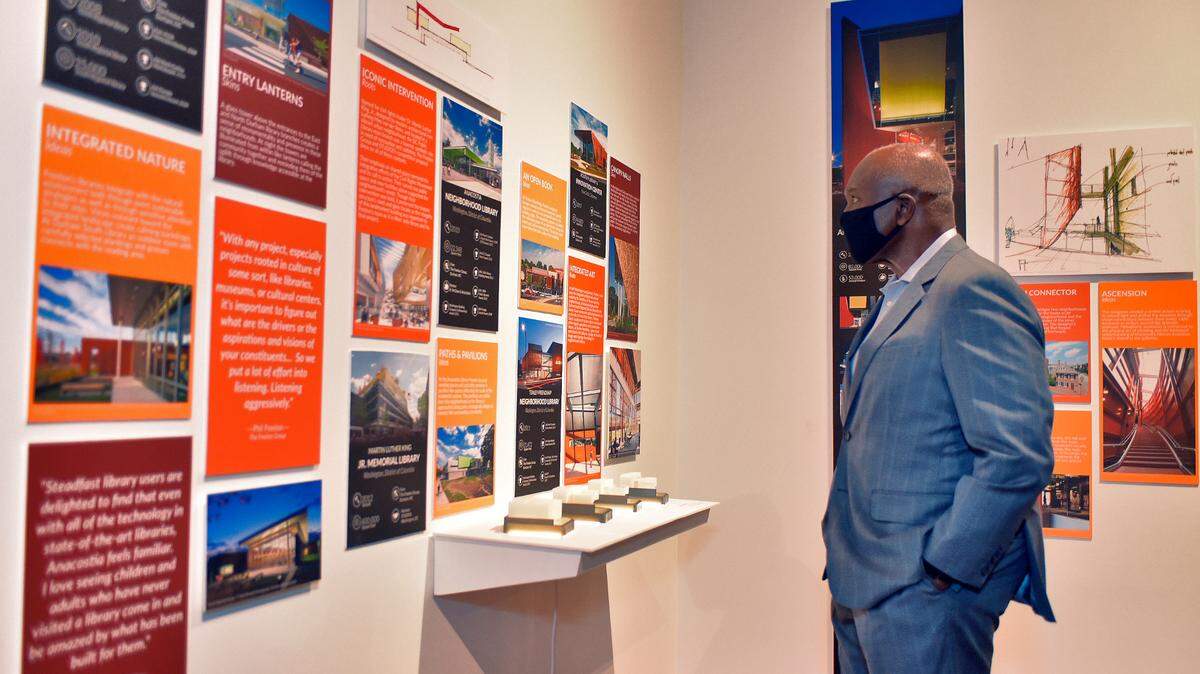
You’ve probably heard of Frank Gehry and Frank Lloyd Wright, but if you don’t yet know the name Phil Freelon, you should.
A new exhibition created by students and faculty at UNC Charlotte’s School of Architecture examines the design contributions of Freelon, a North Carolina-based architect who died in 2019.
“Container/Contained: Phil Freelon — Design Strategies for Telling African American Stories” is now on view at one of Freelon’s award-winning buildings — the Harvey B. Gantt Center for African-American Arts + Culture in Charlotte — through Jan. 17. Then, it will continue on to the North Carolina Museum of Art in Raleigh, beginning Feb. 26.
Freelon, who was Black, imbued his architecture with meaning to express each structure’s content while reflecting the communities it would serve.
The exhibition shows how Freelon turned ideas into subtle architectural elements. Some examples include using the interlocking arms of civil rights-era marches as inspiration for the National Center for Civil and Human Rights in Atlanta, incorporating the colors of hit vinyl records as architectural fins for a new expansion at the Motown Museum in Detroit and utilizing unfolded DNA strands on the facade of the Biomanufacturing Research Institute and Technology Enterprise at North Carolina Central University in Durham.
In his work spanning four decades, leading The Freelon Group in Durham and later as design director for Perkins & Will’s North Carolina practice, he focused particularly on museums and cultural institutions recounting the Black experience, using architecture to uplift and inform.
He designed such prominent buildings as the Smithsonian National Museum of African American History and Culture in Washington, D.C., San Francisco’s Museum of the African Diaspora and the International Civil Rights Center & Museum in Greensboro.
But he also designed many other structures, from public libraries and buildings at historically Black colleges and universities to community parks. One of his final projects, North Carolina Freedom Park in Raleigh, is slated for completion in 2022. It honors the contributions of Black Americans to the state’s cultural, educational and economic development.
A unique collaboration
When Freelon died in summer 2019 from ALS, Emily Makas of UNC Charlotte’s School of Architecture thought it was important for the university — as one of only two accredited architecture schools in the state — to commemorate and analyze his work.
“It’s beautiful work, but it’s also really interesting,” said Makas, noting there had been no previous scholarly or critical examination of Freelon’s designs.
Makas, who is associate director of the School of Architecture and associate professor of urban and architectural history at UNC Charlotte, had just finished a project in which students helped research and design an exhibition at the Levine Museum of the New South.
She proposed offering a similar semester-long class, along with associate professor Greg Snyder. The objective: Delve more deeply into how Freelon used architecture to tell stories — exploring his design strategies and whether patterns or evolution in his work appeared across time — for a campus exhibition.
Then 2020’s coronavirus pandemic happened, bringing challenges as well as opportunities.
With public gatherings on campus on hold, the exhibition was delayed, unexpectedly giving the professors and their students extra time to prepare. It also inspired Makas to contact the Gantt Center about partnering to bring it to its larger uptown gallery, with a wider community reach.

“It just grew and grew and grew,” Makas said. The project expanded from a semester-long look at Freelon’s museum work into a more comprehensive, two-year study of his architecture across design types.
The significance of the project also evolved.
“My work has always been about architecture and identity, but with the George Floyd and the Black Lives Matter resurgence last year, centering the African American part of the narrative became a goal — to lift up his voice but also as a project for my students of color,” Makas said. “We don’t talk about that many architects of color in the examples that we give, (and) here’s this fascinating one that I’m working on anyway.”
It was the perfect opportunity to involve even more students — 23 in all — who conducted research, created exhibition panels and built 3D printed models of Freelon’s designs.
Student perspective
Among the students involved was senior Tahlya Mock, who joined the project her sophomore year. She said the experience learning how Freelon positively impacted his community and designed monumental buildings has been inspiring, particularly as a Black architecture student.
“Like your mom says, ‘You can do whatever you want, reach for the stars,’ but until you see somebody like yourself doing those things, it’s hard to believe it,” Mock said.
“There are so few of us,” she added. “Only 2% of architects are African Americans, which is so much lower than so many other statistics for different career paths.”
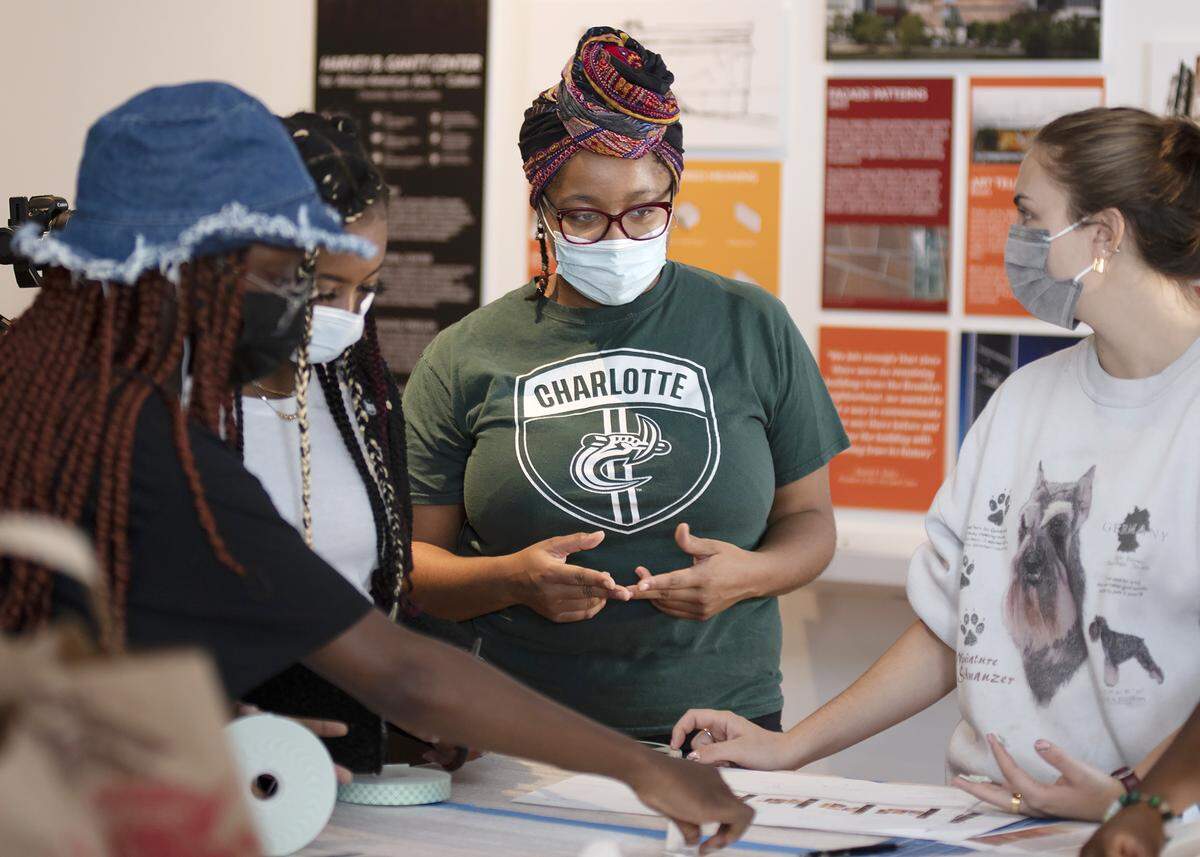
Mock, like many of her classmates, continued working on the project even after her initial class ended. For her that included paid opportunities through UNC Charlotte’s Office of Undergraduate Research one summer and a micro-internship this fall.
“But if those opportunities hadn’t happened, I still would’ve signed up for the independent study class,” she said. “Because I felt too connected to the project to have just let it go.”
A legacy of community and history
“He was just an extraordinary individual,” architect Darrel Williams, founding partner and owner of Neighboring Concepts, said of Freelon, whom he worked alongside on the design team for the Gantt Center.
Freelon captured the history and culture of a community through his architecture, said Williams, who now serves as board chairman for the Gantt Center. That building’s design, for example, pays tribute to Charlotte’s historic Brooklyn neighborhood, a once thriving center for the city’s Black community, razed during the 1960s.
Freelon drew inspiration for the Gantt’s interior stairs and angles on the outside of the building from the Myers Street School, Charlotte’s first public school serving Black children, which is in Brooklyn. The school’s distinctive outdoor fire escape stairs had led to it being known as the “Jacob’s Ladder School.” The Gantt’s exterior also replicates a pattern of quilts, evoking both African American and African history and culture.
“When you explain to (people) how and why the building was designed the way it is, it recalls that history,” he said. “You can tell that history forever, based on and inspired by a building that doesn’t exist anymore.”
Williams said he hopes conversations will continue about Freelon, ensuring “his influence and impact will be everlasting in a lot of ways that will help inspire young people — and inspire young Black boys and girls — that they can become the best in whatever they decide to do.
“And that’s what Phil did,” Williams said. “He became the best ...”
“Container / Contained: Phil Freelon”
Where: Harvey B. Gantt Center for African-American Arts + Culture, 551 S. Tryon St., Charlotte
When: Through Jan. 17 (closed Mondays).
Cost: Adults $9; seniors, educators, K-college students or military $7; 5 and under free.
Details: www.ganttcenter.org.
Where: North Carolina Museum of Art, 2110 Blue Ridge Road, Raleigh.
When: Feb. 26-May 15.
Cost: Free.
Details: ncartmuseum.org.
More arts coverage
Want to see more stories like this? Sign up for the free “Inside Charlotte Arts” newsletter at charlotteobserver.com/newsletters. You can also join our Facebook group, “Inside Charlotte Arts,” at facebook.com/groups/insidecharlottearts.
And you can find all of our Fall Arts coverage in one place: charlotteobserver.com/topics/charlotte-fall-arts-2021.
This story was originally published November 23, 2021 at 6:30 AM.