John Cleese hopes you’ll spend $20 on Sunday. But if you don’t? ‘It doesn’t matter.’
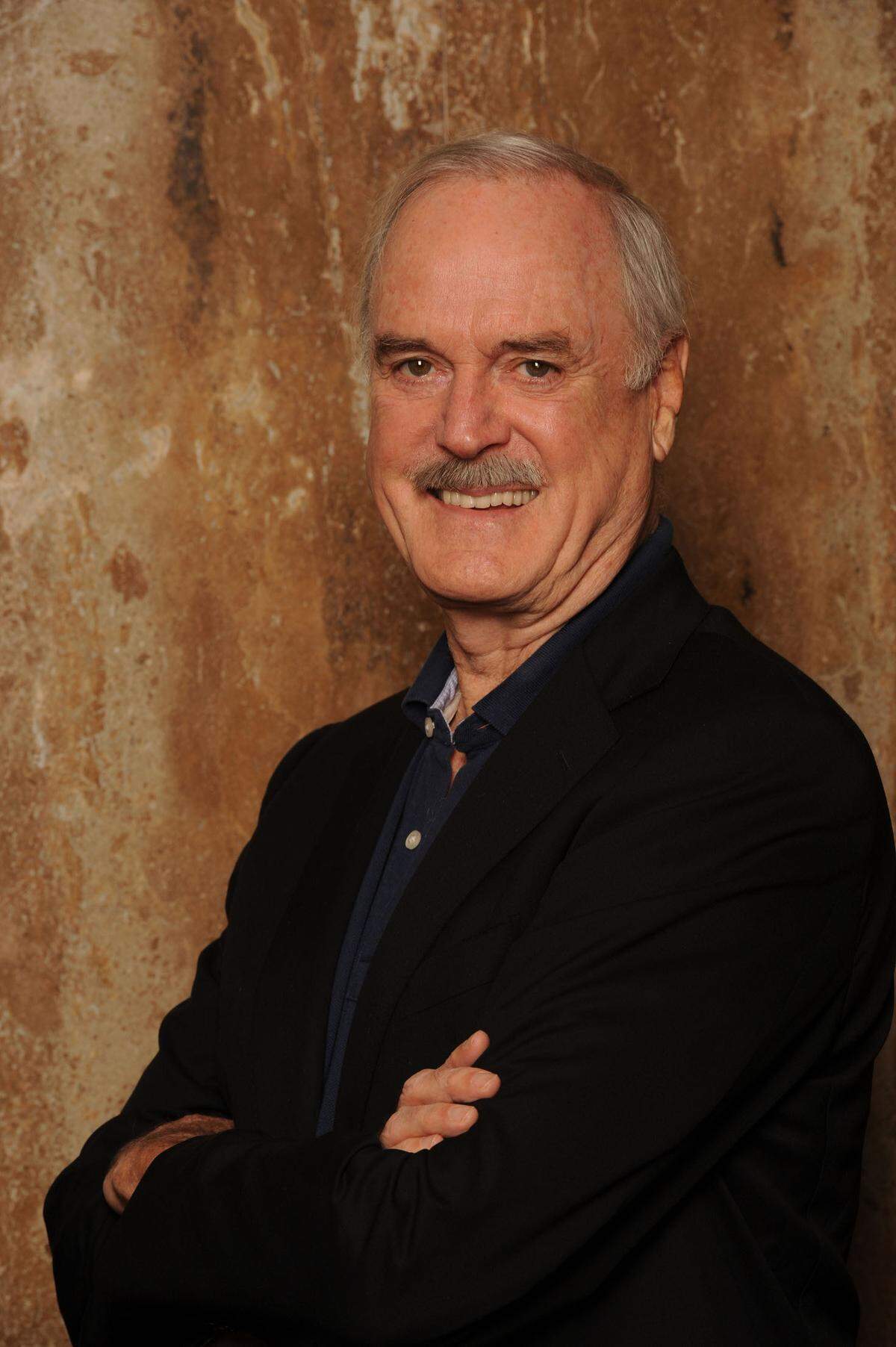
.jpeg "Says John Cleese: “We started to think, ‘Well, what would happen if I just did the speech somewhere, and we had a few people in the hall, socially distanced, so that they would giggle occasionally and sort of encourage me?’”")
Like so many of us, John Cleese started 2020 with plans.
Among them, he was set to bring his one-man show — “Why There Is No Hope,” which he performed in Charlotte two years ago — to venues around the U.S. in the fall.
Then, like so many of us, within a few months the 80-year-old entertainer was abandoning all hope of being able to make those plans happen.
As it turns out, though, there actually is hope for Cleese and his show despite the pandemic — as well as for fans of the comedic genius behind the ’70s British sitcom “Fawlty Towers,” the 1988 film comedy “A Fish Called Wanda,” and much of the Monty Python troupe’s funniest work:
At 3 p.m. EDT this Sunday, Cleese will present a lighthearted stand-up-style lecture and a totally unscripted audience Q&A session in a special one-off performance of “Why There Is No Hope,” which will be performed live at Cadogan Hall in London, England, and streamed around the world to anyone willing to pay $20 for the privilege.
The idea came together, Cleese says, “as I was talking to my promoter — who’s a Hungarian, and I am violently prejudiced in favor of Hungarians — and we started to think, ‘Well, what would happen if I just did the speech somewhere, and we had a few people in the hall, socially distanced, so that they would giggle occasionally and sort of encourage me?’”
“We don’t know whether people will tune in,” he concedes. But “if they don’t, it’s cost very little money (for us to produce). And if they do ... they get to see the show for about 20 percent of what they would normally pay. So we’re gonna see if it works. If it doesn’t, it doesn’t matter. It’s just an experiment.”
In a recent interview to promote Sunday’s virtual event, conducted via a Zoom video call, Cleese regaled the Observer with tales of quarantining in the company of squirrels, cursing at a focus group that was horrified by “A Fish Called Wanda,” and correcting Americans who virtually never pronounce his name correctly.
Q: Good afternoon. How are you?
Well, I’m puzzling about “Theoden.” Your name. Tell me about the name, because “theo,” I know that — that’s a prefix from Greek meaning god. What about the “den”?
Q: So I was born in Seoul, Korea and adopted by Caucasian, American parents, who got the name out of “The Lord of the Rings,” believe it or not.
Really! Oh, very good.
Q: And they pronounce it “THAY-oh-den.” I actually have changed it a little bit to make it easier: I just pronounce it “THAY-den.”
“THAY-den. “THAY-den.” Well, I like the Theo bit, you know. I’m in favor of, for example, theocracy. Right? Which I’m sure you’re in favor of. Which is the government by you, right? (Chuckling.) So listen, tell me what you want to ask me. You can ask me anything you like.
Q: Well, how do you pronounce your name? No, I’m just kidding.
Well, no, no, I can tell you — because when I go to America, everyone calls me John Cleese (says it so it rhymes with “fleece”). I say, “No, it’s John Cleese” (says it so it rhymes with “cheese”). Because my dad’s last name was Cheese. I’m not joking. He was born in 1893 in Bristol, and he was Reginald Cheese. He changed the name when he went into the army, because he was fed up with being teased. But everyone calls me Cleese (says it like “fleece”), and I say, “Well, wait a minute now, if you go into the supermarket, do you ask for a pound of cheddar cheese (says it like “fleece”)? No, you ask for cheddar cheese.” So anyway, I’ve gotten used to it being mispronounced. ... So what do you want to know about?
Q: Well, how are you liking these Zoom interviews, by the way?
I think they’re great fun. What I like is that you can see people. You can see people’s eyes. So much of communication is extra things — like, when I say things to you, you do a tiny little nod of the head. That means that you got what I’ve said, so I then go on. If on the other hand, you stop nodding, I would think, “Oh, you didn’t fully understand that. Let’s explore where the miscommunication is.” So once you can begin to see people, it’s terrific.
I was in lockdown in L.A. for 4-1/2 months, and my wife was in London. If it hadn’t been for FaceTime, it would have been much worse. But because we could have half an hour each day, looking at each other and seeing whether we were smiling or upset or whatever, it improved the communication like 20 percent is what I think.
Q: I was going to ask about whether you’ve been quarantining. So you were basically stuck in L.A. for 4-1/2 months?
Yeah, I arrived there on March the 1st, and I was intending to spend about 10 days there. Then it all happened so fast. There was nowhere that I could go to. I even asked about Cuba and Bermuda and Turks & Caicos, and they’d all shut down in about 48 hours. But I was lucky. I stayed in a hotel on a canyon, and I had a little patio, so I had a bit of greenery, and squirrels and birds. So I became a squirrel trainer. I didn’t teach them anything very important. ...
I’m an introvert. I mean, introverts don’t need a lot to keep them happy. An introvert’s problem is when they get overloaded. Extroverts — who don’t have so much going on in their heads — they need stimulation, or they get very bored. So it hasn’t bothered me at all, or a lot of my introvert friends. But when I think that some people have been stuck in basement flats with those horrible little things called children, I feel very, very sorry for them. It’s their own fault for having children in the first place. Do you have children?
Q: We do. We have a 19-year-old daughter.
Oh, they’re fine when they’re 19.
Q: Exactly. I didn’t like her very much when she was a baby.
J: Well, babies are horrible, selfish little things, aren’t they? They’re sort of miniature versions of Donald Trump. They’ve got to have what they want immediately, or they get angry.
Q: Alright, so when you do this live-streamed show on Sunday, will they tell you as you’re going on, you know, “Mr. Cleese, there are only 100 people logged on,” or “There are 20,000 people” — I mean, will you know how big an audience you’re playing to?
Not till afterwards, no. I keep asking them, “How many tickets have we sold?” And they keep sort of saying, “Well, we’re getting lots of hits.” But apparently — this has been done once or twice before — a lot of people make up their mind in the last 24 hours. For the simple reason it’s so simple to join in and watch it. You see what I mean? You don’t have to get a ticket. It’s not as though there’s a limit to the number of people who can see. So it’ll be interesting.
I don’t see why it shouldn’t work. But I’ve long since ceased to understand what audiences like and don’t like. I sometimes write a joke that I think is terribly funny and the audience laughs a little bit but not a lot; and then I write a line that doesn’t strike me as being terribly funny and they howl with laughter. I mean, in “A Fish Called Wanda,” we had a scene where Michael Palin is being tortured. He had two chips up his nose and an apple in his mouth and he couldn’t breathe. I thought it was hilarious. But the focus-group audience didn’t laugh, so we had to keep editing this sequence. I said to the group of people, “Well, why aren’t you laughing?” They said, “Well, we’re frightened because Michael Palin can’t breathe.” And I said, “It’s a f------ movie. What do you mean, ‘He can’t breathe’?? If he really couldn’t breathe, we’d stop shooting and take the apple out.”
How do you anticipate that an audience is going find a problem with something like that? The answer is: You don’t. You just discover as a matter of fact what happens when they see the film.
Q: So in your show, if there’s a joke that you love, but it’s not getting the laughs that you expected, do you love it enough to keep trying to tell it, or are you editing the show all the time?
Very good question, and one that I used to think about a lot when we were doing Monty Python. The answer is: Can you make the joke without disturbing the flow? In other words, can you just throw it away? If you’re gonna do it and then pause to wait for the laugh — which you sometimes have to do — then it is better, if people aren’t laughing, to get rid of it. But if you can just throw it in casually without missing a beat, then you keep it in.
For example, there’s a line I like about my mother, who was a very nervous person. I’d say that she was frightened of everything, basically. It didn’t matter much what it was. I’d say, “I used to say that she suffered from ‘omniphobia.’ That is: You name it, and she had a morbid dread of it. ... But that wasn’t quite fair. For example, I never saw her frightened by a loaf of bread.” Now, I thought that was really funny. And it hardly ever got a response. So in the end, I took that out because I couldn’t throw it away. It looked like a joke, but it was supposed to get a laugh. As it didn’t, I threw it out.
Q: Well, I know everybody’s probably asking you this question, but since you titled the show the way you did: What are you most hopeless about these days?
The single most frightening thing for me is the attorney general, William Barr. Because I believe that he acts purely as Trump’s personal lawyer. He is not acting on behalf of the people of America. ... Also, in the case of the coronavirus, you suddenly find that the experts aren’t there at the briefings anymore, and then you learn that their appearances in public are being restricted. I mean, anybody who’s doing that is basically committing murder. If you stop proper information about the coronavirus from going out to people, you are helping to promote their deaths.
Q: I spoke to you five years ago — when you came to Charlotte to do a show with Eric Idle — and in talking about how you like to spend your free time you said, “More often I just read a book, because there’s so many books that I want to read — and I’ll be dead in 10 years, so I have to get on with that.” So now that you only have five years left, I would ask: How many of those books have you been able to get to?
Well, the last few months have been very disruptive, and I’m not one of those people who can really concentrate hard in the midst of destruction. I can deal with all my everyday tasks, but to sit down and read any important book that has important ideas in it is difficult. But I’m re-reading Jonathan Haidt’s “The Righteous Mind.” I can’t recommend it enough. I think if people read the first hundred pages of that book, they would understand what’s going on better than they would with any other book. ...
I do think right now that there are more great books being written than at any other time in our history. I think it’s extraordinary, the brilliance. There’s a book called “The Master and His Emissary” by Iain McGilchrist about the two hemispheres of the brain, and how the left hemisphere has become dominant in the last 200 years. I mean, it’s the most interesting thing I’ve ever read. In about a week’s time I’m gonna be sitting in the sun for a couple of weeks, and I’m just gonna take that one book with me and re-read it again, marking it up.
Q: And you have a book coming out soon, don’t you?
Oh yes, I do! Yes, yes, I should talk about it, yeah. On September the 8th. It’s a book about creativity (titled “Creativity, A Short Cheerful Guide”). Because I wasn’t creative at all, I thought. I got into Cambridge on science, and I switched to law. It was only by chance that I discovered that I could write things that would make people laugh. That they could give me a blank sheet of paper and I could create something that would entertain people. I got interested in it because the process seems to be mysterious, and what I believe is that everything that’s really great, really new, comes from the unconscious. So you have to learn how to get in the right relationship with your unconscious.
And the way to get in the right relationship with your unconscious is to become playful. All creativity comes out of playing, and play is always separate from ordinary life — which is full of responsibilities and distractions. You have to get away from that, and create a quiet space for yourself for say an hour and a half. And at that moment, you can really begin to feel the promptings of the unconscious. Not that you’ll necessarily get them during the hour and a half, but rather in two days’ time when you’re out for a walk with the dog and you suddenly think, “Oh! Wait a minute.” It’s very strange how it incubates, but that’s the way you become more creative. And anyone can do that once they’ve learned how to do it. ... There, you don’t have to buy the book now.
Q: OK, I realize we’re running out of time. Last question: I know it sort of goes against the title of the show, but if you had to offer a message of hope for people, what would that be?
Well, what I would say is: Have a good think about what’s known as the serenity prayer. “God, grant me the serenity to accept the things I cannot change; the courage to change the things I can; and the wisdom to know the difference.” In other words, put everything you’ve got into the things you can really change. They are probably on a small scale. But maybe if you’re just nicer to 20 people ... if you can help that guy out because he’s in trouble at the moment ... that can produce a very happy life. You don’t have to be famous or rich. And if it’s something that you can’t change, then don’t worry about it!
Q: Well, Mr. Cleese (saying it so it rhymes with “cheese”), thank you. I appreciate your time. Good luck this weekend.
Thank you. And give my love to Charlotte.
No matter who she is.
“Tickets” to the virtual presentation of “Why There Is No Hope” cost $19.99 and include the live stream plus access for two days following the performance. Details: www.johncleese-uniquelives.com.
This story was originally published July 29, 2020 at 12:18 PM.