Lewis Black attends the Michael J. Fox Foundation for Parkinson’s Research gala at Cipriani South Street on Saturday, Oct. 29, 2022, in New York.
Charles Sykes
Invision/AP
There’s something not quite right with the connection from the start of our interview with Lewis Black, and we can sense it coming — one of his famous tirades, bubbling up from the pit of his stomach.
“I mean, it makes no sense. I’ve got five bars,” grumbles the 74-year-old comedian, who has called to talk about the stand-up tour he’s bringing to North Carolina this month, including a show at Ovens Auditorium in Charlotte on Saturday, Nov. 12. “It’s like a nutcracker ... every so often there’s a —” and here he tries to mimic the grating, metallic sound that bird makes.
“‘Raaaaaaaant! Raaaaaaaant!’”
Then, as if on cue, Black launches into a raaaaaaaant of his own:
“I was just yelling about this. The time setting up the calls is longer than the calls. It’s unbelievable. And the fact that I sometimes have to do Zoom calls now, because they say that the reception is better than on the telephone, makes me psychotic.”
He calls back twice, and, finally ... “That sounds good,” Black admits, though he, himself, still sounds grumbly. (Although he always kind of does, frankly.) “Yeah. That’s good. That’ll go for five minutes. So let’s do it.”
The interview in fact wound up going for 25 more, with a good chunk of the conversation dedicated to his link to North Carolina by way of landing in the Tar Heel State — and to the Tar Heels — as a theater student in 1967. Here are the highlights.
1. It was love at first sight in Chapel Hill: “I should have probably applied there (at UNC) when I was applying to schools, I just didn’t,” Black says. “I wanted to have a school that had a theater program, and I’d applied to a bunch of schools. I got rejected by all of ’em, except for one. So I made the decision to go to Maryland for a year and get the grades and then try to transfer out.”
He applied to transfer to Northwestern’s theater school, and in the meantime, took a bus from Maryland to N.C. to look at Duke’s campus. But someone had also told him about Carolina’s theater department; so on his way to Durham, Black stopped in Chapel Hill.
“Literally walked onto the old campus and that was that. I felt like I’d been there my whole life. It felt like home. And not that, ‘I’m a Tar Heel born and a Tar Heel dead,’ or that insanity. But it was profound. It was weird. I just went, ‘Ohh, this is how people pick their schools. They like the environment!’”
2. Theater was the thing: “I had no desire to go into comedy,” he says. “Worst-case scenario, I’d teach. I mean, I wanted to at least find out if that (theater) is really what I wanted to pursue, ’cause I had a real interest in it. But I wasn’t much of an actor. I wasn’t really a director. I didn’t do tech.”
His theater credits included just one way-off-off-off-Broadway show, something he and his friends had written for kicks and that featured him as the main character. (His one-word review: “Dumb.”) Beyond that?
“I’d seen a ton of plays. I’d read a ton of plays. I’d read a bunch of criticism. I actually thought I might even end up as a theater critic — which really takes an ass---- to think that, at any time in their lives. And so I decided I’d try writing plays, and then I got a lot of reinforcement for it.”
3. His relationship with comedy started after college, but still in Chapel Hill: “It was the summer I’d gotten out of school,” Black says. “My friend had a band. Mike Cross. I think he’s still playing down there. Or did for quite a long time. It was a folk-rock band called The Cross-Reynolds Band. My friend Charlie Huntley played the drums.”
On a whim, basically because they thought he was funny, his buddies invited him to try performing some stand-up comedy — something he’d never tried in his life — during one of their shows at Cat’s Cradle in downtown Carrboro.
“I went on stage and I wasn’t funny. And I went back again the next week, which was crazy. The first 30 seconds I’m going, ‘Um, uh...’ I didn’t say a word for practically a minute. I just made sounds. I just was too nervous. I’ve said it time and again when teaching: The only difference between the person sitting in the audience who’s funny and the person on stage is the three feet that you gotta go to get on the stage — and how big that is.”
4. During that second show, after not saying anything for 60 seconds, he resorted to gross-out humor: Despite the paralyzing fear he felt during his debut, “I went back, yeah,” he says. “I wasn’t gonna be a comic, so it didn’t matter. I was fascinated by the process. I wanted to try to figure it out. It’s like figuring out a really hard math problem.
Toward the end of his allotted time, as he continued flailing away, he pulled his pet cocker spaniel up onto the stage with him.
“And I — probably can’t even put this in the paper, but I literally put the dog like he was my dummy, and I said, ‘This is how a dog masturbates.’ And I took his two paws and (mimed it). The place went nuts. That was the biggest laugh I had that night. So the fact that I’m not a prop comic is extraordinary.”
5. Earlier this year, Black donated his plays, scripts for TV pilots, and various other writings from his comedy career to the Wilson Special Collections Library at UNC. But he didn’t review them before doing so: “That would have required me to sit down and be able to deal with that,” Black says. “And I wasn’t yet able to deal with what I’d written.”
One of the pieces was the first play he ever wrote. “I won’t even talk about it ... but it was a really rough play, in the subject matter and everything. I haven’t read it in 40 years. It’s gonna be hard for me to go back and look at it, ’cause it’s like looking in your psyche. It’s just — it’s a lot.”
But “it’s a huge honor. It’s bigger than Grammys, for f---’s sake.”
Black has been nominated for six Grammy Awards, and has won two trophies.
6. You may have heard that Black maintains a second residence in Chapel Hill. He no longer does: “I wasn’t there enough,” he says, explaining that he sold his place during the pandemic.
Then he unexpectedly pivots into another rant. “Also, I have to say that some of the architecture that was being built down Franklin Street was insane-looking. I mean, just ugly. You f------ idiots! It’s not tough. They gave you a blueprint. You’re looking at it. Then you come up with this? And some of the colors. Really? Where did you find that green?”
He settles down as quickly as he’d gotten worked up.
“But if there’s another place that comes along, I just might take it. There’s still a possibility I’ll end up back there.”
7. In a teaching role, perhaps: Black says he’d like “to do some more work down in Chapel Hill,” leading classes on a part-time basis; and he says that will happen when he transitions away from the stand-up comedy circuit. “I’ll still do some stand-up, but not the amount that I was doing. And I’ll do some kind of Q&As. I’ve got at least another book in me and hopefully another play. I’ve started them, and I’d like to get to work on them.”
But not in anything called retirement.
“My mother (who died earlier this fall at 104), the last two years of her life, all she kept screaming was that I should retire. But it’s not what I plan on doing.”
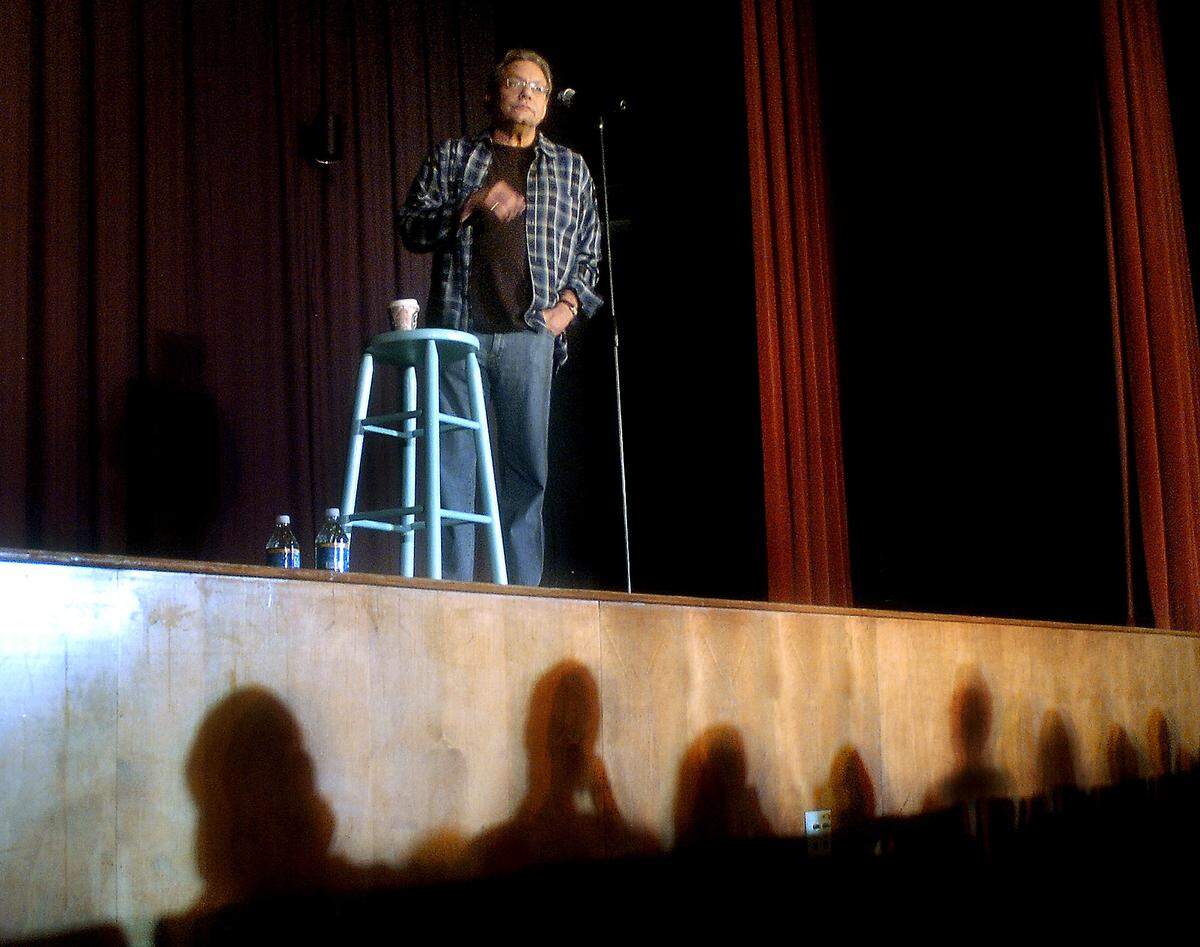
Lewis Black, photographed in 2006 in Chapel Hill while teaching a comedy class in conjunction with the old Carolina Comedy Festival at the University of North Carolina. SARA D. DAVIS AP
If you go | ‘Lewis Black: Off the Rails’
In Durham: 8 p.m. Friday, Nov. 11 at Durham Performing Arts Center, 123 Vivian St.
In Charlotte: 8 p.m. Saturday, Nov. 12 at Ovens Auditorium, 2700 E. Independence Blvd.
What Black says audiences can expect from his act: “Well, they can expect that their lives will be changed. That they’ll become better people. That when they wake up the next day that everything will be different. That they will experience a complete renaissance. Their thinking will become so focused they won’t even know what to do with it.”
No, but seriously: “Basically I’m gonna talk about how we’re not getting anything done. How we’re focused on stupidity. That we continue to focus ourselves on making dumb choices. And the arguments we’re having have nothing to do with any reality that we need to be focused on. ... I mean, it’s the high points of comedy: immigration, global warming, Social Security, health care, and guns. ... It’s gonna be funny. That much I know. And I’m really happy about it.”
Bonus: After both shows, he’ll stick around on stage for a segment that he calls “The Rant Is Due,” during which he reads diatribes largely submitted by fans in the city he’s visiting.
Tickets: Prices start at $39.50 (not including taxes and fees) and are available at www.ticketmaster.com. Must be 18 or older to attend.
Théoden Janes has spent nearly 20 years covering entertainment and pop culture for the Observer. He also thrives on telling emotive long-form stories about extraordinary Charlotteans and — as a veteran of three dozen marathons and two Ironman triathlons — occasionally writes about endurance and other sports.Support my work with a digital subscription