She and her dog lived in a shopping center for two years. Then along came a stranger.
Joette Tavernise has slept in some pretty uncomfortable places over the past two years.
At one time, she was slumbering beneath the overhang of a drive-through-teller lane at an abandoned bank, in the front seat of her 2002 Honda CR-V. At another, she bunked at a shelter in a room housing dozens of other homeless people, all separated by barely an arm’s length. Just a few weeks ago, she spent the night snoozing next to a dumpster in south Charlotte.
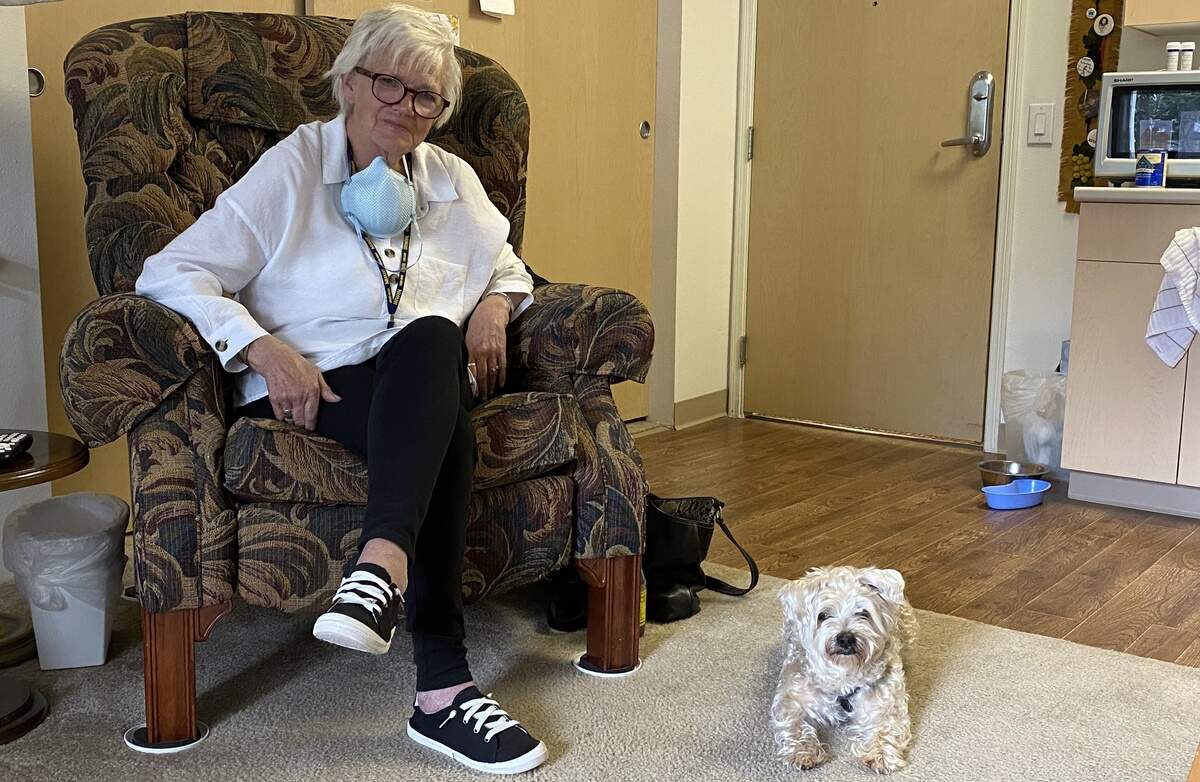
None of these are ideal sleeping arrangements for a 73-year-old woman whose only protection is a diminutive dog named Boogie.
Therefore, the tidy, quiet, nicely appointed one-bedroom apartment with the included meal plan at this independent-living retirement community in Hickory that she’s currently holed up in is, by any measure, a vast improvement. And she can’t help but smile at the thought of her good fortune to be here.
“It’s just great,” Joette says. “Before I go to sleep at night, I look up at the ceiling and think, ‘Ahhh. Got a roof over my head, and don’t have 50 people sleeping beside me coughing.’ It’s wonderful.”
It’s remarkable, too. Mainly that she was able to keep herself and Boogie alive for so long on the streets — since a series of unfortunate events forced her from her normal life in 2018 — but also that, thanks to the kindness of strangers, these devoted companions are finally back in a living situation offering genuine peace of mind.
At the same time, this living situation is only temporary. And for reasons that go beyond just the structural, and just the financial, Joette fears she and Boogie won’t necessarily live happily ever after together.
‘What is going on here?’
Marceil Handkammer has always had a soft spot in her heart for older people.
She says it’s because she lived with her grandparents until she was 5, and even after her dad took over, her grandparents “were always very, very, very, very much involved with my life.”
She also has always had a soft spot for homeless people — as often as feasible, she’d hand food or a couple dollars to those standing at stoplights hoping for a handout.

So last December, right before the holidays, when the 47-year-old stay-at-home mom saw an older woman lying in the grass in a sleeping bag as she was navigating her way out of the Arboretum Shopping Center in south Charlotte around dinnertime, she did a double take.
“I look over again and I’m like, ‘What is going on here?’” Marceil recalls.
She pulled a u-ey, re-parked, and — after learning from another passerby who’d stopped to check on the woman that she was indeed homeless — marched into McAlister’s Deli, bought a cup of soup and brought it out to her.
“I remember that I was shivering, just like a leaf, because it was so cold that night,” Marceil says. “I said, ‘Um, do you stay here all night?’ I was kind of looking around, just trying to process what I’m seeing, and she looked over to where I was looking and goes, ‘Well, I don’t move over there.’”
The playful bit of sarcasm caught Marceil off guard, and she stifled a laugh. The older woman grinned back.
“I’m Marceil,” she said.
“Nice to meet you,” the older woman replied. “I’m Joette.”
Her prized (and pricey) pup
On top of having a heart condition called mitral valve prolapse (an improper closure of the valve between the heart’s upper and lower chambers), Joette also suffered a cerebellar stroke awhile back that has caused memory challenges.
But she clearly remembers the day, roughly four years ago, when a four-legged friend came into her life.
She was living on her own in an apartment complex along McAlway Road near Cotswold Village, divorced twice, retired from a career that included work for the Iredell Arts Council in Statesville and a job as an office manager at a medical office in the Charlotte area, and perhaps a little bit lonely.
So when she saw those little black eyes peeking through the long strands of wavy white hair splashed across his face, in a photo a neighbor had posted asking if anyone had lost their dog, Joette fell in love. And although his previous owner would eventually claim him, that person also ultimately found herself in a situation where she couldn’t keep him; as luck would have it, Joette found herself in the right place in the right time to adopt him.

It was only after she’d gotten him home — and changed his name from Stanley to Boogie — that she realized via a little internet research that her new 6-year-old “morkie” (a cross between a Maltese and a Yorkshire terrier) truly was a prized pup:
“These dogs start at $800 and go up to $3,000,” she explains, in separate conversations on different days, as she probably does whenever she tells someone how Boogie came to be hers. She laughs. “I don’t know what the difference is between an $800 and a $3,000 one, but I would have never been able to buy him.”
Joette receives $1,000 a month in Social Security payments and has health-care coverage through the government’s Medicaid program. She did then, and she does now. (The money is direct-deposited into her bank account, since she doesn’t have a permanent address.) While living in the apartment complex on McAlway, that gave her enough to cover the monthly rent and put a little food on the table.
She was scraping by, but wasn’t in over her head.
After she adopted Boogie, however, she says a new landlord took over. To make a long story short, Joette says he started making life for her and some of the other residents difficult in a variety of unprofessional ways. So in 2018, after living there for seven years, she decided she couldn’t take it anymore and moved out with Boogie. But when she went to apply to live in another apartment building the next week, she learned he had filed an eviction proceeding against her — and even though it had been done without proper justification, her new application was declined.
Not knowing what else to do or where else to go, she drove to the Stonecrest Shopping Center and parked among the vehicles belonging to employees working the overnight shift at Target.
For the first of what would turn out to be hundreds of nights, Joette drifted off to sleep in her CR-V, with Boogie curled up next to her in the passenger seat.
“You always hear it: ‘So many people are one paycheck away from being on the street,’” Joette says, “and that’s the honest-to-God truth. Never in a million years would I have thought that I would have ended up the way I did.”
‘I feel like I’m not alone’
Marceil could hardly bear the thought of this woman sleeping on the grass in the freezing cold, but was relieved to learn a police officer was whisking her off to the safety of an extended-stay hotel for the night.
She had shared her number with Joette, who had promised to share it with a couple of other women who offered to help, and after one of them reached out, they were all able to connect and pooled their money to help keep Joette in the hotel for a little longer as the cold snap continued.
Paying for a hotel room wasn’t a viable long-term or even medium-term solution, though, so the women hatched a plan to try to get her into a shelter.
At first, Joette refused. There was no way, she said at the time, that she’d allow Boogie and her to be separated. She’d rather sleep on the ground with no roof over her head.
As she explains it: “I feel like I’m not alone.” And she doesn’t just mean in a literal sense. “I feel like ... I’m not in this by myself. That I don’t have to go through the rest of my life by myself.”
But the women in her new support group eventually wore her down, arguing that submitting to a shelter would allow them both to survive the elements during the winter — which would be her first without the relative comfort and safety of her CR-V.
Life in the parking lot
That first night parked under the lights at Stonecrest, two years ago, went uneventfully for Joette and Boogie. So one night there turned into two. Two nights into four.
She kept trying to get into the apartments that she could manage on her income, but $600- to $700-a-month options had become scarce in this fast-growing city, and besides, she kept running into rejections thanks to the black mark on her file.
Four nights turned into a week. A week turned into a month.
She had virtually no friends she felt close enough to to ask for help. Her exes were not in her life at all. A daughter she’d had with her first husband lived in Charlotte, but they’d been estranged for some time. Her mother, with whom she was extremely close, had passed away; and her sister, who she says would never have let her live that way, was in a home suffering from dementia.
All she had was Boogie.
“He was so in tune with what my moods and state of mind were,” she says. “If I cried — which I did often — he would crawl up on my lap and put his paws up on my chest and just look at me like, ‘Are you OK?’ If I coughed, he would put his paw on my knee and make sure I was OK. ... He was always there for me.”
One month turned into two. Two months turned into six.
She moved to the Arboretum Shopping Center in south Charlotte after being warned away from Stonecrest, and eventually the Arboretum felt like home.
Though she couldn’t work due to chronic back problems, ankle and foot swelling (due, ironically, to sleeping in her car), and the memory issues from her stroke, Joette had enough money to feed herself and Boogie; enough to buy cheap clothes off the rack in Walmart when she needed them; and good enough coverage to see her doctor when necessary.
But it wasn’t really much of a life.
“We just walked around and did things,” she says. “We just survived. I don’t think I knew how or what a homeless person was supposed to do. I mean, I was just hoping, I guess, that I would wake up the next morning and I’d be OK and Boogie’d be OK — and that we’d live through the next day.”
Six months turned into a year. A year turned into 18 months.
Then one day early this past fall, Joette was inside a store when a motorist smashed into her car while careening through the Arboretum parking lot, causing enough damage that it was rendered undrive-able; the person didn’t stick around to offer to pay for the repairs.
After her car was towed away, she and Boogie had nowhere left to go but the ground.
‘Good night, and love you!’
A few weeks after she handed Joette that cup of soup, Marceil — who was not at all a dog person at the time — agreed to let Boogie come stay with her family while Joette was in the shelter.
At first, though, they were in contact only once or twice a week, as Marceil and others continued to try to find a solution that would get Joette out of the shelter and back together with Boogie. But after Joette contracted a urinary tract infection due to dehydration, Marceil began texting her every day to check on her.
(Worth noting: Residents of shelters are given a bed to sleep in, but they aren’t allowed to stay at the shelter during waking hours. By day, the homeless are out on the street, and because of the challenges of finding a public restroom, they’ll often limit water intake.)
“Joette kind of thought that was funny, and she started calling me ‘Mom,’” says Marceil, who wanted to make sure Joette was staying hydrated and feeling OK. “She was like, ‘Alright, Mom — I’ll drink my water.’”

She started picking up Joette’s medication from the pharmacy and bringing it to her, and quickly realized that she might as well start bringing Boogie to see her, too.
“Then that turned into, ‘Well, hey, I run errands every Monday. Why don’t I just come get you on Mondays and you can ride around with me while I cart the kids all over town?’ It was weird, because it was like, OK, I’m going to actually have my kids in the car with this woman. And at times I thought, What am I doing? But it turned out OK, because she’s a normal person,” Marceil says, laughing.
It eventually turned into a standing weekly date.
Meanwhile, Marceil kept following leads on low-cost apartments for Joette, but kept running into dead ends. Joette was able to apply for public housing, but others in the homeless community told her it could take a year or more to move to the top of the waiting list.
Some of the other women originally involved drifted out of the picture, for various reasons. But Marceil and Joette were developing a unique bond.
In fact, one night — a little less than two months ago — they had gone shoe shopping together, and when Marceil dropped Joette off at the shelter, Joette got out of the car, looked back, and said to Marceil: “Alright, well, goodnight, and love you!”
After a bit of initial shock, Marceil realized she felt a fondness for Joette, too. Before long, the two were exchanging “love yous” on a regular basis.
(And for what it’s worth: “She doesn’t use people for money,” Marceil insists. “That’s how she earned my trust, is she wasn’t ever with her hand out to me. When I would take her shoe shopping, she insisted on using her own money. When I had a vet bill for Boogie that was quite steep ... she didn’t just offer it; she got the cash and put it in my hand.”)
But just as they were starting to settle into a happy routine as friends, Joette abruptly left the shelter.
A desperate plea for help
According to Joette, the shelter she was staying in wasn’t doing enough to try to mitigate the risks associated with the coronavirus pandemic.
She walked out on April 1, and spent most of the next couple of weeks at an extended-stay hotel, partly using money she’d saved from her Social Security checks while staying at the shelter (Marceil also paid for seven nights’ lodging). When the money finally ran out, she told Marceil she was hopping on a bus and heading to camp out at the Arboretum.
Joette took it in stride, but Marceil seemed completely defeated. When Marceil met Joette there — to hand off Boogie and the sleeping bag she’d kept for her at her house — she says she could barely look at her.
“That was horrible,” Marceil says. “It was the worst thing I’ve probably ever done is take an elderly person a sleeping bag so they could sleep on the ground. ... But at a certain point, you know, she runs out of hotel money, I put up a week of hotel. I couldn’t afford to just keep footing a hotel bill. So I said, ‘Well, I guess we’re out of options here. The weather looks warm enough to sleep out. It looks like that’s the only option.’”
Upon leaving, she was overcome by desperation. Back home, she wound up posting a plea for help on NextDoor, sharing Joette’s story and asking for suggestions on temporary solutions.
Someone suggested starting a GoFundMe campaign to raise money to get her back in the hotel. A local pet photographer, Roberta Sá Griner, saw that and offered to take photos to use with the campaign. Roberta persuaded a writer friend, Jennifer Wski, to craft Joette’s story into heartstring-tugging prose.
Then, as they were launching the fundraising effort, another friend of Roberta’s, Kitty Szpyrka, offered a short-term solution: Her 90-year-old mother Norma, who was living in an apartment at an independent-living retirement community in Hickory, had broken her wrist and would be moving out of the facility and into her daughter’s home for the duration of her recovery.
And after Kitty explained the situation to the staff there, the staff agreed to allow Joette to move into Norma’s apartment.
So on April 19, having just spent two nights on the ground, Joette and Boogie walked in the front door of their new temporary home, and moved — hopefully — one step closer to a permanent one.
How will her story end?
It’s not the uncertainty about her living situation that’s weighing heavily on Joette these days, though. She’s become a survivor after two years spent living in a car, on the ground, and in a homeless shelter.
The primary cause of anxiety, instead, is the health of her beloved Boogie.
Just a couple of months ago, Joette learned from Boogie’s vet that they share something in common besides an undying devotion to one another. Boogie was diagnosed with the same heart condition — mitral valve prolapse — that she has.
“It’s when your heart valve doesn’t close all the way, and the blood rushes through and doesn’t come back exactly like it’s supposed to,” Joette explains. “I’ve never had a problem with mine before. His is very serious, though. ...
“Yeah, I —” Joette takes a long pause, and when she starts talking again, her voice breaks. “I mean, he just kind of saved me these past two years. I don’t know what I would do if he was gone.”
At the same time, she admits to a new reality: that Boogie is no longer the only one she can count on in her life.
She says she’s extremely grateful for the outpouring of support around the GoFundMe campaign, which has generated more than $7,000 now earmarked to help provide a bridge for Joette between this temporary situation and the time she can get off the wait list and into public housing.
And she knows that that wouldn’t have happened without Marceil.
But as Marceil has indicated, it’s not about the money for Joette.
“Marceil has just — she’s acted like I wish (a daughter) would. I mean, calling and checking on me, and things like that.” Joette pauses again, and cries softly. “I think without even realizing it, that I just let Marceil into that spot in my heart that had sort of closed up.”
Yes, Joette is worried about losing Boogie. Terribly.
But when that day eventually comes, it seems almost certain that — for the first time in as long as she can remember — she’ll have the shoulder of another human being to cry on.
This story was originally published April 30, 2020 at 10:18 AM.