Her dying wish was for her family to change the world. They’re off to an astonishing start.
The cold, sad, inexorable truth is that this may well be the last Christmas for Sunnie Williams, an 11-year-old North Carolina girl whose disposition is a perfect match for her name.
Sunnie was diagnosed in the fall of 2022 with an exceedingly rare and savagely aggressive type of brain tumor called DIPG, and “DIPG is a 100% terminal,” explained Lauren Harnett in late October, as she stood on the sidewalk in front of Sunnie’s parents’ house in Monroe.
“There’s a 0% survival rate. ... It’s gonna go downhill quickly.”
Which is precisely why the executive director of the upstart Charlotte nonprofit called, simply, Jane’s Fund was there, clutching in one hand a big care package loaded with pink-heart sunglasses, gold-colored bracelets, a bedazzled jacket, a stuffed puppy, and so much more swag for Sunnie; and in the other, a small envelope for Sunnie’s mom, Jade.
Lauren wept on the drive over, thinking about what the note tucked inside that envelope represented.
Two mornings prior, she’d walked into a Wells Fargo branch and, unbeknownst to the Williamses, quietly paid the $213,000 left on Sunnie’s parents’ mortgage. When she told the tellers the backstory about Sunnie — whose family Jane’s Fund had already been helping with bills here and there for months leading up to this — they started crying, too.
On this day, Jade greets Lauren at the front door and takes her into the living room, where Sunnie is sitting. Because of her cancer, Sunnie’s balance is unsteady, her arms and legs are weak, her eyes don’t track in sync anymore. But her smile is as bright as ever, and she dives into the gift bag, plucking the goodies from it one by one, ooh-ing and ahh-ing upon the reveal of each.
Finally, after Sunnie reaches the bottom of her bag, it’s time for the biggest surprise of all. The one in the envelope.
“That,” Lauren says, turning to Jade, “is a letter from Jane — the founder of Jane’s Fund — if you want to check that out.”
Jade opens it casually, but only gets past reading aloud “‘Jade, Happy Day...’” before she stops. “Oh my goodness. For, like — ?”
“Forever,” Lauren says, softly. “Every cent.”
Jade’s eyes bulge. “Are you serious?” Lauren nods: “This house belongs to you.” Then Jade squints her eyes, as they fill with tears. Sunnie starts crying, too.
“Listen,” Lauren continues, “you have to think about things nobody should. So let’s take one of those off your plate.”
Although tears continue to fall, the room also fills with smiles. And it’s easy to imagine that Jane Harrell, the huge-hearted teenager who inspired Jane’s Fund and the gift just given to Sunnie’s parents, would have been right there smiling along with them all — if she was still alive.
You should know Little Jane ...
You should know Little Jane was the oldest of four siblings, someone who was not simply always looking out for her sister Piper and her brothers Max and Sam, but also someone who those three considered a best friend.
You should know Little Jane’s is a family name. That Little Jane’s mom is also Jane (sometimes referred to as Mama Jane), having been passed the name from her mother.
You should know that Little Jane loved lacrosse, and the Lord, and Luke Kuechly, and her family, and her friends, and fireflies, and fishing for sharks, and just clearly loved life — as is abundantly clear from the obituary her family wrote to honor hers after it was cut short by DIPG in August 2019, just 11 days shy of her 18th birthday.
But as much as anything else, you should know that Little Jane possessed a selflessness and a capacity for compassion she seemed to have been born with, and that practically defied belief.
There are hundreds of examples. These are just a few.
Little Jane, 4 years old, in the backseat of her parents’ car as they drive through the parking lot at Cotswold Shopping Center, sees a mom standing there with a stroller asking for money. She starts crying. Wails, “Somebody’s gotta do something for them!”
Little Jane, 5 years old, being watched by a babysitter because her parents are out of town for a wedding. She comes home from transitional kindergarten crying, goes straight to her room. Won’t stop crying. The sitter calls Mama Jane and her dad, Mike, wondering what to do. They all later learn that Little Jane is distraught because she can’t get over a video her teacher showed in class — about starving children in Africa.
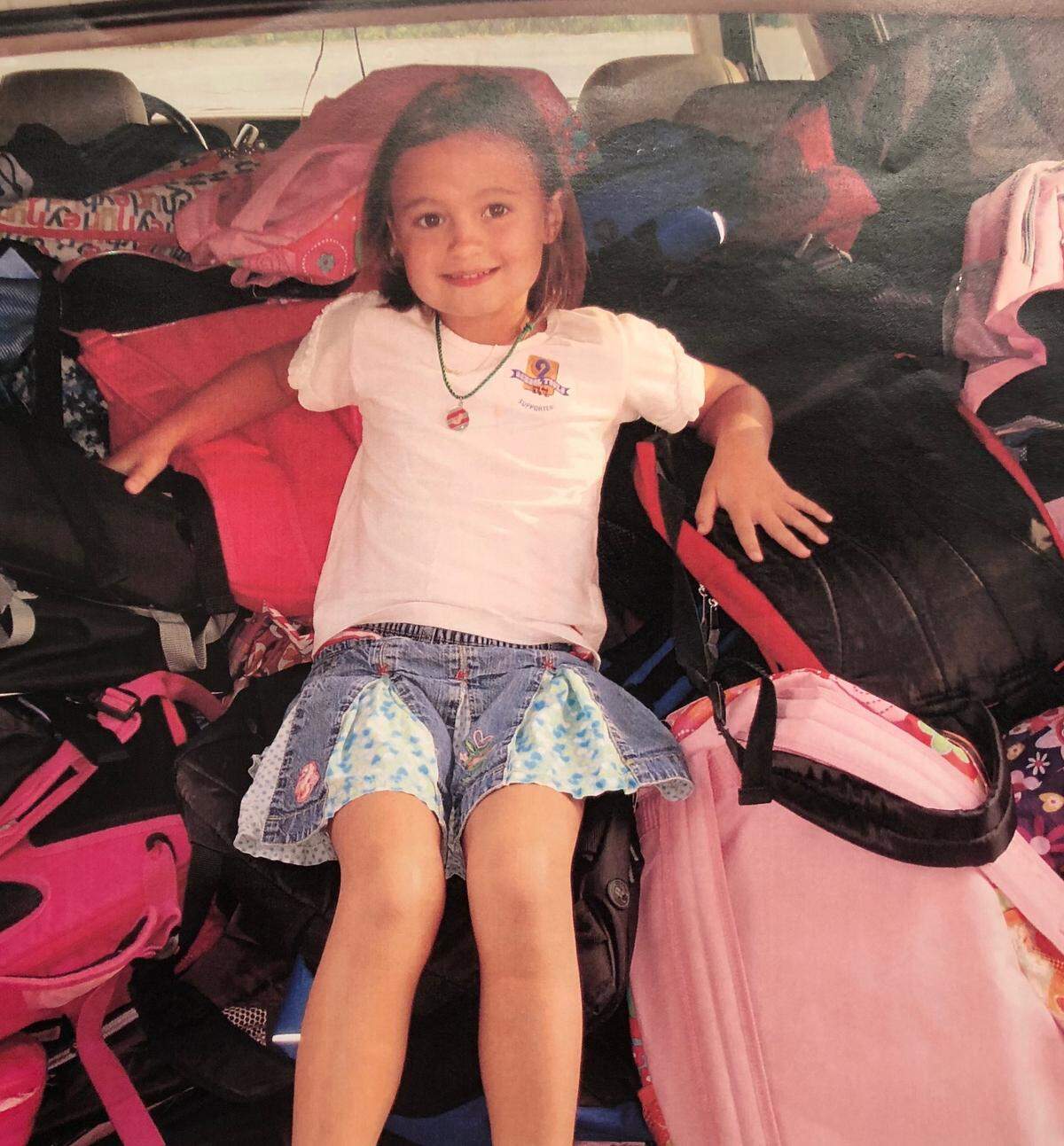
Little Jane, 6 years old, learns about children in Charlotte whose parents can’t afford school supplies, starts a grassroots backpack drive that continues for years and puts hundreds, maybe thousands of backpacks loaded with school supplies into the hands of kids in need.
Little Jane, 7 years old, having learned about children with cleft lips and cleft palates, convinces younger siblings Piper and Max to part with the money they were all saving up to pay for a backyard tree house so it can be donated to an organization that could use it to fund multiple repair surgeries.
“Obviously,” says Piper, now a 20-year-old Davidson College student, “your parents kind of raise your siblings all the same and everyone kind of has similar morals. But Jane had this heart that really just, like, hurt for other kids, and she saw people in need in a way that was different from me and different from other kids I knew. ... Things that wouldn’t have occurred to me as a kid.”
This giving heart of Little Jane’s — this I-want-to-make-sure-YOU-are-OK-first mentality — would define her life. Even after she found out, in the spring of 2019, that hers would soon be over.
‘Her two words were ‘keep living’’
The tumor Little Jane’s doctors found was the size of a baseball.
For at least a year prior, she’d been periodically experiencing vision loss, balance problems, dizziness and an inability to focus and initially waved it off as iron deficiency anemia that she tried to treat on her own. But she ultimately became convinced of two things: One, that did in fact have a tumor; and two, that her parents wouldn’t be able to handle it.
As Mama Jane drove her to get an MRI that day back in March 2019, Little Jane suddenly started pleading with her to turn the car around. Mama Jane tried to assure her the scan would turn up nothing. She was wrong.
The doctor who had to confirm the DIPG diagnosis to the Harrells the next morning turned to Little Jane and basically said, I’m so sorry, but you’re not going to survive this. Then he turned to Mama Jane and Mike and basically said, Don’t let her be a lab rat. That is, Don’t get caught up in the rat race of clinical trials. Keep your family together.
And also this: Tell her everything you ever wanted to tell her.
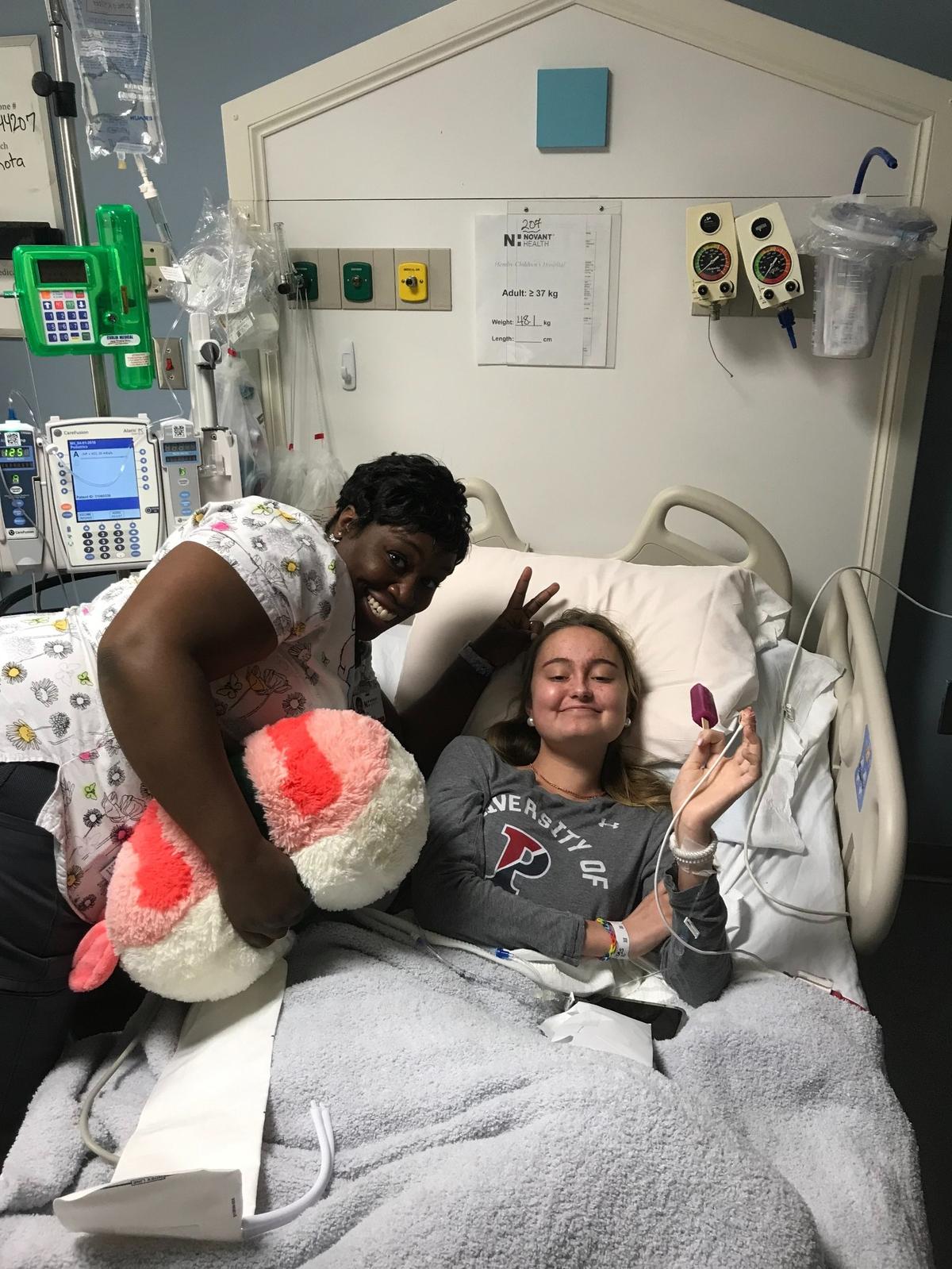
Over the next five months, as Little Jane’s DIPG wreaked its havoc, it eventually took her ability to walk. It took her ability to see. For the last half of her battle, it took her will and desire to eat. Vomiting, passing out and falling over became daily occurrences.
“It was a nasty, awful fight,” Mama Jane says. “What she lived through the last three months was worse than death.”
Mama Jane still can’t talk about the ordeal without tears spilling onto her cheeks. Mike’s face still becomes ashen any time a conversation shifts to the pain they all endured as Little Jane got sicker and sicker. If you didn’t know, and someone told you their daughter had died not four years ago but four weeks ago, you’d believe them.
Yet at the same, no one in her family can talk about watching Little Jane slowly die without expressing admiration for the dignity with which she did.
They talk about how she didn’t want brain shunts, or feeding tubes, or ventilators. They talk about how she laughed with them through chemo, through radiation, through catheter insertions, when she fell down while trying to walk. They talk of how concerned she was about the impact that her passing would have on her parents and on Piper, Max and Sam. About how Mama Jane is a physician, and how Jane privately reached out to Mama Jane’s nurse to say, If Mom doesn’t show up to work after I’m gone, you go get her and tell her she has to. For me.
“Her two words were ‘keep living,’” Max says. “I want you guys to keep living. Keep loving each other. Don’t worry about me.”
And — after just briefly, early on, grieving the fact that she would not live to grow up to change the world — she became steadfast in her belief about this:
I’m not gonna change the world. But you guys are.
Paying for a boat to make hope float
For a year and a half after Little Jane died, maybe two, the Harrells did keep living. But they weren’t doing a whole lot to try to change the world. They were just trying to make it through the day without breaking down.
Then one day Mama Jane learned about a couple who had a teenage daughter with a recent DIPG diagnosis. Their community had started a fundraiser to help with medical expenses, but Mama Jane found out both parents had stopped working to care for their daughter, putting their finances into the red. She also found out the family had a boat that was the girl’s favorite thing in the world. The parents had originally hoped she’d live long enough to get back into it, but they were about to give up on that dream and sell it to help stave off spiraling debt.
In Mama Jane’s mind, the girl would never be well enough to get back in that boat. But she knew, from experience, that the parents were going to need that boat when their child was gone.
They needed, in her words, “that hope of the boat.”
That night, she came home, told Mike about it, asked him what he thought they should do. Mike — who everyone in the family says is not a crier — doubled over, sobbing. All he could get out was that, yes, they should absolutely save that family’s boat.
Mama Jane and Mike, who is a senior partner at a commercial real estate firm in Charlotte, hadn’t had to worry at all about those kinds of financial pressures with their own daughter. They were able to focus completely on Little Jane.
So, wanting that for this family, too, they ended up paying off the family’s mortgage. Out of their own pockets. Anonymously.
“We never met ’em,” Mike says. “Never talked to ’em. Still haven’t ever made that connection, which is totally fine. But I think that for me was kind of the beginning, to think about, Hey, we know this pain that these families are going through. We were blessed enough to have amazing people supporting us where we could stay with our daughter for five months, and not worry about finances. So we want to make sure anybody else that ever has to go through anything like this doesn’t have to experience things on the side, like worries about their financials.
“To maybe give some of these families some hope.”
They didn’t need, and still don’t need, to see the expressions on the faces of people who they surprise with gifts. They’re the type of folks who pay for the people behind them in the drive-thru line, then take off without looking back.
What they did, realize, however, is that they had done something they never would have if not for their daughter’s influence.
That it made them feel good because it connected them to her in a way that made them remember her lightness instead of those dark days near the end of her illness. That what they did had not only made a dent in fulfilling the challenge she had given to them — change the world — but also helped them move slightly closer to something that felt like healing.
They knew what they had to do next, and they knew what it was going to be called.
Right away, ‘the money poured in’
Mama Jane filed the paperwork for Jane’s Fund to become a nonprofit in September 2021, but for more than a year’s time it was in pseudo-soft-launch mode.
The family quietly spent those many months establishing relationships with schools and hospitals, and on an informal basis, they helped families dealing with terminal cancer diagnoses here, students from lower-income families who were getting lackluster opportunities there.
Their mission had a wide-ranging, almost nebulous scope then. The Harrells were still working on it.
But this past January, they sent out a gratitude letter to friends, acquaintances and colleagues who had brought them comfort and support in myriad ways during their trials through Jane’s illness.
With it, the family formally launched Jane’s Fund, which it said would focus on five areas — sports, education, camp, smiles and terminal pediatric cancer — and was “created to bring hope and transformational change to children and their families experiencing personal hardship. Jane’s Fund identifies projects in the community where encouragement and financial support will not only ease pain and suffering, but also provide opportunities for new life.”
There wasn’t an aggressive plea for donations. And yet, says Lauren, Jane’s Fund’s executive director, “the money poured in.”
It’s not unusual for startup nonprofits to struggle to gain traction. There’s a reason this one did, however, and it’s no big mystery: Mike and Mama Jane, once again, are very financially comfortable; they have many friends, acquaintances and colleagues who are very financially comfortable; and those people deeply love, respect and sympathize with Mike and Mama Jane.
As for Jane’s Fund’s mission, well, the Harrells have since decided if it sounds too broad, that’s OK. It does and will always have a particular focus on families of children dying of cancer, but otherwise, Lauren says, “we exist to help families and children going through hardship.” That makes Jane’s Fund flexible. That makes it so it can provide summer-camp experiences like the ones Jane used to love; or dental or surgical solutions for producing more confident smiles; or expensive musical instruments or sports equipment for programs at Title 1 schools.
As Mama Jane puts it: “This’ll be what God wants it to be. We’ll just raise our hands and say, ‘We’re here. How can we help?’”
As of this month, less than a year after that letter went out, Jane’s Fund has raised $2.7 million.
But what’s even more remarkable is the amounts the fund has given out — and the simplicity of the process.
Seeing a need, taking swift action
While longstanding personal relationships played a significant role in getting money into the fund, the way Jane’s Fund puts that money back out into the world is different.
It uses an approach called trust-based philanthropy. In practice, that means it almost all but eliminates red tape by leaning on the new relationships the Harrells — and, since being hired as executive director this past fall, Lauren — have built over the past two years with hospital social workers and school administrators and staffers and largely empowering those individuals to identify and vet potential projects. (There is a grant application form, but for now, the family is trying to keep the approach as personal as possible.)
In terms of how Jane’s Fund is helping healthy, living kids, here’s one of many examples from over the past year:
Ken Loeber knew of the Harrells through business and social spheres, and at the time was board chair of Greater Enrichment Program (GEP), an after-school program that focuses on opportunities for kids from limited-income families.
A mutual friend suggested a meeting with Mama Jane, at which she asked, point-blank: What do you need? Ken replied that their buses — which they rely on to take kids to events and to get them home since their parents often can’t — were decades old. Maybe tuneups for them?
She said that didn’t seem sufficient. How much would a new bus cost?, she asked. After the meeting, he sent her an email to say the answer was about $100,000.
Not long after that, Ken got a call from Mama Jane. “She said, ‘Ken ... we want to provide two (15-passenger) vans,’” he says. “I was at a loss for words. I was brought to tears.”
Another example: Alisa Jones, a family advocate at Renaissance West STEAM Academy — a school with one of the highest-poverty rates in North Carolina — was introduced to Mama Jane in 2022. Since then, the Harrells have been in a partnership with Renaissance West that has included support for various programs.
This past summer, a teacher pitched the idea of taking the entire sixth-grade class (about 60 students) to see the “Marvel: Universe of Super Heroes” exhibit at Discovery Place Science. But the money just wasn’t there.
Well, along came Mama Jane with an out-of-the-blue call to ask if they had any needs.
“I was like, ‘It’s a reach, but we do have sixth grade wanting to go on this trip,’” Alisa says. “Literally, she said, ‘How much? ... Who do we pay?’ It was just that simple.”
The hope, the Harrells say, is that Jane’s Fund will grow to a point when it can do this for all Title I schools in Charlotte, and eventually be able to spread these kinds of opportunities to students in need throughout the state.
If Little Jane hadn’t gotten DIPG — if she was still alive — helping healthy, living kids is exactly the type of thing she would have done.
But because she did, and because she’s gone, the Harrells also keep doing something else. Something Little Jane might not necessarily have otherwise considered.
‘Everything is and will be OK’
In total, Jane’s Fund to date has awarded $1.8 million in gifts, and those gifts have included help for more than 20 families in the midst of dealing with children who’ve been given terminal cancer diagnoses.
Not just payment of utility and phone bills — though they have done that — but also things like covering car payments, or rent payments, or urgent home repairs, or sometimes funeral expenses.
But perhaps most impressive of all: Jane’s Fund has paid a portion of 11 mortgages, and has fully paid off five of them. One was for the family of Sunnie Williams, the 11-year-old Monroe girl who is battling DIPG. Two more will be Christmas-morning surprises under the trees of two other families.
Lauren and the Harrells identify these families with the help of social workers at Novant Health Hemby Children’s Hospital, Atrium Health Levine Children’s Hospital, and Atrium Health Wake Forest Baptist | Brenner Children’s Hospital in Winston-Salem. Social workers like Mallory Valverde at Levine.
“When I have to do a new-diagnosis conversation with a family, that’s the worst day of their lives,” Mallory says. “Their only focus in that moment is about their child. What am I gonna do? How am I gonna go to work? How am I gonna pay my bills? How am I gonna get my kid to treatment?
“And we have a lot of foundations that will cover certain bills, little things here and there, but Jane’s Fund comes in and they’re like, OK, we’re gonna cover four months of their car payment or six months of their mortgage and — well, you know what? We’re gonna pay off their mortgage. That’s life-changing.”
Adds Juliet Galton, another Levine Children’s social worker: “What’s different — what’s special — is the amount and breadth for the way that they help. ...
“Often those families have been in treatment a long, long time, and they have used up all their other existing resources over the years. But yet the need is even more now because they really want to spend those last moments with their child, and not have to be pulled away for any other reason.”
That’s it. That’s the whole point, as far as Jane’s Fund is concerned. To let love, care and togetherness be the focus. To give parents every chance to tell their child everything they ever wanted to tell them, in the precious little time remaining. Like the Harrells got to do with Little Jane.
They don’t do it anonymously anymore. But they do still stay in the background as much as possible, save for a note from Mama Jane.
“I’m Jane,” she wrote in the one to Sunnie’s mom, Jade, earlier this fall, “and my daughter Jane had DIPG and we laughed, cried and pinky promised our way thru the highs, the lows, the incomprehensible, and the miracles. Live each moment knowing that everything is and will be okay — pinky promise.”
She signed it “Jane,” and it’s not hard to imagine that she was doing so on behalf of both herself and her daughter.
This story was originally published December 20, 2023 at 6:00 AM.