A 13-Foot Shark Filmed In Antarctic Depths Where Scientists Said Sharks Didn’t Exist
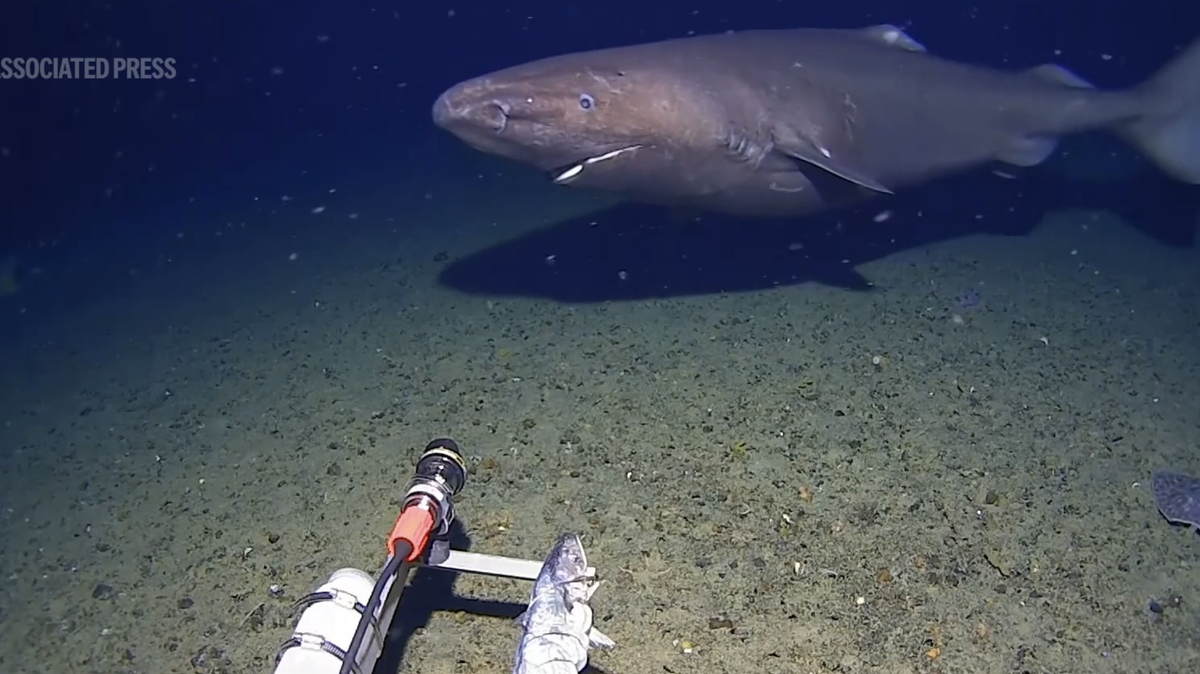
In January 2025, a deep-sea camera dropped into near-freezing water more than 1,600 feet below the surface of the Antarctic Ocean captured something no one expected: a massive sleeper shark staring back at the lens. The footage, recorded by the Minderoo-UWA Deep-Sea Research Centre off the South Shetland Islands near the Antarctic Peninsula, challenges a long-held assumption that sharks simply do not inhabit these waters.
The center gave The Associated Press permission to publish the images on Wednesday, Feb. 18.
This was no small animal. The specimen was estimated to be between 10 and 13 feet long — a full-grown predator found thriving in one of the planet’s most extreme marine environments.
‘These Things Are Tanks’
Alan Jamieson, founding director of the University of Western Australia-based research center, was blunt about what the team encountered.
“We went down there not expecting to see sharks because there’s a general rule of thumb that you don’t get sharks in Antarctica,” Jamieson said.
“And it’s not even a little one either. It’s a hunk of a shark. These things are tanks,” he added, per AP.
A shark in the 10-to-13-foot range is a formidable animal in any ocean. Finding one at depth in Antarctic water that hovers just above freezing puts this discovery in rare company.
Jamieson said he could find no record of another shark found in the Antarctic Ocean. Peter Kyne, a Charles Darwin University conservation biologist independent of the research center, agreed that a shark had never before been recorded so far south.
“This is great. The shark was in the right place, the camera was in the right place and they got this great footage,” Kyne said. “It’s quite significant.”
A Survival Strategy Written In Water Temperature
The specifics of where this shark was found are as telling as the animal itself.
The shark was observed at a depth of 1,608 feet, where the water temperature was 34.29 degrees Fahrenheit — barely above the freezing point of freshwater and remarkably cold for any large predatory fish.
Jamieson said the photographed shark maintained a depth of around 1,640 feet along a seabed that sloped into deeper water. The shark remained at that depth because it was the warmest of several stacked water layers.
The Antarctic Ocean is stratified to a depth of around 3,280 feet due to colder, denser water below not readily mixing with freshwater from melting ice above. This layered structure creates distinct thermal bands. The shark appeared to be tracking the warmest available zone — a calculated response to a brutally cold environment.
Whale Falls and Giant Squid On the Menu
What does a massive sleeper shark eat in the deep Antarctic? According to Jamieson, the answer involves some of the ocean’s most impressive creatures.
Jamieson expects other Antarctic sharks may live at similar depths, feeding on carcasses of whales, giant squids and other marine animals that sink to the seafloor.
For anyone familiar with the concept of “whale fall,” where a dead whale descends to the deep ocean floor and sustains entire ecosystems for years, this connects the sleeper shark to one of the most dramatic ecological processes in the deep sea. These sharks may be scavenging on remains of animals that are themselves among the largest on the planet. The picture that emerges is of a deep-sea world far more active and interconnected than surface observations would suggest.
A Three-Month Window In a Vast, Unwatched Ocean
This discovery also reveals how little of the deep Antarctic has actually been observed.
There are few research cameras positioned at that depth in Antarctic waters, and they can operate only during the Southern Hemisphere summer months, from December through February.
“The other 75% of the year, no one’s looking at all. And so this is why, I think, we occasionally come across these surprises,” Jamieson said.
For nine months out of every year, there are essentially no eyes on these depths. The window for observation is narrow, the equipment is limited, and the remoteness of the region makes sustained monitoring a serious logistical challenge. The fact that a camera happened to be recording in the right place at the right time during that slim operational window makes this footage all the more valuable.
The camera also captured a skate, visible in the footage and motionless on the seabed. Scientists already knew skates inhabit waters that far south, but its presence alongside the shark adds detail to the picture of what the deep Antarctic seafloor community looks like.
Could There Be More?
Jamieson said the sleeper shark population in the Antarctic Ocean is likely sparse and difficult for humans to detect.
Kyne said climate change and warming oceans could potentially be driving sharks toward colder Southern Hemisphere waters, but data on range changes near Antarctica is limited due to the region’s remoteness. He also said sleeper sharks could have been present in Antarctic waters without being detected.
That second possibility is particularly striking. If sleeper sharks have been quietly occupying these depths all along, undetected simply because nobody was looking, the biodiversity of the deep Antarctic may be more complex than current records indicate.
The deep ocean remains one of the last places on Earth where a single camera deployment can rewrite the textbooks. And sometimes, when you drop that camera into the dark, a 13-foot shark swims into frame.
Production of this article included the use of AI. It was reviewed and edited by a team of content specialists.