Newly Discovered Galaxy From 8.5 Billion Years Ago Offers Rare Look at Early Cosmic Evolution
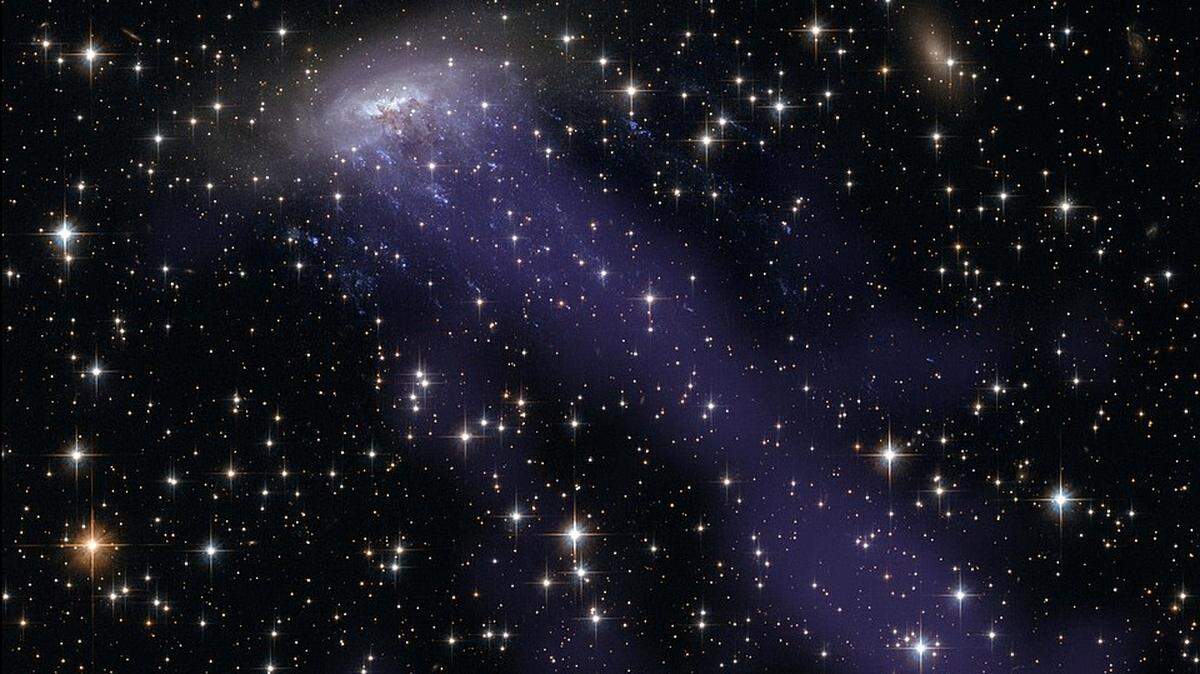
Astrophysicists from the University of Waterloo have identified the most distant jellyfish galaxy ever observed, a finding that forces researchers to reconsider when the universe’s harshest environments began reshaping the galaxies inside them.
The galaxy, cataloged as COSMOS2020-635829, was spotted in data from the James Webb Space Telescope (JWST) and has a redshift of z = 1.156, meaning astronomers are seeing it as it existed about 8.5 billion years ago.
The findings were published in The Astrophysical Journal.
The discovery suggests the processes responsible for killing star formation in galaxies may have been at work far earlier in cosmic history than researchers had assumed.
Bright blue knots of very young stars dot the galaxy’s gas trails, indicating stars are forming outside the main galaxy within stripped gas itself.
What Is a Jellyfish Galaxy?
A jellyfish galaxy is found in dense clusters and appears to be “dripping” gas, forming long, tentacle-like tails of newborn stars trailing behind it. The process creating it is called ram-pressure stripping.
The hot, dense intergalactic medium of a galaxy cluster pushes against a galaxy moving through it, tearing away its interstellar gas.
COSMOS2020-635829 has a normal disc structure, but those bright blue knots in its gas trails are very young stars — born in the wake of destruction.
Why This Discovery Matters
The galaxy’s extreme distance is what makes the finding significant.
Before this, jellyfish galaxies had been documented at closer distances, and the assumption was that ram-pressure stripping needed a more mature, settled cluster environment to occur.
COSMOS2020-635829 pushes that timeline back by billions of years.
“We were looking through a large amount of data from this well-studied region in the sky with the hopes of spotting jellyfish galaxies that haven’t been studied before,” Dr. Ian Roberts, Banting Postdoctoral Fellow at the Waterloo Centre for Astrophysics in the Faculty of Science, said in a news release.
“Early on in our search of the JWST data, we spotted a distant, undocumented jellyfish galaxy that sparked immediate interest,” he added.
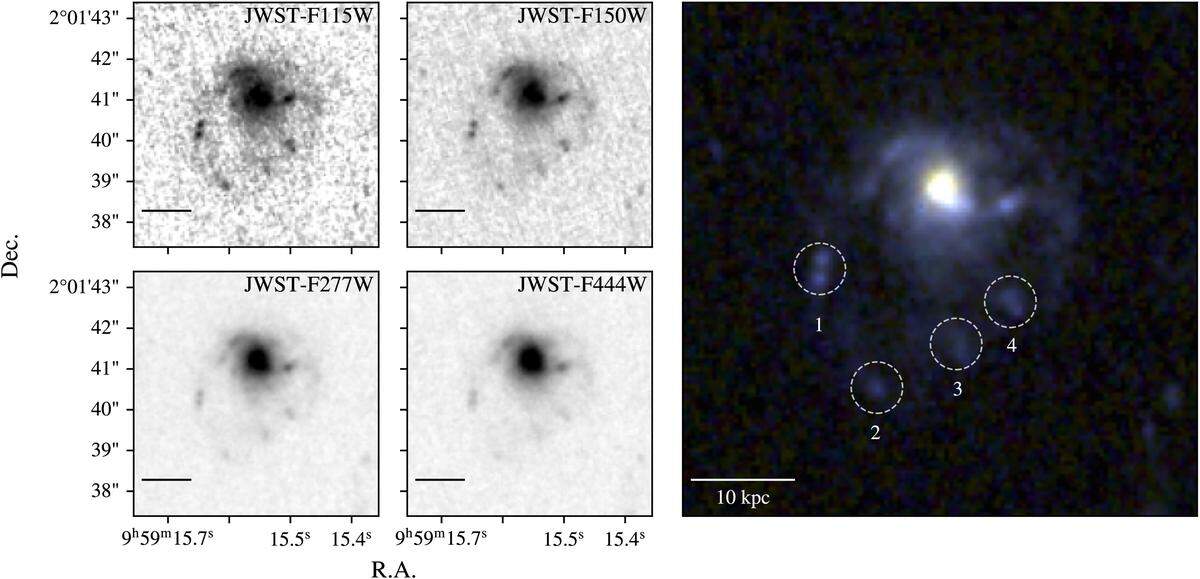
The team drew three key conclusions that challenge existing models of cosmic evolution.
“The first is that cluster environments were already harsh enough to strip galaxies, and the second is that galaxy clusters may strongly alter galaxy properties earlier than expected,” Roberts said, per the release.
“Another is that all the challenges listed might have played a part in building the large population of dead galaxies we see in galaxy clusters today. This data provides us with rare insight into how galaxies were transformed in the early universe,” he added.
“Dead galaxies” refers to galaxies that have stopped forming stars entirely. Galaxy clusters today are full of them. This discovery suggests the processes responsible may have started far earlier than assumed.
The Telescope That Made It Possible
The JWST is the largest, most powerful infrared space observatory ever launched, designed by NASA, ESA, and CSA. Launched on December 25, 2021, it orbits the sun one million miles from Earth, using a 6.5-meter gold-coated mirror to peer through dust and observe the very first galaxies formed after the Big Bang.
That infrared capability allowed the team to identify the jellyfish galaxy’s features at such an extreme distance.
The galaxy was identified in the COSMOS field (Cosmic Evolution Survey Deep field), a region frequently studied because it is far from the Milky Way’s plane, has minimal interference from stars and dust, provides a clear view of distant galaxies, and is visible from both hemispheres.
What Happens Next?
Stars born outside their parent galaxy, in the turbulent wake of ram-pressure stripping, point to creative processes at work in some of the universe’s most destructive environments.
The galaxy’s distance, structure, and the three conclusions drawn by the Waterloo team suggest the early universe was a more dynamic, more aggressive place than scientists had mapped out.
The JWST continues to deliver discoveries that shift established timelines in astrophysics — reaching deeper into cosmic history than any previous instrument and finding things that don’t fit neatly into prior models.
BOTTOM LINE: This single distant jellyfish galaxy suggests the universe’s most violent galaxy-shaping processes started billions of years earlier than expected, and the JWST has barely scratched the surface of what it can reveal.
Production of this article included the use of AI. It was reviewed and edited by a team of content specialists.