Ancient Species With Twisted Jaw, Sideways-Facing Teeth Leaves Scientists Stunned
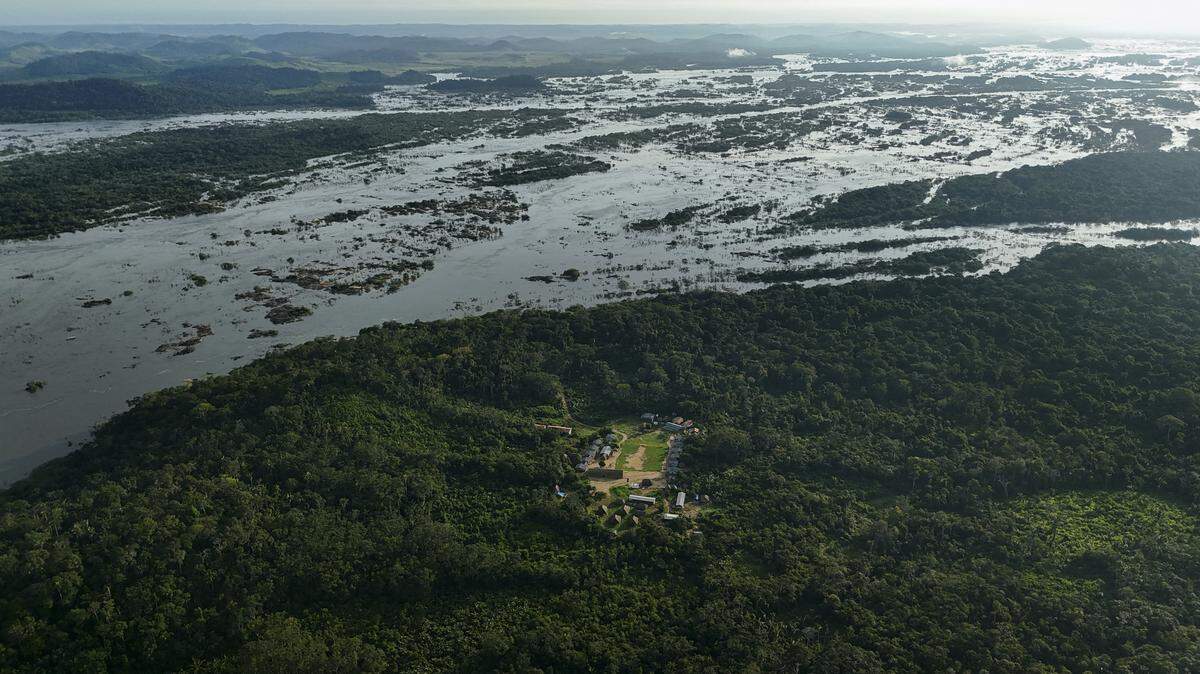
Researchers working near the Amazon rainforest in Brazil unearthed a twisted fossilized jawbone and couldn’t figure out what they were looking at. Was it broken? Deformed? Did it belong to a fish?
The answer, it turned out, was far stranger than any of those explanations — and it took nine separate specimens to prove it.
The new species has been named Tanyka amnicola, a name that roughly translates to “jaw living next to the river.”
It lived roughly 275 million years ago during the Early Permian Period, and its jaw defied everything scientists expected from an animal of that era.
A Living Fossil That Didn’t Make Sense
The initial discovery looked like a mistake. A team excavating near the Amazon rainforest in Brazil pulled a jawbone from the rock, and its shape immediately raised questions.
Geological pressure can warp fossils over millions of years. Damage during excavation can distort them. And the overall form looked like it might have come from a fish.
“At first, we wondered if these fossils might be the remains of a fish,” co-author Martha Richter recalled, per the Natural History Museum. “It was only once the fossils were properly prepared in the lab that the true nature of Tanyka was clearly revealed to us.”
Had researchers found only that single twisted jawbone, they might have written it off as damaged. One oddity can be dismissed. But then a second turned up. Then a third.
Nine total jawbones emerged over time, each displaying that same unmistakable twist. Among them were remarkably well-preserved examples that left little room for doubt.
“It’s a really strange animal, and the weird twist in the jaw drove us crazy trying to figure it out. But nine jaws we’ve found have this twist, including the really well-preserved ones, so it’s not a deformation. It’s just the way this animal was,” lead author Jason Pardo added, per the NHM.
The study describing the species was published in the journal Proceedings of the Royal Society B.
A Jaw Unlike Anything Seen Before
In most tetrapods — from lizards to lions to your household cat — the teeth in the upper and lower jaws face each other. This allows animals to slice, cut and grind food effectively.
Tanyka broke that mold entirely.
Its lower jaw twisted outward from back to front. Some of its teeth pointed outward and sideways, not toward the opposing jaw but off to the side. Lining the inside of the jaw were small grinding teeth called denticles.
If you were to run your tongue over the teeth on your lower jaw, you would feel the tops of your teeth facing up towards the roof of your mouth.
In Tanyka, the twisted lower jaw meant the teeth were pointed out to the sides. The part of the jawbone that normally faces the tongue is pointed upwards.
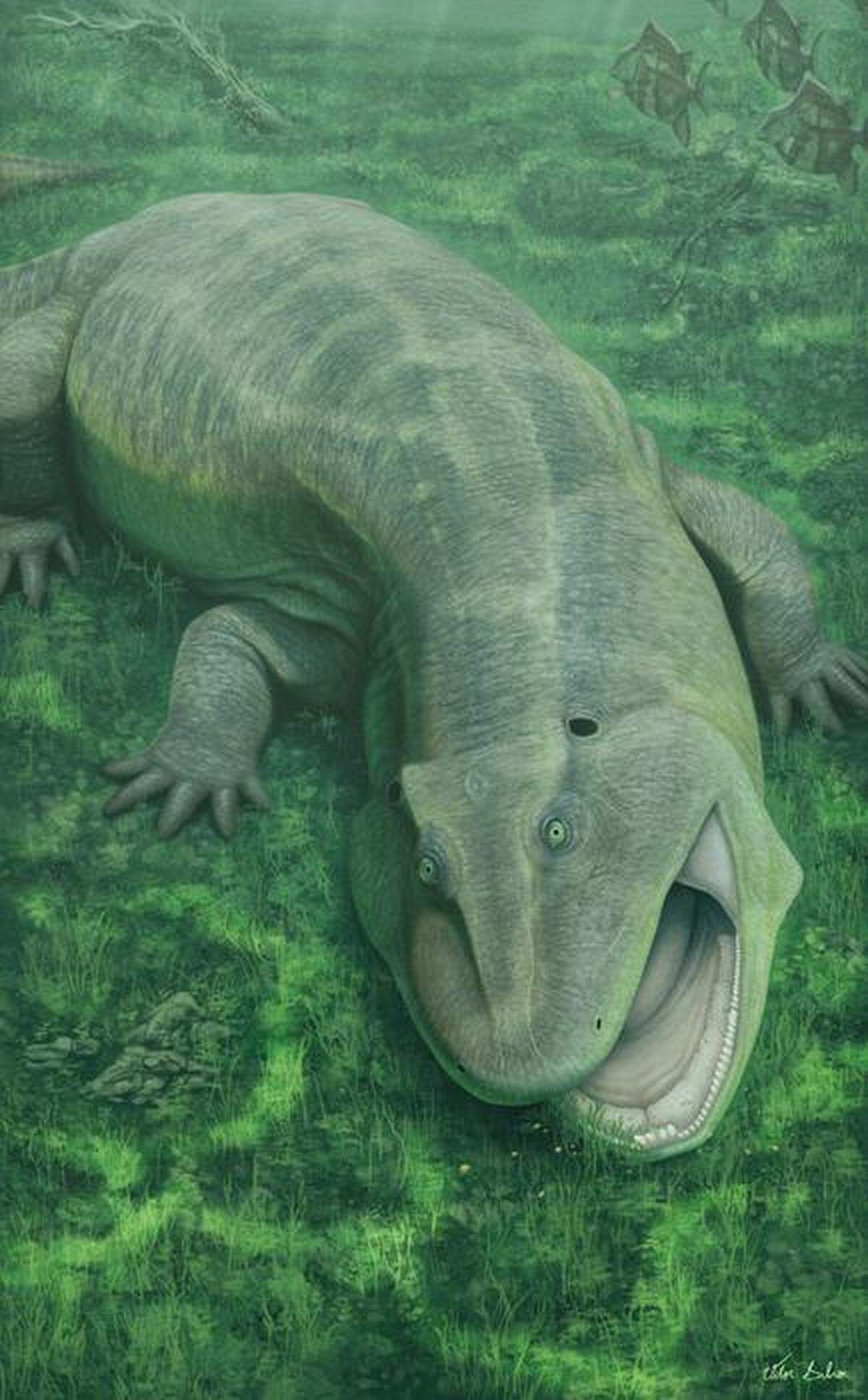
Researchers believe those denticles in the upper and lower jaws likely rubbed together to grind food. This mechanism suggests Tanyka may have eaten tough plant material and small invertebrates with hard shells.
Unlike many of its meat-eating relatives, this creature may have been omnivorous or herbivorous.
The species belonged to what researchers described as a more experimental stage in early animal evolution — a time when nature was trying out wildly different designs to see what worked.
Tanyka amnicola Was Like a Platypus
Tanyka belonged to a group called stem tetrapods, early relatives of modern four-limbed animals. This ancient lineage eventually gave rise to the ancestors of amphibians, reptiles, birds and mammals.
Here’s the catch: most stem tetrapods went extinct long before Tanyka lived. This creature was a holdover, a relic of an earlier evolutionary era still hanging on while newer, more advanced animals were already evolving around it.
Pardo offered an analogy that makes the concept tangible. He compared the species to a platypus.
“Tanyka is a little like a platypus, in the sense that it was a member of the stem tetrapod lineage that remained even after newer, more modern tetrapods evolved,” Pardo said, per the NHM. “It was a living fossil in its time.”
Just as the platypus retains ancient mammalian traits that seem out of step with modern mammals, Tanyka retained primitive features that had long since disappeared in more recently evolved animals.
Scientists are uncertain about Tanyka’s full body shape because only jaw fossils have been definitively linked to the species.
Researchers believe it likely resembled a salamander-like animal with a longer snout. Other nearby fossils may belong to the same species, but this has not yet been confirmed.
For now, the picture is of a salamander-shaped creature with a long snout and that remarkable twisted jaw — a small, strange animal grinding its food in a way no other known creature did.
A Survivor Against the Odds
During the time Tanyka lived, all of Earth’s land was joined into the supercontinent Pangaea. The climate in the region where the fossils were found was likely hot and seasonally dry.
Scientists long believed that stem tetrapods largely disappeared after a major ecological event known as the Carboniferous Rainforest Collapse.
This catastrophe caused widespread destruction of tropical forests and the loss of humid environments that many early tetrapods relied on. Stem tetrapods were thought to be among the casualties.
The discovery of Tanyka amnicola challenges that assumption. It suggests some stem tetrapods survived much longer than scientists thought.
One possible explanation: species in the southern part of Pangaea may have experienced different climates than those in the north. These conditions may have allowed them to survive after northern populations went extinct.
“By comparing its anatomical traits to the characteristics of known species from across hundreds of millions of years, we found that this animal was actually a primitive tetrapod after all,” Richter added.
What began as confusion over a seemingly broken fish bone produced one of the more remarkable paleontological finds in recent memory.
Nine identical twisted jawbones. A creature that ground its food sideways. A living fossil that outlasted its own kind by millions of years on the southern edge of a supercontinent while the world transformed around it.
The story of Tanyka amnicola started with the words every scientist dreads and secretly loves: “That can’t be right.”
Production of this article included the use of AI. It was reviewed and edited by a team of content specialists.