The World's Most Endangered Sea Turtle Just Washed Ashore in Texas. Now It Needs Help
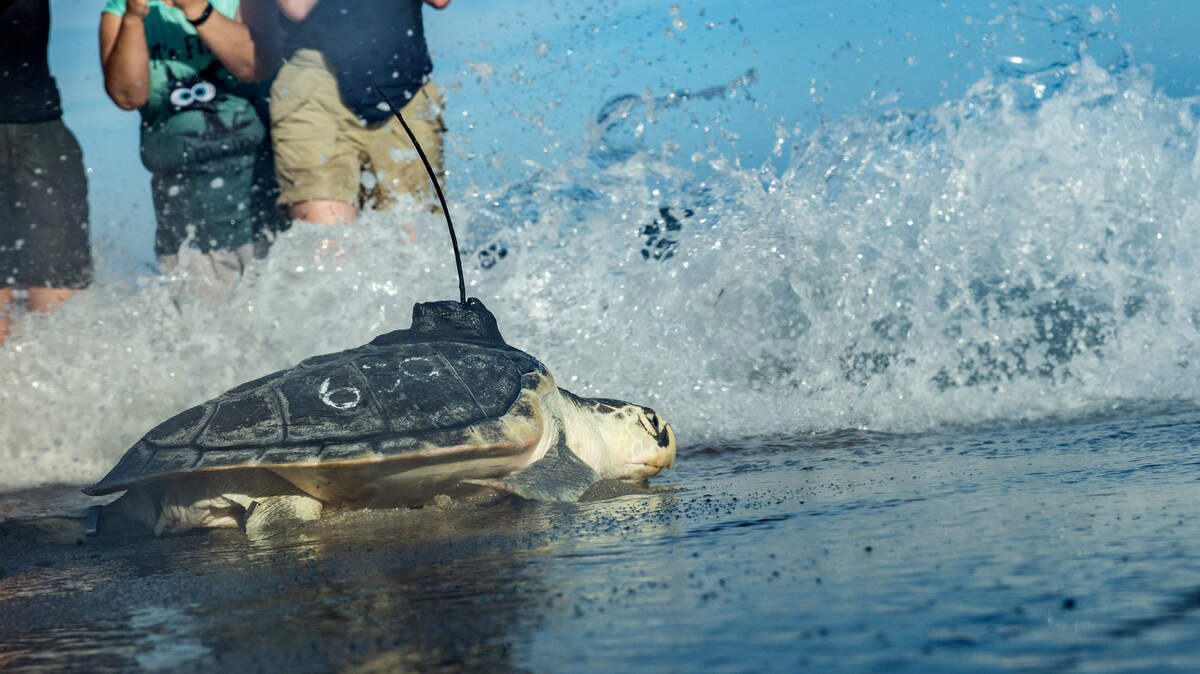
A massive adult female Kemp’s ridley sea turtle — the world’s smallest and most critically endangered sea turtle species — washed ashore near Beach Pocket Park #3 in Galveston on March 7.
She was lethargic, weighed down by marine growth, and in trouble.
The Gulf Center for Sea Turtle Research (GCSTR) got word through the Texas statewide sea turtle hotline. What followed involved a zoo veterinary team, a rehabilitation hospital, and a species so rare it carries its own state designation.
According to KHOU11, the turtle was “lethargic and covered in barnacles, algae and sediment.”
That coating told its own story. Christopher Marshall, director of the GCSTR, broke down the science in an interview with Chron, published March 11.
“Healthy sea turtles are swimming sea turtles,” Marshall said.
“Sea turtles that slow down their swimming due to health issues are quickly colonized by organisms in the water,” he added. “This can turn into a positive feedback loop in that the extra weight causes the turtle to slow down further and expend further energy, which allows more epibionts to grow.”
Epibionts — barnacles, algae, other marine organisms — latch onto a turtle’s shell and body. A healthy, active turtle moves fast enough to keep colonization in check. Once a turtle slows, the growth accelerates.
More weight means more energy spent, which means more slowdown, which means more growth.
The turtle was rushed to the Houston Zoo for evaluation by veterinary partners, then transferred to a rehabilitation hospital. Marshall told Chron the turtle is in “critical condition” but receiving the “best care” at the Houston Zoo.
Once she recovers, she will be released back into the Gulf.
Why Kemp’s Ridley Sea Turtles Matter to Texas
The Kemp’s ridley sea turtle (Lepidochelys kempii) is the world’s smallest most critically endangered sea turtle species, per the National Park Service.
Texas designated it as the official state sea turtle because of its critical status and connection to the region.
These turtles nest primarily on Padre Island in Texas and in Mexico. Padre Island National Seashore hosts the largest number of nests in the country.
The species is named after Richard M. Kemp, a fisherman from Key West, Florida, who first submitted the species for identification in 1906, per the National Oceanic and Atmospheric Administration (NOAA).
The Kemp’s ridley turtle is listed as endangered under the Endangered Species Act.
They’re physically distinct: a triangular-shaped head with a slightly hooked beak, grayish-green color on top, yellowish bottom. Each front flipper has one claw; the back flippers may have one or two.
Adults are small compared to other sea turtle species, which makes the Galveston turtle’s description as “massive” relative to its own kind.
Other Kemp’s Ridleys Were Recently Returned to Gulf
The Galveston rescue wasn’t isolated. The same week, 27 Kemp’s ridley sea turtles were returned to the Gulf in Mississippi after nearly four months of rehabilitation at the Audubon Institute.
Those turtles had migrated to New England before getting trapped in the Cape Cod area, where they were cold-stunned (similar to hypothermia), according to WWL. They had been in captivity at the Audubon Institute since November.
The damage was extensive.
“A lot of them had shell lesions, frostbite lesions from that cold. So, once those start to heal up as well. A lot of them come in with eye problems, eye ulcers from the sand and the wind,” Gabriella Harlamert of the Audubon Aquarium Rescue told WWL.
On March 11, the sea turtles were safely returned to the Gulf. More than 100 people attended to watch the turtles reach their natural habitat.
Two rescues, two Gulf Coast states, one endangered species — all in the same narrow window of time.
What to Do If You Spot One In Need of Help
The rescue network that connected the Galveston turtle to the Houston Zoo started with a single report of a stranded animal. That’s the entry point for anyone who spends time on Gulf Coast beaches.
Anyone who encounters a stranded or nesting sea turtle is asked to call the Texas statewide sea turtle hotline at 1-866-TURTLE-5.
Knowing how to recognize a Kemp’s ridley helps, too. Their grayish-green shell, triangular head, and relatively small size set them apart from larger species like loggerheads or green sea turtles.
A sea turtle that isn’t moving, is covered in growth, or appears to be struggling warrants a call — even if you can’t identify the species.
The organizations involved in these rescues, from the GCSTR to the Houston Zoo to the Audubon Institute, rely on early reports from the public. The faster a stranded turtle gets flagged, the better its chances.
With nesting season approaching on Padre Island, the chances of encountering a Kemp’s ridley along the Texas coast go up.
Knowing what to look for — and having that hotline number saved — could make a difference for a species that’s been fighting back from the brink for decades.
Production of this article included the use of AI. It was reviewed and edited by a team of content specialists.
This story was originally published March 12, 2026 at 2:20 PM.