Disabled Kea Parrot Achieved Alpha Status Through Innovation Alone, Rewrites History
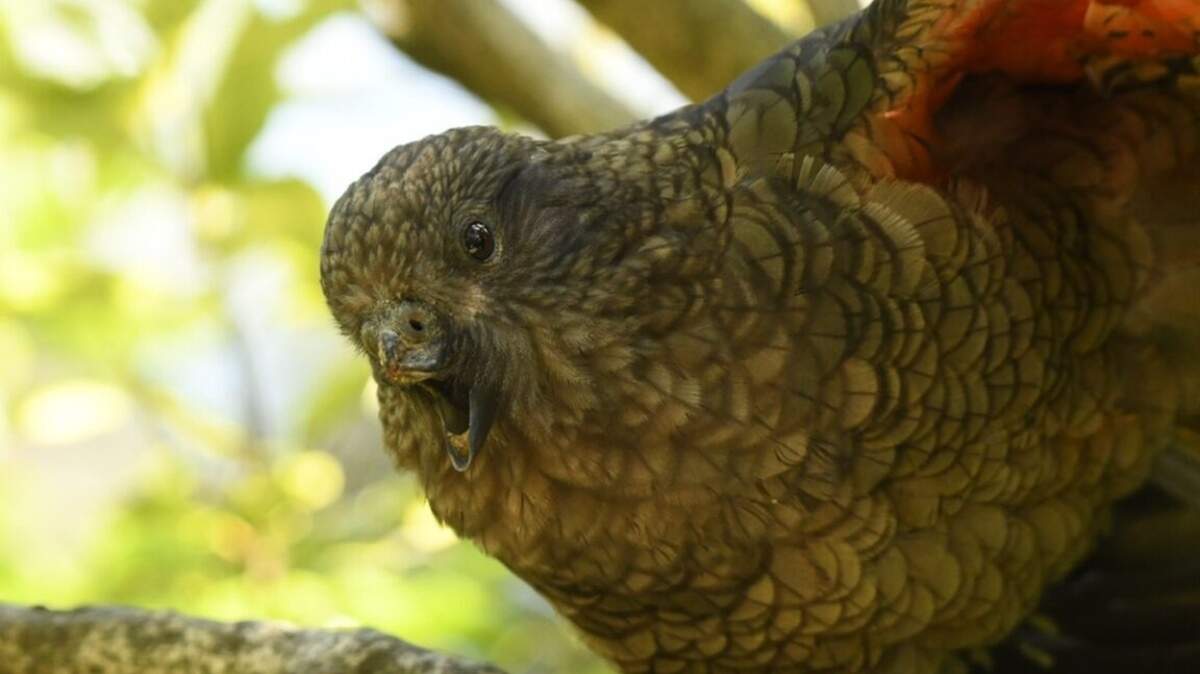
A kea parrot missing the entire upper half of his beak has become the dominant male of his social group — and in doing so, delivered the first documented case of a physically disabled animal of any species individually achieving and maintaining alpha status through behavioral innovation alone.
The findings, published Monday, April 20, in Current Biology, challenge core predictions of contest theory and offer a rare individual-level demonstration of how behavioral flexibility operates in a large-brained, non-primate species.
The Subject and the Study Site
The parrot, named Bruce, is an endangered kea found in 2013 by bird expert Raoul Schwing in mountainous Arthur’s Pass, New Zealand. It is not clear how Bruce lost part of his beak. He ended up at Willowbank Wildlife Reserve, where researchers conducted a long-term observational study of his behavior within a captive social group.
The research team, which includes study coauthor Ximena Nelson, a professor of animal behavior at the University of Canterbury in New Zealand, systematically tracked social interactions, aggressive encounters, feeding access, grooming behavior and stress hormone levels. What they found defied expectations.
A Novel Fighting Strategy for Bruce
Contest theory predicts that larger or better-armed individuals should dominate in agonistic encounters. Bruce, lacking his primary weapon — the powerful hooked upper beak kea typically use for biting — should have been at a profound disadvantage. Instead, he developed what the researchers describe as a “jousting” technique.
“Bruce deployed his exposed lower beak in jousting thrusts, both at close range, with an extension of his neck, and from afar, with a run or jump that left him overbalanced forward with the force of motion,” the report says. “During further behavioral observations, this jousting targeted opponents using motions intact kea do not replicate.”
This approach proved highly effective, allowing Bruce to win the majority of confrontations.
“Because of his disability, he has had to innovate behaviors. He’s found a way to make himself more dangerous,” says Nelson.
The finding is consistent with kea’s reputation for ingenuity. “They’re often called hooligans and rightly so,” Nelson says. The birds make snowballs, sled on their backs, joyfully deface tourists’ cars and use their beak to fling rocks at passing people, she says.
Bruce Exhibits Measurable Dominance Across Multiple Metrics
The study documented Bruce’s alpha position not only through combat outcomes but through quantifiable social and physiological indicators.
“Bruce’s alpha position was reflected not only in combat, but also in measurable benefits across social interactions, feeder priority, and physiology. He was the only individual to receive allopreening from a non-mate, directed at the inside of his lower beak to remove debris, his head and neck, or all three areas,” the report says.
His feeding priority was equally striking. Despite four central feeders being deliberately distributed to prevent monopolization, Bruce was first to arrive on any feeder on 83 percent of recorded days, was never challenged while feeding and on four days maintained sole access to all four feeders for at least 15 minutes before subordinates visited stations he had vacated.
As the top-ranked individual, Bruce also exhibited lower stress hormone levels than other birds in the group — a physiological signature of secure dominance.
Some Broader Implications and Skepticism
The researchers argue the findings support an emerging view that disability provides a powerful natural lens on behavioral flexibility and resilience in animals. They also raise a provocative question about whether well-intentioned prosthetic assistance for physically impaired animals will always improve positive animal welfare.
“The bird missing his upper beak has rewritten what disability means for behaviorally complex species,” the report states.
Christina Riehl, an evolutionary biologist at Princeton University who wasn’t involved in the new work, calls the findings illustrative of how “ingenious” these alpine parrots can be. “This bird is using behavioral flexibility to compensate for a disability, which is really cool,” she says.
But Riehl isn’t entirely convinced of the broader framing. “Maybe Bruce would be even better off if he had his upper beak intact,” she says. “Who knows?”
It is a fair caveat — one the study’s design, observing a single individual in a captive group, cannot fully resolve. Still, the systematic documentation of Bruce’s dominance across combat, feeding access, social grooming and cortisol levels represents a methodologically rigorous contribution to a growing body of research on how disability intersects with behavioral complexity in non-human animals.
This article was created by content specialists using various tools, including AI.