
'Wagyu' Doesn't Always Mean What It Used To
(Critic’s Notebook)
LOS ANGELES -- A few weeks ago, in Pasadena, California, I waited in a line that snaked all the way down the hot, sunny block for a cheesesteak the length of my forearm.
At first glance, it was a totally straightforward sandwich, but one that happened to cost $24, built with 8 ounces of intensely beefy Wagyu rib-eye and sirloin. It had developed a cult following in Los Angeles after debuting as a lunch special at Matū, a steakhouse in Beverly Hills, California.
The meat was finely sliced, sizzled on the flattop with diced onion that went golden in the rendering beef fat, then tucked into an airy sesame roll along with some sticky cheese and a single, crinkly hot pepper. It was excellent, though it was also the kind of lunch that invited me to clear my schedule and take a little nap.
Matū and its single-subject spinoff, Cheesesteaks by Matū, serve grass-fed beef from First Light Farms, a ranch in New Zealand that raises Japanese Wagyu bred with Angus stock or New Zealand dairy cows.
Whether or not that qualifies as Wagyu might depend on whom you ask.
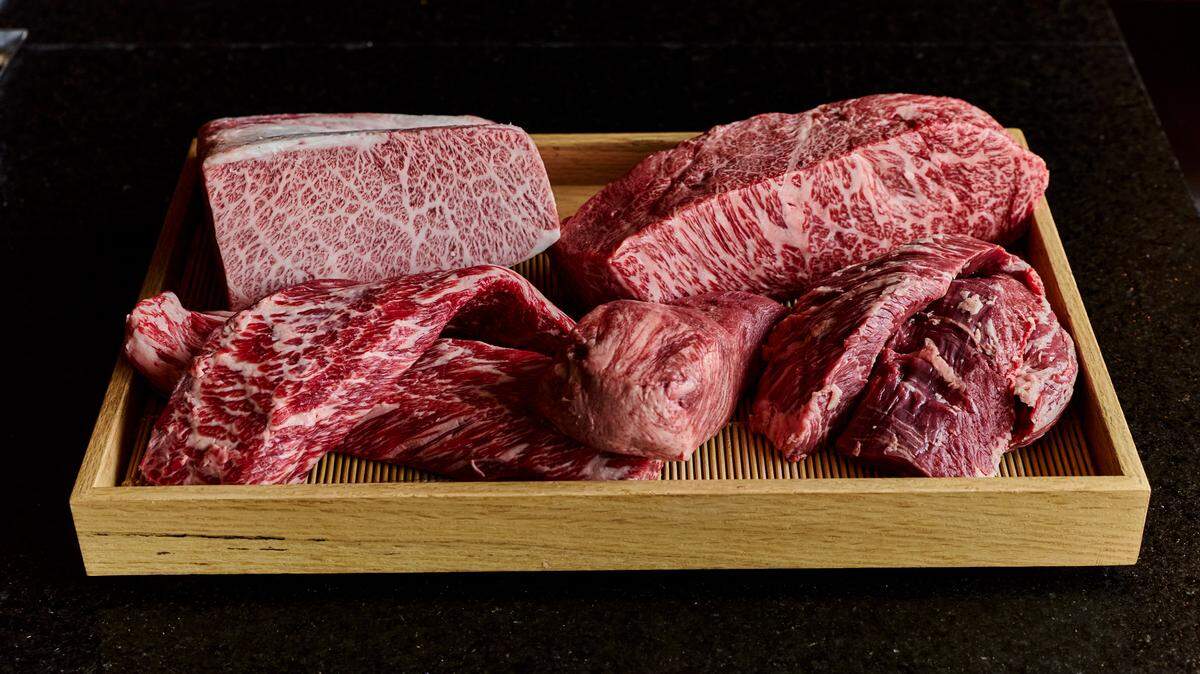
Decades ago, Wagyu referred exclusively to mind-bendingly fatty (and mind-bendingly expensive) beef imported from Japan. If you could find it in the United States, it was at high-end butcher shops or luxurious restaurants that served it in opulent little bites, the meat so evenly marbled and with such an impossible amount of buttery, sweet-tasting fat, it melted in the warmth of your mouth.
Now, what Wagyu means in the United States has expanded and includes American and Australian beef from part-Japanese cattle. The word alone, hyping up something on a menu, can mean many things -- as anyone who has felt scammed, or at least bewildered, by Wagyu already knows.
I keep thinking we’ve reached peak Wagyu, only to be proven wrong, again and again (even Costco carries it). At a time when the American cattle herd is at its smallest since the 1950s and beef prices are at record highs, Wagyu is seemingly everywhere. But it’s not always clear to diners what they’re paying for.
In the 1970s, Japan exported some of its prized Wagyu cattle, bred for their capacity to produce meat with lots of intramuscular fat, which had a lower melting point. By the late ‘90s, when Japanese officials realized that might threaten their control of the market, they banned the export of Wagyu genetic material and wrote a definition of their national treasure into law: beef from four cattle breeds, born and raised in Japan.
It was a little too late.
Wagyu was taking off, trickling down from fine dining into the mainstream, materializing in burgers and pizzas, kebabs and barbecue, hot pots and shabu shabu. Exorbitant bumps of Japanese Wagyu might seem endless, but a good deal of the Wagyu on our menus is either domestic or Australian, particularly the colossal statement steaks that require a bit more structure and muscle.
The terms Parmigiano-Reggiano and Champagne have long been protected and regulated as regional products made through distinct processes, and that might have been the path at one point for Wagyu. Instead, it grew with less persnickety oversight in the United States, and now competing forces are trying to reestablish it as a luxury, codify what it means and control a booming market.
In September, the American Wagyu Association rolled out a new program, certified by the U.S. Department of Agriculture, to label “Authentic Wagyu” by verifying levels of fat-marbling that go beyond the basic USDA Prime grade and by tracing the cattle’s bloodline to Japanese Wagyu.
Sheila Patinkin, who runs Vermont Wagyu, a ranch of about 500 cattle in Springfield, and once served as president of the American Wagyu Association, was one of the first to apply for the new label. She hopes it sets a bar for trust and quality in the United States.
“We’re getting marbling that is approaching Japanese marbling,” she said of the highest quality American Wagyu. “But this is the point: We’re not the same product as Japanese Wagyu. American Wagyu has developed in its own right.”
At the same time, Japan is trying to win back some of the ground it lost. I spoke with Nan Sato, a lawyer specializing in international law and the founder of Wagyu Sommelier, a company that promotes Japanese Wagyu. Sato recently collaborated with the Institute of Culinary Education on several days of workshops for chefs and other food professionals.
Her aim is to teach more chefs how to butcher, store and cook Japanese Wagyu, particularly those working outside Japanese culinary traditions, so they can order half an animal and cook every part of it -- not just the big-time cuts you see at steakhouses.
“With Wagyu, every cut can be eaten as a steak,” she said, as opposed to braised for long periods of time or ground. “But there’s a bias against these lower cuts, and we have to work against that.”
A5 has become shorthand for the finest Japanese Wagyu, but Sato noted that the Japanese grading system wasn’t really made for consumers. That letter grade, from A to C, has nothing to do with what a diner might experience at the table but indicates how much usable meat the whole animal yields, while the number grade, from 1 to 5, rates a combination of marbling, meat color and fat color.
Sato wants to develop a new system that also considers taste, then highlights the differences among Japan’s small producers. Kobe beef was an early breakout star from the world of Wagyu, but there are hundreds of lesser-known producers that Sato believes could gain brand-name recognition, too -- and potentially be trademarked.
For now, at the market’s highest end and lowest low, in grocery stores and in kitchens, there are so many scams at play -- mislabeled meat, fraudulent paperwork, ridiculously long long-term freezing, sketchy all-you-can-eat meals, even cheap beef treated with fat injections to simulate the visual effect of marbling. What are we chasing, exactly?
People in the meat business used to say this about Wagyu: that if it seems like a deal, you probably shouldn’t trust it. But some restaurants manage to keep prices down by putting a mix of American, Australian and Japanese Wagyu on their menus and focusing on those less-prized secondary cuts.
The other night in Torrance, California, I met my brother for a quick dinner at Wagyu Butcher, a casual yakiniku outpost from Osaka where a $50 set meal calls mostly on small pieces of American Wagyu -- tongue, chuck roll, hanging tender, short rib, intestine -- grilled at the bar.
A piece of Japanese Wagyu arrived at the end, as a treat. Kaku Serada had been carving beef all evening at the counter in front of us, and this piece came from the shoulder, sliced into a neat, perfectly even sheet, as if for sukiyaki. When the server dragged it gently over the grill and flipped it, the fat caught fire, just for a second. Then he dropped the shimmering meat into a little bowl of seasoned whipped cream and rushed off to pour some beer.
This bite was unlike any of the others and announced itself instantly -- the satiny fat on fat, the way it almost dissolved, delivering so much unctuousness with such a light touch, making my teeth feel pretty much superfluous. It tasted, faintly, of caramel. It was absurd.
And one piece was plenty. It was more than enough.
This article originally appeared in The New York Times.
Copyright 2026 The New York Times Company