
Modern love: Together always, in darkness and in light
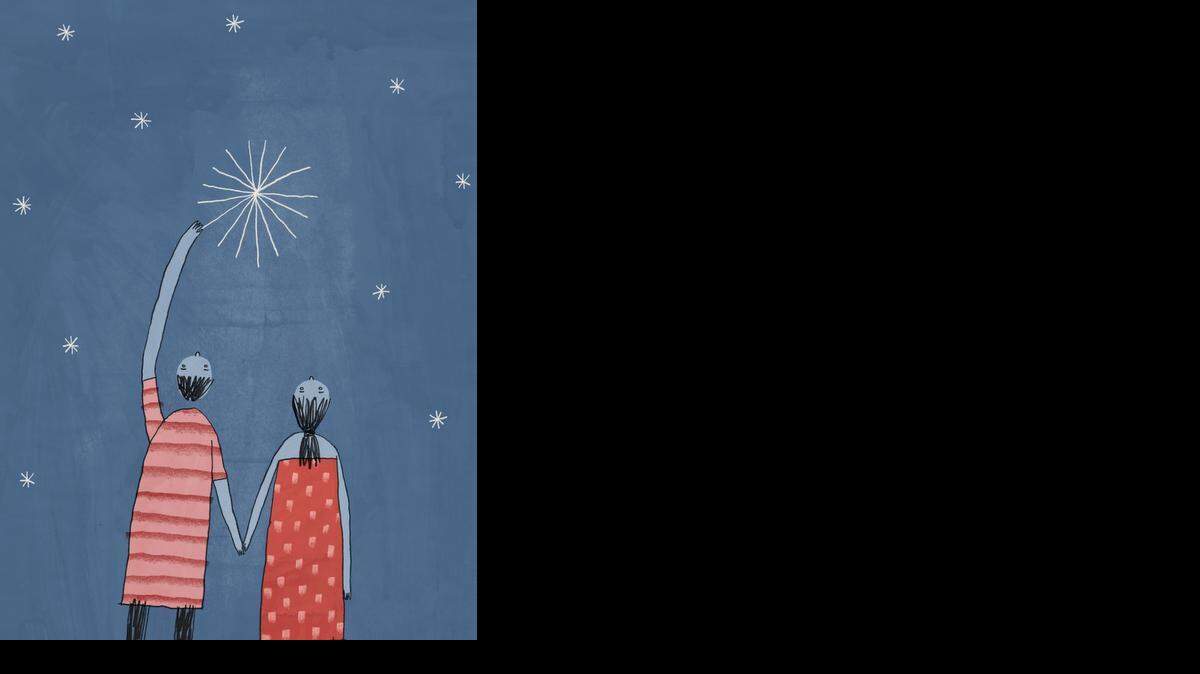
There is no good way to tell a new guy in your life that you’re going blind. I chose the best of lousy options: I broke the news after sex, and I packaged it right.
At 22, David was a novelist just starting his career, and I knew if I framed my plight as poetic, he’d find it irresistible, at least on a narrative level. So lying next to him in the dark, I told the story like a Gothic novel.
I started with how, three years earlier, at 19 an incurable degenerative retinal disease. The doctor told me I would slowly lose my eyesight over the next 10 to 15 years - first my nighttime and peripheral vision, and later, my central vision, too.
I ended on a high note: Losing my vision, I explained, was teaching me to really see. I would go blind with a bang, not a whimper, by seeing and doing more in the next decade than most people did in a lifetime.
All true, but only part of the story. The pretty part.
The next time we met, he wore my name on his arm. Six lowercase letters stained the skin, indelibly. As I admired the tattoo, he told me I had lit his darkness and he would light mine. No matter what came, he said, we would face it together. He was all in.
I met David during our last semester in college, where we were both English and theater majors. I liked that he was smart but not pretentious, funny but never mean. I liked his disarming sincerity, so different from my own reliance on charm and subterfuge. There was solidity to him and it made me feel safe for the first time since my diagnosis.
Where David was heavy, I was light. Where he was restrained, I was freewheeling. I made him laugh and got him to do things that scared him, like moving to Los Angeles.
In the abstract, blindness is epic, noble, simple. In reality, it’s a different story altogether.
In reality, it’s tedious, draining, messy. It changes you in surprising ways, some positive and some not. It’s a lot like the reality of being married.
10 years in
Ten years after David had my name tattooed on his arm, our story felt less like a Gothic love story than a Raymond Carver story: doomed in the most quotidian way. Ten years in, on my 33rd birthday, I found myself sobbing alone on a stoop in Brooklyn.
We had moved back to Brooklyn, my hometown, because my driving had become untenable. We had gotten married and had a son, a long, lithe baby with bee-stung eyes.
The year of our daughter’s birth marked the 10-year anniversary of my diagnosis, and by then I had lost enough sight to be deemed legally blind.
I constantly collided into people and things: monkey bars, fire hydrants, cabinet doors left ajar. I developed cataracts that made it difficult for me to fill out forms at the pediatrician’s office or, really, read anything at all.
All of that, in addition to the typical strains of raising two young children, was taxing on a marriage.
On my 33rd birthday, David and I splurged on a sitter and planned a dinner out with friends.
On the walk to the restaurant, we reopened the debate about whether to have a third child.
I wanted to but was terrified I wouldn’t be able to take care of the baby with my failing vision. David told me he would follow my lead, but he didn’t see how we would possibly make it work.
Our discussion developed into an argument, which ended with David storming off. I crumpled onto the nearest stoop and sobbed.
I remembered how I had told him I would go blind with a bang, not a whimper, and how he had promised we would always be together in darkness and in light. It seemed we’d both been wrong.
Some minutes later, David’s big brown boots stepped into frame.
“You can’t just leave me,” I said, “I need you.”
“I know,” he said.
“I hate it.”
“So do I.”
Then he took my hand and said we’d figure it out.
The thing about slowly losing something that feels indispensable is you’re constantly adjusting to the loss. As soon as you find a comfortable balance, something shifts and you have to recalibrate.
Not long after my birthday, I called the New York State Commission for the Blind, which taught me how to use a mobility cane and adaptive technology. I got a magnifier so I didn’t need David to measure the children’s Tylenol or adjust the thermostat.
I reclaimed many abilities I had lost and started to make peace with what I had to let go.
Our story
A year later, David took me to dinner and said he had something to tell me. His face was hazy in the candlelight, but I could see his mouth breaking into a smile.
“I think we should have another baby,” he said.
I blinked. “But what about –”
David took my hand and cut me off: “We’ll figure it out.”
He spoke with the same certainty that made him tattoo my name on his arm so long ago. His faith bred faith in me. We would have another child, and it would be hard and spectacular, and we would be in it together.
Together in the Gothic romance moments and in the Raymond Carver moments. Together in moments glorious and tedious. Whatever else it was - poetic, prosaic and everything in between - our story would be ours to share.
Nicole C. Kear is the author of the memoir “Now I See You.”
This story was originally published April 12, 2015 at 2:00 AM with the headline "Modern love: Together always, in darkness and in light."