
At Levine Children’s Hospital, Arts for Life teaches patients hands-on healing
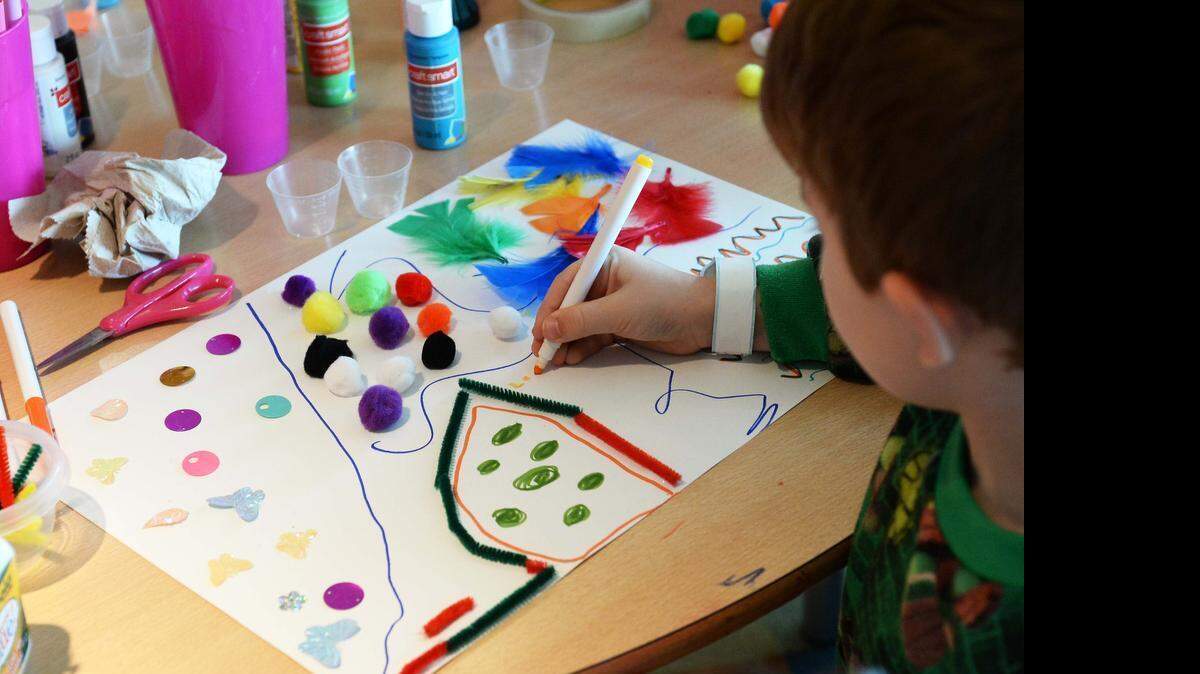
It’s quiet at 2 p.m. in the 10th floor playroom at Levine Children’s Hospital. The Arts for Life team, Sarah Ness and Shayan Nazari, ready paintbrushes, glue sticks and brightly colored feathers.
Ten minutes later, 5-year-old Logan Engleman opens the door dragging Mom by the hand, his blue socks flopping around his toes. He’s in the hospital because he fell at the pool and hit his head, causing a concussion and bleeding in his brain. “Ready to make another owl?” Ness asks.
It’s the third month at Levine Children’s hospital for Arts for Life, a North Carolina-based nonprofit that brings art education to children with serious illnesses and disabilities.
The new chapter at Levine is estimated to cost $90,000 a year, said Rachel Zink, executive director of Arts for Life. This cost includes staffing, supplies and volunteer training and is shared by the group itself and Carolinas HealthCare Foundation.
Ness is in charge of setting up the new chapter. Its first intern is Nazari, a biology graduate student at UNC Charlotte, who plans to apply to medical school.
For eight hours a day, Arts for Life welcomes patients and their families to an art table in the hospital playrooms. They also go room-to-room teaching “Bedside Studio” lessons to patients who can’t come to the playroom.
The child and family as a whole can regain a sense of normalcy, reconnect and forget about the stress and worries of illness for just a moment.
Keri Stevenson
child life specialist at Levine Children’s HospitalThe program provides art education – not art therapy – meaning its focus is teaching the patients how to create art. But even without the element of therapy, making art has mental and emotional benefits.
“The process of making art helps people to relax,” said Susanna Lund, an art therapist who is not involved with Arts For Life but has worked with hospice patients and families for 22 years. “It might become a safer way to express fears or anger.”
Ness agrees art can offer an alternative way to express feelings. “Animals can be a real favorite for kids. ... Maybe they choose an animal to draw or paint they can relate to because that animal is really brave or really strong,” she said.
For young participants that need inspiration, each month is themed by topic and material. The guidelines help kids struggling to get started, said child life specialist Keri Stevenson. “Once they realize that’s it a chance for them to be creative and expressive you see these lightbulb moments,” she said.
Since Logan has already made an owl during morning playroom hours, Nazari shows him a different project to work on. It’s a piece of paper resembling a quilt with different patterns and colors.
“Mom, can you open this?” Logan hands her a bottle of glue. “If I do it, this might hurt.” He points to the IV needle taped on top of his left hand.
“Like how it hurts when they put the medicine in?” she says.
“No, that tickles!” he says.
Making art offers a chance for patients to have fun in a very un-fun place. “The child and family as a whole can regain a sense of normalcy, reconnect, and forget about the stress and worries of illness for just a moment,” Stevenson said.
“I’ve noticed kids return each day to find out what new art projects Sarah has planned for the day. She even has ‘followers’ to where kids will participate in art table multiple times a day. This shows us that what she is doing is valuable and working,” Stevenson said.
Melissa Engleman, Logan’s mom, said the activities brightens Logan’s spirits and breaks up the monotony of the day. “Otherwise we’re just kind of sitting there in the hospital room staring at each other trying to play a game.”
Logan has started a new paper quilt, but he doesn’t think it’s turning out as well as the first. “That one was more beautifuller,” he says.
Capwell: 704-358-6194;
Twitter: @jessicacapwell
About Arts For Life
Arts For Life was founded in 2001 at Brenner Children’s Hospital in Winston-Salem when Anna Littman began teaching photography to her younger sister Katie, who at 11 had spent months in the hospital battling bone cancer. Soon, the rest of the patients were participating in Anna’s lessons, too. Doctors and families shared success stories of the children’s skyrocketing morale and improved communication. Arts For life grew largely by word of mouth and now has chapters at four North Carolina hospitals.
To learn more about volunteer and intern opportunities: www.artsforlifenc.org.
This story was originally published June 29, 2015 at 10:05 AM with the headline "At Levine Children’s Hospital, Arts for Life teaches patients hands-on healing."