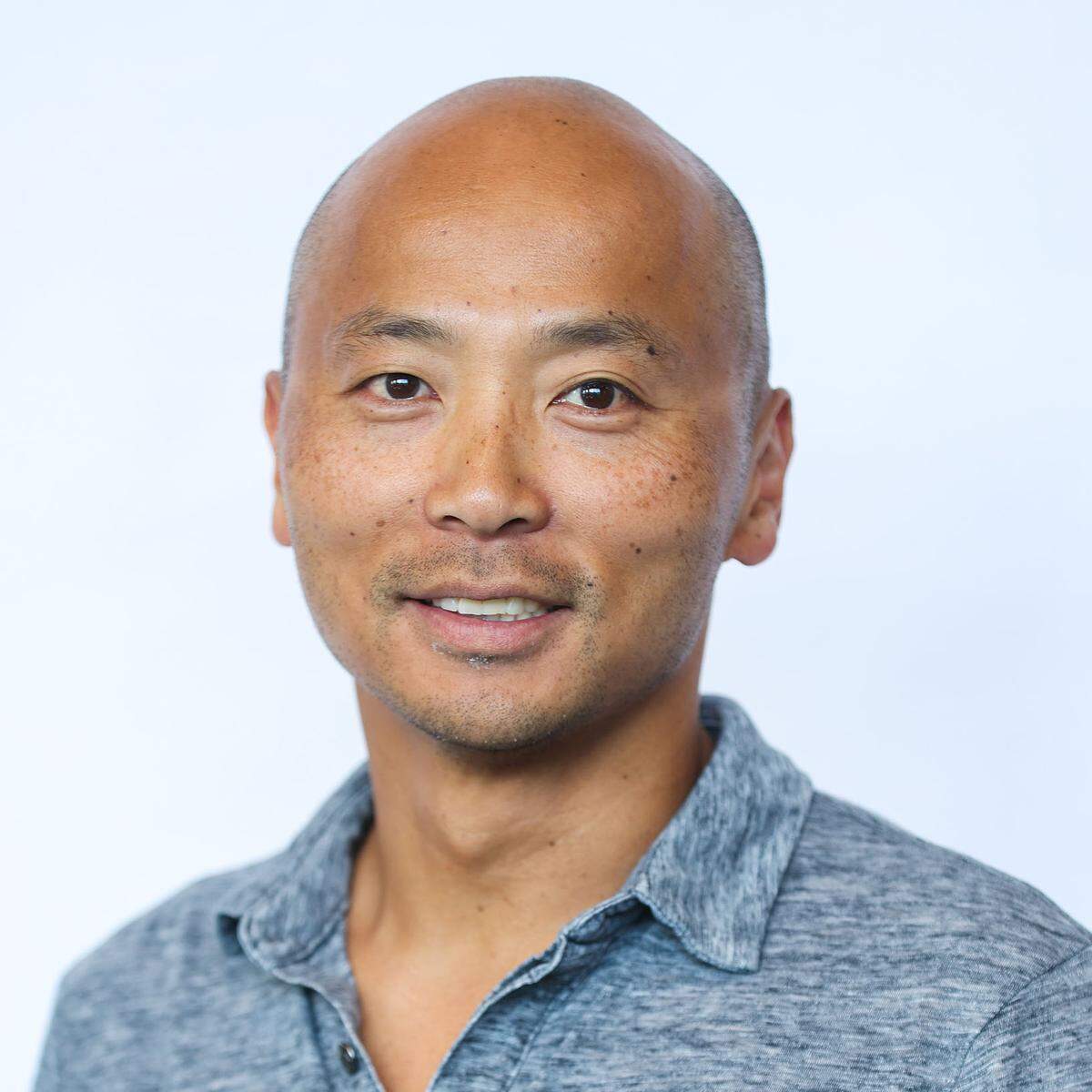
He was told he had less than 18 months to live. That was 3 years and 3 marathons ago.
Something seems slightly concerning about Frank Turner’s stride as he trails behind friends running along East 36th Street in NoDa.
His gait is stiff and awkward, his shoes loudly slap against the asphalt with every step. A couple times in the first half-mile or so of his run, one of the soles makes a scuffing sound on the pavement, and in both instances he appears to have to catch himself to keep from tumbling forward onto his face.
He certainly doesn’t have the same smooth gait that he had just 2-1/2 months earlier, when he hurried through a 50-kilometer ultramarathon in Winston-Salem at a fleet-footed average pace of 8 minutes and 33 seconds per mile. But on this chilly morning in March — before, during and after the soft-spoken 38-year-old former Army captain guts out his first double-digit run since his last brain surgery — it’s evident that he’s happy.
Happy to be back with his regular Saturday running crew.
Happy, just generally speaking, to be here at all.
Less than six weeks earlier, the surgeon who was about to cut into his brain for the third time in three years explained to Frank and his wife, Lena, that it was very possible he’d come out of the procedure with a severe lack of muscle coordination and control on his left side, and that there was a small chance of paralysis. That, realistically, it could be months before he was able to run again.
The long-running, far-more-serious concern, though, has been this: In March 2019, Frank was diagnosed with a fast-growing and aggressive type of brain cancer and told he had roughly six to 18 months to live.
Today, three years removed from what seemed at the time like a death sentence, this man of few words — but of many running friends, who have universally come to refer to him as “Frank the Tank” — has outlived the upper end of his expiration date by more than double.
And his oncologist, once worried about his determination to keep running longer and longer distances, has given up on trying to try to slow him down.
‘A big slap in the face’
Prior to falling suddenly ill on the morning of March 10, 2019, with a headache, nausea, numbness in his left arm and trouble walking, Frank had been a perfectly healthy man in his mid-30s.
Though he says “I wasn’t a big runner then,” he nonetheless was logging 20 miles a week. He says his most serious prior trips to the hospital — before finally relenting to an ER visit two days after the onset of those symptoms, which led to his first brain surgery the next day, which led to the cancer diagnosis — were for a shoulder surgery and for kidney stones, both when he was much younger.
As for how Frank felt after being told he had a type of tumor called a glioblastoma, which is almost always fatal?
He doesn’t elaborate much beyond saying it was “not easy,” and that “probably shock” was the best way to describe the state that he, his wife, Lena Hasselberg, and his mother, Michal Turner, left the surgeon’s office in.
Lena, meanwhile, says: “That’s a big slap in the face. ... And, you know, you start reading about everything, and the more you read, the more anxious you get. And I think I got more scared, and I think Frank wanted to have more information about it.”
But the next day, when Frank, Lena and Michal met with Frank’s oncologist, they got some information that reframed their outlook.
According to Michal: After they sat down, Atrium Health physician Ashley Sumrall asked if any of them had looked up glioblastoma on the internet. They all looked at each other and raised their hands. Dr. Sumrall instructed them never to do that again. Then she explained that people with Frank’s type of tumor were regularly living five to six years, and that in a year, that figure could be six to seven years. Basically, she told them not to set a time limit on his life.
Dr. Sumrall nods when she hears Michal’s account of their meeting.
”I think our patients,” she explains, “they need to be realistic, but I don’t want them to feel defeated before they even start.”
And once Frank was able to share her optimism, he quite literally took it and ran with it.
Getting bitten by the running bug
It was a slow burn at first.
Over the course of the spring and summer of 2019, he gradually started running more, and eventually set a goal: to complete a 13.1-mile race in November.
Frank admits now that he was “trying to prove to everyone else — and myself — that if I can run a half marathon eight months later, then I’m ‘normal,’ and I can still run like I wanted to before. Like I liked to before.”
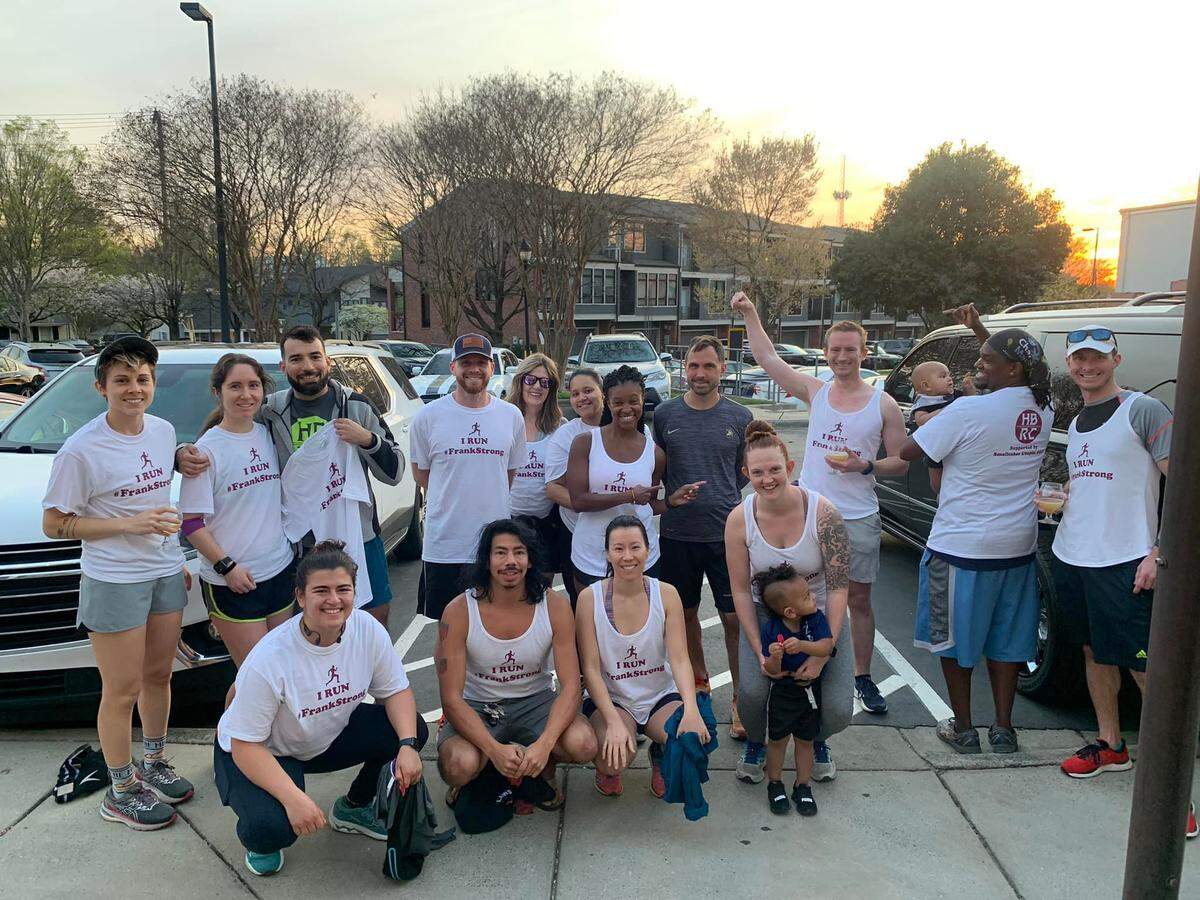
By fall, he says, he was also making a concerted effort to start “getting out with people, getting out with friends, and meeting new people and running with people in Charlotte.” In October, Frank began showing up to run with local groups like the Monday-night run club at Heist Brewery in NoDa and the Thursday-night run club at Legion Brewing in Plaza Midwood.
Then in November, he completed the Charlotte Half Marathon in 2 hours and 18 seconds.
Over the next year, Frank became a fixture with those run clubs, and in spite of his reserved and quiet demeanor, he made friends easily. But he didn’t become a patient who gave his doctors anxiety until September 2020, when he decided to try out a hardcore Saturday-morning group called “The Urban Runners” — which ran long, looping routes from the heart of NoDa to uptown and back.
By Christmas, Frank says, he was eyeing full marathons, and had set a personal record for distance of 17.6 miles.
By February, he was signed up for his first-ever 26.2-mile race.
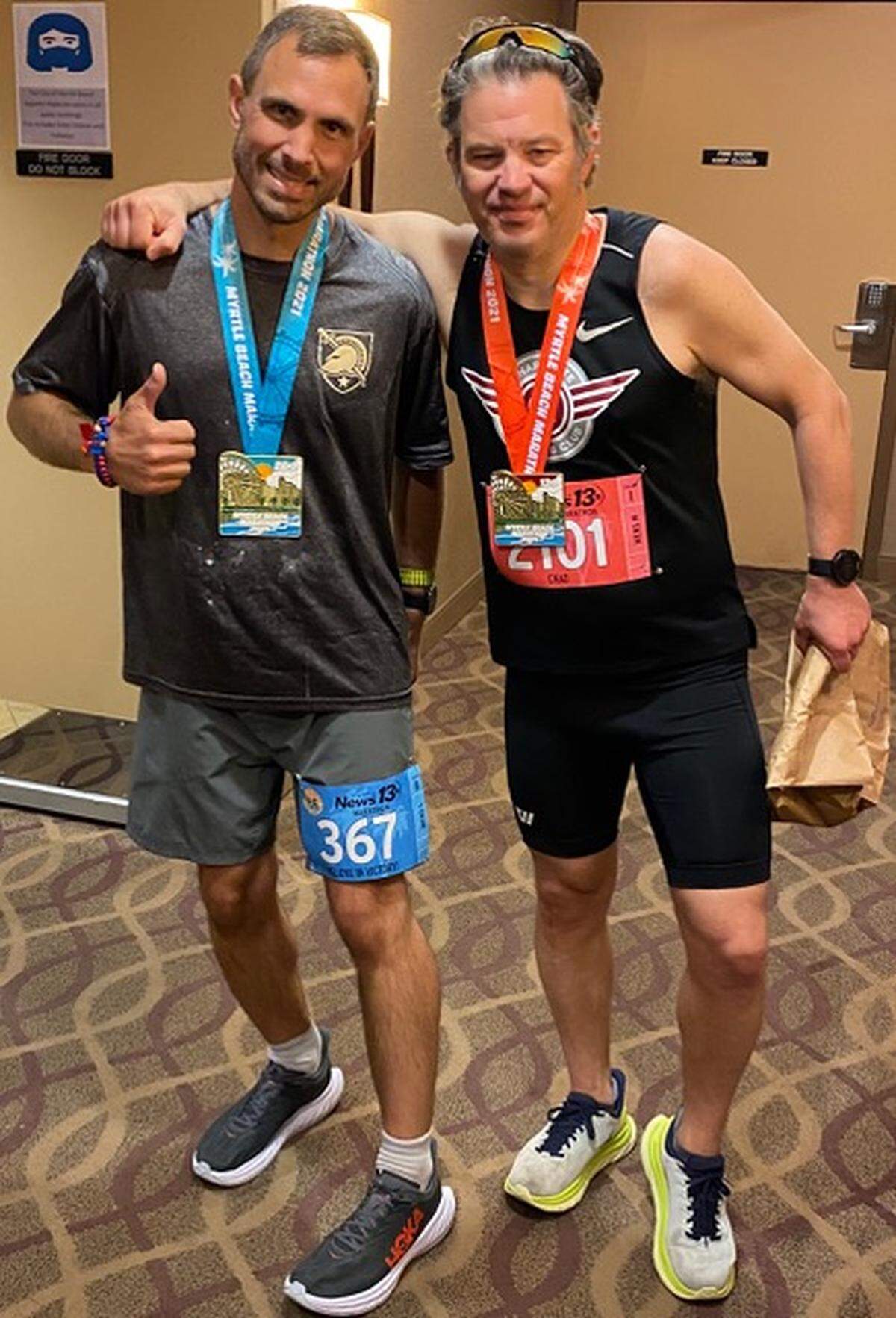
And on May 1, he ran the Myrtle Beach Marathon in 3 hours, 29 minutes, 6 seconds, a respectable time that ranked him 157th out of nearly 1,000 finishers.
Then, in the middle of last summer, a setback: Despite 42 rounds of radiation and a year’s worth of chemotherapy treatments, the tumor had grown back — as often happens in glioblastoma cases — and he needed brain surgery again. But as his running friends remember it, Frank treated it like a minor inconvenience.
“I really didn’t know about really Frank’s past health issues at all,” says one of his closer running buddies, Chad Champion. Not until that day in July, when he said he wouldn’t be at the next week’s run. As Chad recalls it, Frank told the group, “Yeah, I’m just going for a little trip to the hospital.”
Adds Clifton Miller, who organizes The Urban Runners group: “He was just very nonchalant about it — ‘not a big deal.’ Of course, the rest of us didn’t know what to think about it. We were overly worried, we were overly concerned, as his friends.”
On July 28 of last year, Frank’s surgeon went back into Frank’s brain and took out 97% of the tumor. Five days later, he showed up at Heist and walked three miles. Nine days after that, he ran five.
“We just couldn’t believe it,” Clifton says, shaking his head.
Then Frank started training for another marathon.
‘I thought about intervening’
He told Dr. Sumrall he was planning to run the Charlotte Marathon in November as casually as he’d told Clifton he was having brain surgery.
“Are you sure about this?” she remembers asking him.
But since his brain scans had been good, since he was experiencing no symptoms and no seizures (the latter of which are common in glioblastoma patients), and since he so absolutely, positively was sure about this, she somewhat reluctantly cleared him. He would go on to finish Marathon No. 2 last November in 3:39:25.
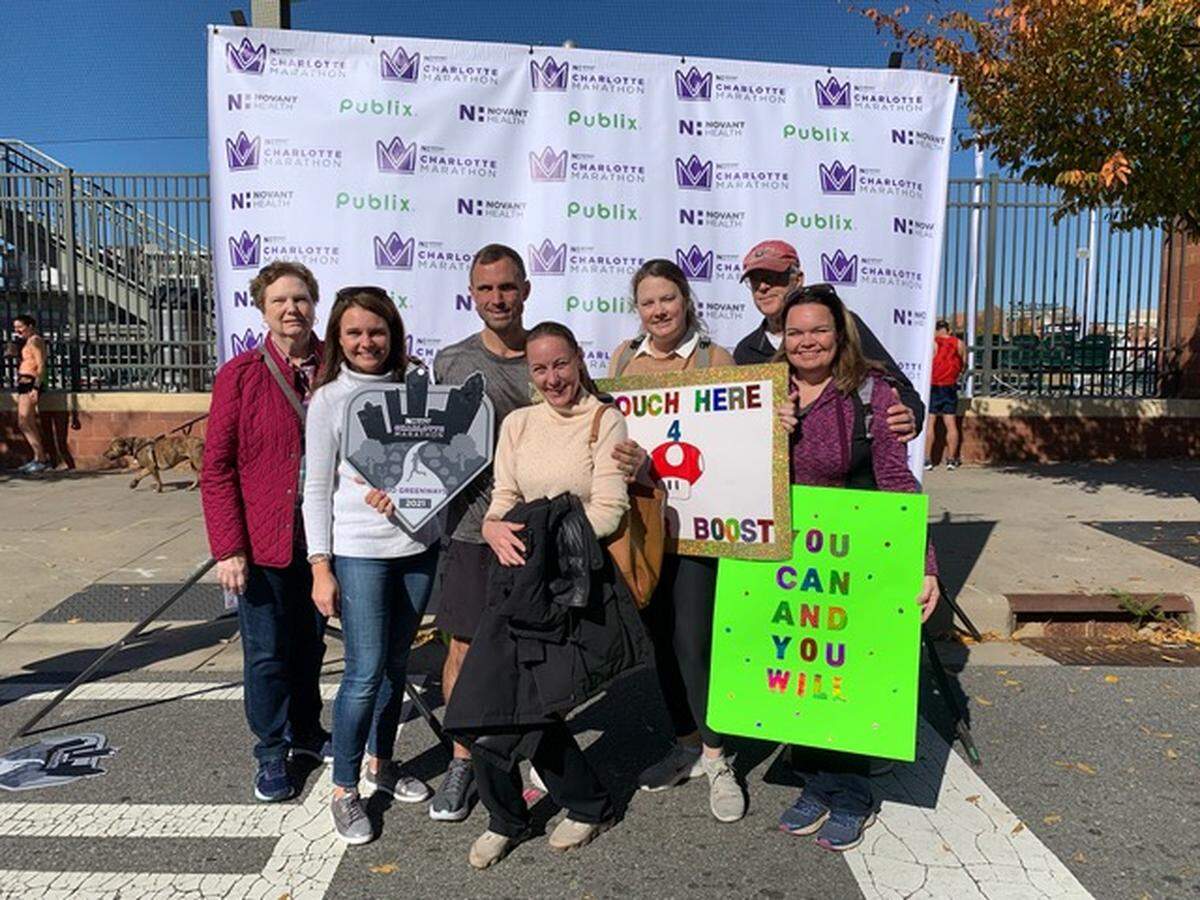
Then he told Dr. Sumrall he planned to do yet another long-distance race, called the Frosty 50K, to be held in Winston-Salem in January.
The length of this one? 31.1 miles.
“Oh my gosh,” Dr. Sumrall says, shaking her head. “I thought about intervening.”
As she explains it, the chance of him dying due to exercise is almost zero. Her biggest concern was his seizure risk — and that if he had a significant seizure, he could break a bone or have trouble breathing So she told him, explicitly, that she believed the ultramarathon was a bad idea.
And Frank reacted as if someone had given him the worst news since the day he was told he had six to 18 months to live.
“He just looked completely just crestfallen,” Dr. Sumrall recalls. “Just crushed. And then I realized, you know, I’m not sure what the future holds for him, and this is so important to him, and he values it so much that if he understands what could happen and he’s still OK with it, then who am I to stand in the way?”
Frank crossed the finish line at the Jan. 8 race in 4:17:03, after having maintained a faster average pace than he had during the Charlotte Marathon — which was almost five miles shorter. He placed seventh out of 63 finishers.
But then, in March, yet another setback: The tumor had grown back again, and this time, it was attached to a part of his brain that is responsible for coordinating movement. This time, he was told that he might lose significant function on his left side. That he might need to relearn how to walk. That, in the worst case, he might be paralyzed.
On Feb. 12, he did a 20-mile run with friends out in Albemarle that took him to the top of Morrow Mountain.
Two mornings later, he drifted off into an anesthesia-induced sleep not knowing when — or if — he’d ever be able to do a run like that again.
Racing down the road to recovery
It turned out not to be the worst case, but it wasn’t the best, either.
Atrium Health physical therapist Rebecca Hine says Frank needed about 25% assistance to walk when he first arrived at Carolinas Rehabilitation Center.
She also says all he talked about was running. And she hints that there were two key reasons why he was able to get in and out of the facility in a matter of a single week, which is a week to two weeks faster than the average patient treated there. One was his work ethic. The other was his friends.
“He told me about the runs that they were doing while he was in the hospital, for him, in his honor,” Rebecca says. “I could tell when he told me he was just really just itching to get back out there and be with them.”
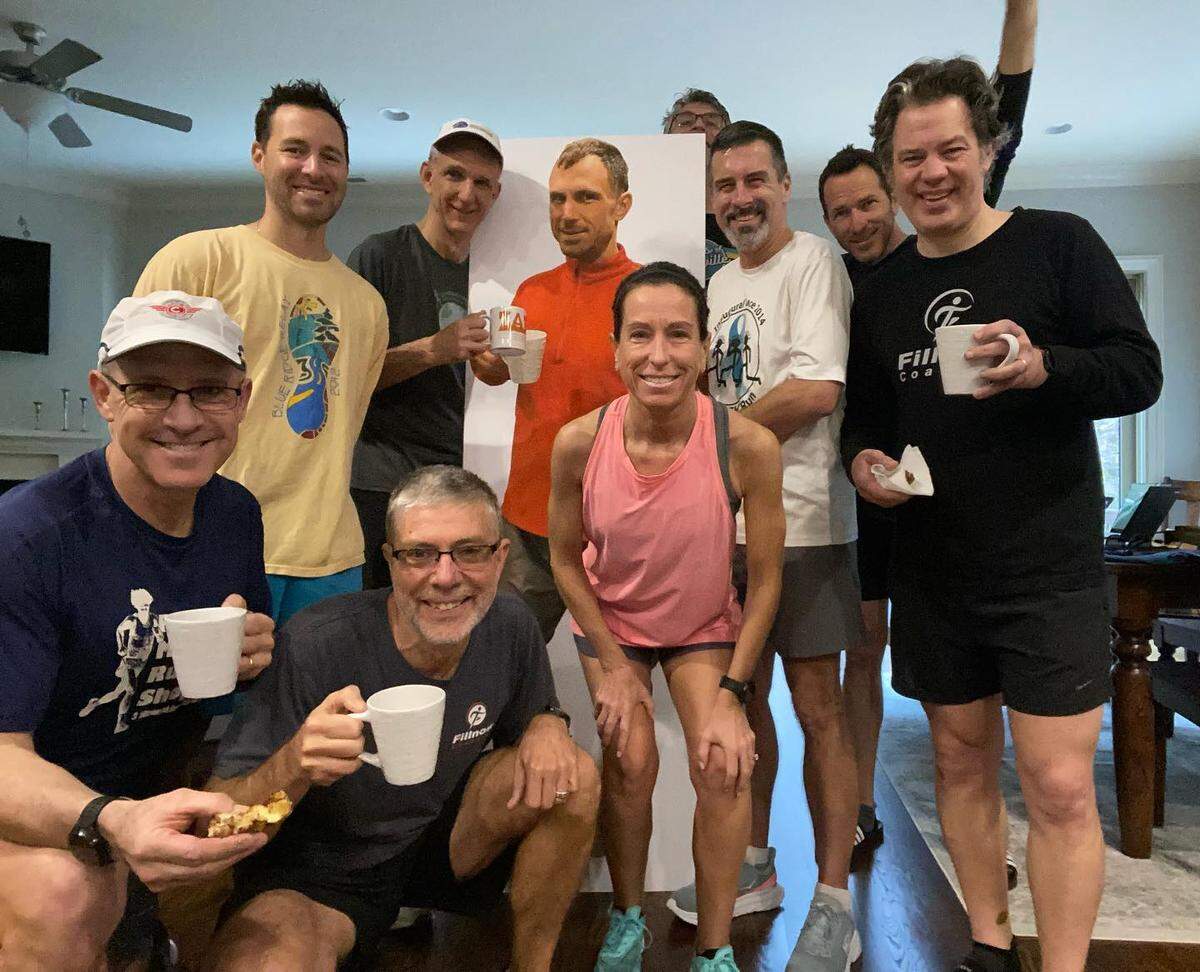
Most notably, a member of an informal group he runs with regularly on Thursday mornings through Providence Country Club came up with the idea to have a life-size cardboard cutout made of a photo of Frank in running clothes with a cup of coffee in his hand, and she started pulling it out of her car and posing it with the group in photos before or after runs.
“Hopefully it gave him some motivation,” says that friend, Heather Carpenter, “and at least let him know that we were all thinking about him.”
By all accounts, Frank typically does not like to be the center of attention. But when the topic of the cut-out comes up, he smiles.
“I was happy,” he says, softly, “to be part of the group still.”
On the morning of March 3 — 16 days after his third brain surgery, which left him unable to stand without assistance — he was released from the rehab center. Almost immediately, he had his father take him to the YMCA in Matthews so he could spend 40 minutes walking around the track.
Four days later, he was able to jog a slow, painful, but also glorious mile.
“It really lifted his spirits,” says his dad, Del Turner. “It just validated what we’ve seen with him since the kid was born.”
By the end of the month, although he was still having trouble locking in spatial relations with his left hand and left foot, still experiencing pain with every step, still not near as fast as he was before his third surgery, he had worked his way back up to a 10-mile run — and was finally feeling alive again.
But one big question lingers: How much more life does he really have left?
‘We may see miraculous things’
His oncologist, Dr. Sumrall, says there’s honestly no way to know.
Basically, she says, “I like for people to be prepared and to understand that the tumor can come back at any moment. But the flip side of that is that if you’re on a treatment where we have good data and you’re handling the treatment well, we may see miraculous things.”
At the same time, Frank’s wife suggests that we already might be witnessing something of a miracle: “I’m amazed,” Lena says, “that he’s still alive.”
Of course, she’s also still a little concerned about his safety when he’s out running, even if his doctors have become less so.
Back in March, three days before he went out for that painful but glorious 10-mile run — the one where he stumbled and looked as if he might take a header onto the asphalt a couple times — he said he hadn’t fallen since his third surgery left him debilitated, and that he wasn’t a fall risk.
He may have jinxed it. A couple of Thursdays later, he did take a spill, while fumbling with his watch during his weekly group run through Providence Country Club.
But in almost no time at all, with his friends by his side, “Frank the Tank” was back up and running again.
This story was originally published May 6, 2022 at 6:00 AM.