
These 4 questions are central to explaining Passover
While the biblical story of the Jewish people’s exodus from ancient Egypt is well chronicled, the exploration of the four questions asked during the ritual Passover Seder offers insight into the origins and significance of this holiday.
“The story of Passover is important because it brought the concept of liberty, freedom and emancipation to the world,” said Rabbi Yossi Groner, director of Lubavitch of North Carolina and chief rabbi at Charlotte’s Orthodox Congregation Ohr Ha Torah.
As told in the book of Exodus, Moses and the Israelites were allowed to leave Egypt only after the final plague, the killing of all Egyptian’s first-born sons, including Pharaoh’s, was exacted by God. Jews were spared this fate as their homes were “passed over,” their doors marked for omission by the blood from a sacrificial paschal lamb.
“On one level, Passover speaks to physical freedom and the Israelites’ removal from bondage,” said Groner. “On a much deeper level, Passover addresses the importance of spiritual freedom. The true significance of Passover is found in realizing uninhibited spiritual freedom that accompanies selflessness and recognition of a higher purpose in life extending beyond one’s self.”
Groner said the term “Seder” means “the order,” referring to the sequencing of rituals performed during the service held on the first evening of Passover.
He noted that in Jewish life, it is important to trigger inquisitiveness in children and to train them to look for deeper meanings in rituals associated with observances such as Passover. During the Seder, both children and adults read from a Haggadah, a book containing the story of Passover. Here four specific questions are read aloud by the youngest child able to do so.
“Children are asked to recite the four questions,” said Groner, “because answers that are given in a way understood by children can be understood by all.”
An overarching inquiry – “What differs this night from all other nights of the year?” – is a precursor to the four questions that follow.
The first question: ‘Why on all other nights do we eat leavened bread, but on this night we eat only unleavened bread or matzo?’
The answer is twofold, Groner said.
Fleeing Egypt in haste, the Israelites had no time to allow bread to rise, thus baked matzo, a cracker-like unleavened bread.
“Matzo is a humble food,” said Groner. “The deeper meaning behind eating matzo is in expressing gratitude and humility to God for the freedoms bestowed upon us.”
Passover is observed for seven days, and observant Jews eat only unleavened bread for its duration.
The second question: “Why on other nights do we eat all vegetables, but on this night eat only bitter herbs?
Bitter herbs, often horseradish, represent the bitterness and pain of slavery.
The third question: “Why on this night do we dip twice when on other nights we need not dip even once?”
It refers to the ritual dipping of greens first into salt water and then in a sweet nut paste called charoset, before eating. Groner said the Lord commanded “no nation should be within another nation” to be truly free. Greens symbolizing a Jewish nation are surrounded by saltwater symbolizing the tears of Egypt. The first dipping represents the separation of one nation from the other. The second dipping in charoset represents the sweetness of freedom and gaining identity through a unique homeland.
The fourth question: “On all other nights we eat either sitting or reclining, but on this night why do we all recline?”
“In reclining,” said Groner, “we’re demonstrating the relief from burdens such as doubt, guilt and (encumbrances); this relief comes with the new found sense of freedom.”
Sharing tradition
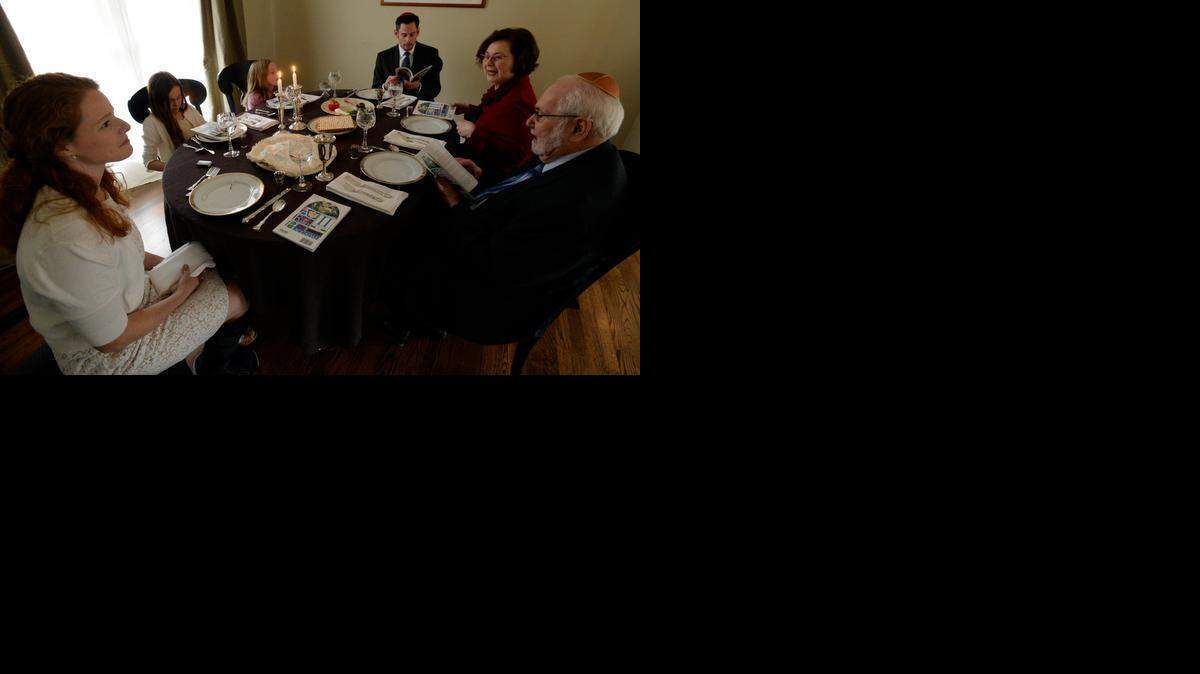
Drs. Elissa and Josh Levine are hosting Passover Seder in their south Charlotte home this year for about 20 friends and family. Half will be children, including their daughters, Talia, 11, and Sasha, 9.
“The focus of our Seder is on teaching the children,” said Elissa Levine. “It’s important for them to understand our history as a Jewish people and also to understand and learn about our personal family history. The kids learn about my great-great grandmother’s emigration from Germany from my mother and come to recognize the lessons of freedom and that the Israelites are not simply historical people, they are us.”
During the Seder, youngest daughter Sasha recites the four questions in both Hebrew and English. Older daughter Talia is learning the questions in Yiddish, the language of Levine’s grandparents.
Levine said she felt the teachings of Passover helped her daughters draw strength from their heritage and perspective when they faced challenges in their own lives.
“They are fascinated by the stories told in the service and are alternatively awed and questioning regarding the miracles that are described,” said Levine. “Knowing that you are a small character in a much larger story is humbling. It is also humbling to know what our ancestors endured simply because of their religion. The story of Passover also demonstrates to our children, that individuals can derive a superior strength from their community and overcome unimaginable hurdles that an individual alone could not.”
No Jewish holiday is complete without a special meal, and Passover is always one of the culinary highlights on the Jewish calendar. On the menu at the Levine’s Seder are traditional items such as gefilte fish, matzo ball soup, charoset, brisket, apple kugel, root vegetable tzimmes (a stew), chocolate- and toffee-covered matzo and macaroons.
“Passover teaches us about perseverance, hope and strength, and staying true to yourself, your identity, your community and your God,” said Levine. “I have heard this story for four decades and continue to benefit from retelling this to my children in ways that are new each year.
“Our daughter recently asked, ‘I have memorized the story, why do we need to tell it again?’ Only with the knowledge of our history’s failures and successes can we move forward as a community. Passover is the history of the Jewish people, our history.”
Community Seders
Passover is observed from the evening of April 3 through the evening of April 11. These Seders are open to the public.
▪ April 3, 7:30 p.m. Congregation Ohr Ha Torah, 6619 Sardis Road. 704-366-3984. $25.
▪ April 4, 6 p.m. Temple Beth El, 5101 Providence Road. 704-366-1948. $45, $55 nonmembers.
▪ April 4, 6 p.m. Temple Israel, 4901 Providence Road. 704-362-2796. Seder is sold out, though those looking to be paired with a host family can contact the temple.
▪ April 8, 5:45 p.m. Temple Kol Tikvah. Held at Northstone Country Club, 15801 Northstone Drive, Huntersville. 704-987-9980. $30, $60 nonmembers.
This story was originally published March 28, 2015 at 2:00 AM with the headline "These 4 questions are central to explaining Passover."