
Former CPI Security manager claims racial discrimination, retaliation in lawsuit
A former CPI Security Systems employee has filed a lawsuit against the Charlotte company and its CEO Kenneth Gill alleging she was fired because of her race and in retaliation for raising concerns about the company’s “culture of racism.”
The 18-page lawsuit filed last week in North Carolina Superior Court in Mecklenburg County details what CPI’s highest ranking Black employee said is a “deep-seated culture of racism” at the company that eventually led to her retaliatory firing in August 2020 after 20 years with the company.
Among the allegations, former call center director Kelley Phelps said she was told not to hire people with dreadlocks and that Gill told a tanned employee “if you get any darker, we’ll have to seat you at the back of the bus.”
CPI Security “adamantly” denied the lawsuit’s allegations in a statement to the Observer, and said the company is 42% racially diverse. Gill also has been involved in improving police accountability and reform, according to the company.
“As this is an ongoing lawsuit, we will not make any further comment,” CPI spokeswoman Kristi O’Connor said.
The lawsuit comes more than a year after CPI faced backlash following Gill’s remarks about protests after a local activist sent a mass email to city officials and community members calling for police reform. Days of protests across the country, including Charlotte, followed the death of George Floyd, who died with a Minneapolis policeman kneeling on his neck for more than nine minutes.
CEO’s comment and backlash
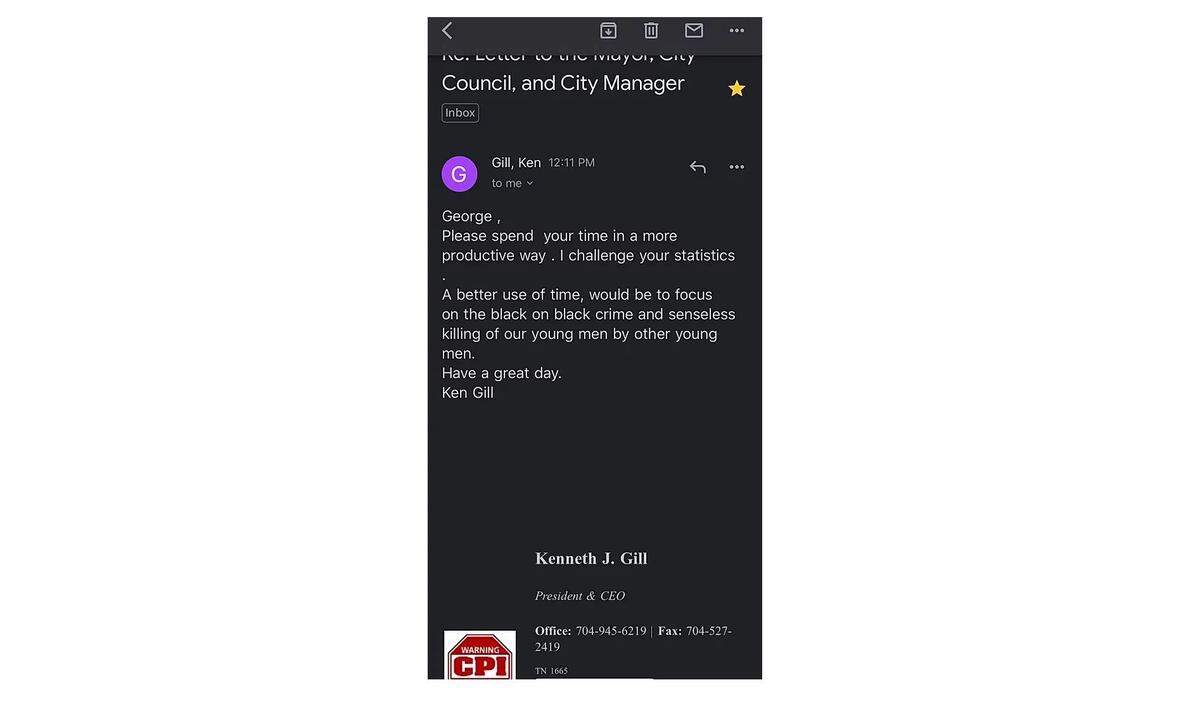
In June 2020, Queen City Unity nonprofit leader Jorge Millares posted Gill’s response to his email on Facebook, saying it was “insensitive and racist” and calling for a boycott of CPI.
“Please spend your time in a more productive way...,” Gill said in the emailed response. “A better use of time would be to focus on the black on black crime and senseless killing of our young men by other young men.”
Customers overwhelmed CPI’s phone lines to cancel its services with hold times over 24 hours. Sports teams such as the Carolina Panthers, Charlotte Hornets and Charlotte Knights cut ties with CPI, as did Bojangles’ and the YMCA of Greater Charlotte.
Gill issued a public apology, listing three steps the company would take toward inclusion and fairness. Gill founded the security company 30 years ago and now has more than 750 employees with services in the Carolinas, Georgia and Tennessee, according to the company website.
On Tuesday, in its statement to the Observer, CPI included the June 4, 2020, email exchange and said: “To be clear, Mr. Gill’s response, nor the email he was responding to, were about the death of George Floyd or Black Lives Matter. Mr. Gill was specifically responding to the allegation that CMPD has a ‘long history’ of ‘the murder of unarmed and cooperative people of color.’”
In the lawsuit, Phelps said despite finding Gill’s comments “deeply offensive,” CPI leaned on her to help quell customer and employee outrage. Employees had threatened to walk out, according to the lawsuit.
The all-white leadership treated Phelps as the token “Black expert,” according to the lawsuit, being a Black liaison for CPI employees regardless of whether they reported to her.
When senior staff asked Phelps to review a statement that they intended to send to The Charlotte Observer in regards to Gill’s comments, according to the lawsuit, she was shocked by the use of the term “colored people” referring to Black Americans.
‘Culture of racism’
The lawsuit alleges discriminatory practices years before Gill’s comments last year.
CPI ran credit checks on prospective customers in areas with higher Black populations such as west Charlotte, parts of Henderson, Durham, and Greensboro, according to the lawsuit.
Customers also could request service technicians based on race, according to the lawsuit. Phelps told employees to reject such requests. Gill turned down Phelps’ advice to create a company policy against such practices, according to the lawsuit.
Phelps claims she was told not to hire people with dreadlocks, “a hairstyle commonly understood as expressing Black culture,” the lawsuit states.
When Phelps told Gill about two CPI employees’ racist social media posts, Gill was dismissive, saying Black people had “come a long way,” according to the lawsuit.
He went on to criticize President Barack Obama for failing to “teach black men not to run out on their children.” He also mocked Black Charlotte City Council member Braxton Winston for addressing protesters’ concerns about police violence against Black people “instead of focusing on real problems like crime,” according to the lawsuit.
Phelps claims she was underpaid compared with her white, male peers by as much as $60,000 a year despite her longer time with the company and more responsibilities.
The firing and lawsuit
Phelps said in the lawsuit that she was so frustrated by CPI’s failure to make changes to build an inclusive company culture that she resigned in July 2020. However, senior staff convinced her to stay on.
But a month later Phelps was fired after discussing CPI’s alleged racist practices and suggesting ways to create a more racially inclusive workplace with a company official and an outside human relations consultant, according to the lawsuit. Those conversations were supposed to be confidential, but Phelps said senior managers and Gill then avoided talking with her and questioned her commitment to the company. One executive said family members “must be wondering why you’re still working for a company they consider racist,” according to the lawsuit.
Phelps was fired Aug. 18, 2020, and Gill made the decision, according to the lawsuit.
Phelps filed complaints with Equal Employment Opportunity Commission alleging discrimination and retaliation violating the Civil Rights Act of 1964.
A white man replaced her at CPI, according to the lawsuit.
Phelps — represented by the law offices of Garrison, Levin-Epstein Fitzgerald & Pirrotti in Connecticut and Law office of Faith Herndon in Durham — is seeking lost wages and compensatory personal injuries, according to the lawsuit. The lawyers have asked for a jury trial.