Milestones and miles to go: Inside the ongoing coal ash cleanup work in North Carolina
At a sharp bend in the Catawba River, across from Cowan’s Ford Wildlife Refuge and a few miles south of Lake Norman, a greenish-brown clearing of dirt and shrubs cuts its way through the forest.
The abandoned tract spreads over where 5.4 million tons of coal ash used to sit at the former Riverbend Steam Station, a coal-fired power plant in Gaston County operated by Duke Energy. Coal ash is a byproduct of burning coal, similar to how ash is left over from burning wood in a fireplace.
In 2014, a pipe failure at Duke Energy’s Dan River Steam Station, in Rockingham County, unleashed one of the largest coal ash spills in U.S. history. The spill released approximately 38,000 tons of coal ash into the Dan River, according to the N.C. Department of Environmental Quality.
In the wake of the Dan River disaster, state regulators designated four coal ash sites as high priority because of their proximity to water or population centers, among other factors. Those sites were the Dan River, Riverbend, Asheville and Sutton Steam Plant in Wilmington.
This summer, Duke Energy reached a significant milestone: it completed excavation of the 25.6 million tons of coal ash at all four high-priority sites. Other excavation efforts across North Carolina are moving ahead, and areas where lakes and streams were long at risk of pollution from coal ash are seeing notable signs of progress.
But drive 40 minutes north of Riverbend and the earth tells another story.
The Marshall Steam Station, on the western flank of Lake Norman in Catawba County, is one of Duke Energy’s six active coal-fired power plants in North Carolina. There, 16.2 million tons of coal ash still sit in towering mounds that are expected to take until December 2035 to excavate, according to data from Duke Energy.
The two sites on waterways near Charlotte embody the current state of coal ash excavation across North Carolina. The cleanup process is bringing promising results, but environmental experts say the incredible amount of ash to be moved means safety concerns will remain for at least the next decade and a half.
Coal ash settlement goals
In April 2019, DEQ ordered Duke Energy to excavate its remaining coal ash sites around North Carolina. Coal ash contains mercury, cadmium, arsenic and other pollutants, according to the Environmental Protection Agency, all of which have been linked to health problems at certain concentrations.
Duke Energy challenged DEQ’s order, and the Southern Environmental Law Center joined the legal effort to force the utility’s hand. Later that year, a judge upheld the state’s right to order Duke Energy to excavate the ash.
That December, a settlement agreement between Duke Energy, DEQ and several community groups represented by SELC detailed how Duke Energy would excavate its remaining coal ash sites. That effort is the largest coal ash cleanup in the United States, according to SELC.
Duke Energy is on track to meet the settlement’s cleanup requirements, industry and environmental experts agree.
“We haven’t seen any major problems during the removal of the ash,” said Frank Holleman, a senior attorney at SELC who litigated the settlement and spent years involved in coal ash proceedings. “Duke appears to be on target to meet the deadlines.”
But the job is far from done. Under the agreement, Duke Energy has until 2038 to move all of its coal ash in North Carolina out of unlined basins.
In total, nine of 31 coal ash basins across 14 current and former coal-fired power plants in the state have been excavated into safe storage, according to the most recent figures from Duke Energy.
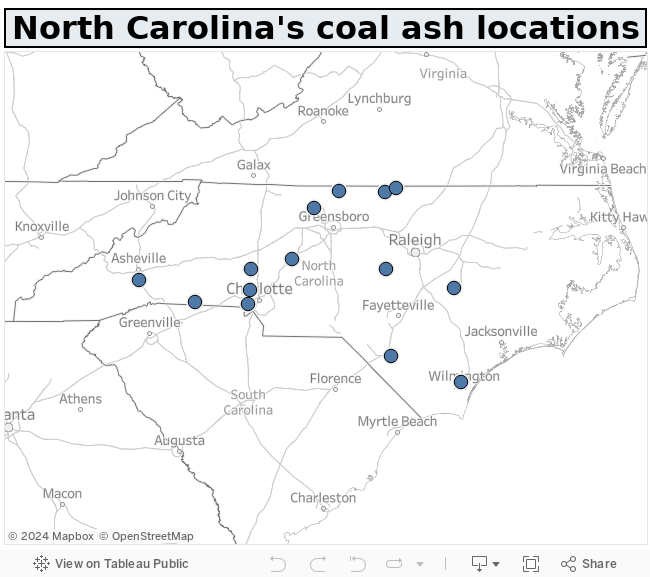
The excavated basins contained 33.6 million tons of ash, while 93.8 million tons remain, Duke Energy said. The remaining ash is enough to fill Bank of America Stadium 170 times over, according to Catawba Riverkeeper Brandon Jones.
A second settlement reached in January 2021 between N.C. Attorney General Josh Stein, Duke Energy, the N.C. Utilities Commission and the Sierra Club saved North Carolina utility customers over $1.1 billion on coal ash cleanup costs over 10 years, according to the N.C. Department of Justice.
The total cleanup cost is estimated to be around $8 billion, Duke Energy spokesman Bill Norton said.
What ‘cleaned up’ means
The cleanup process for coal ash can look different depending on the site. The ash at Riverbend, for example, was moved to off-site storage primarily by rail, Norton said.
In most places, it’s transferred to a safer storage area on-site.
The process works like this: ash that was once in open basins, in direct contact with the soil beneath it, is excavated and moved by dump trucks into newly-dug lined basins. Bulldozers put the ash in place, and other large machines compact it. The area is sprayed with water to suppress dust.
With a multi-layer synthetic barrier and drainage, the lined basins are essentially landfills designed to prevent contaminants in the ash from leaching into the soil, where they can pollute groundwater and other nearby waterways.
When a lined basin is filled, it’s topped off with another multi-layer barrier and vegetation to hold the ash in place.
‘Past the time that we’re here’
Amid the legal back-and-forth that has surrounded coal ash for years, riverkeepers have been sounding alarms about the threat the ash poses to the ecosystems they monitor.
Jones, the Catawba Riverkeeper, receives a massive file of groundwater data from Duke Energy each quarter. It’s his responsibility to see how water quality is changing at North Carolina’s coal ash sites.
Jones works for The Catawba Riverkeeper Foundation, one of the organizations involved in the 2019 settlement with Duke Energy.
Contamination from coal ash on Duke Energy’s properties isn’t going away any time soon, he said. “These sites will continue to have groundwater impacts long past the time that we’re here.”
But in some areas, recent ash excavation could help groundwater quality improve faster than expected. Jones said he’s been impressed with Duke Energy’s progress on its cleanup effort so far.
The Riverbend site is one where water quality has improved in the years since the ash was excavated.
The power plant closed in 2013 and the ash was moved off-site by 2019 amid fears that it would leach toxins into Mountain Island Lake, the dammed section of the Catawba River where Charlotte gets some of its drinking water.
“You certainly wouldn’t want to put a well in there and drink it yet,” Jones said of the former power plant site. But the nearby lake water is clean, and these days he’s seeing the level of pollutants in wells there trend down.
Coal ash ecosystem impact
It’s one thing to measure water quality from monitoring wells, which are made for just that purpose. Quantifying the impact of coal ash on an ecosystem, though, is a whole other type of challenge.
Steven Pulliam, the Dan Riverkeeper, said ash from the 2014 spill accumulated at the bottom of the river with other sediment, making it practically impossible to measure.
“When they give estimates of this percentage cleaned up, you can’t really gauge that in a river,” he said. “We find tons of artifacts here from Colonial life. Why would we think that the coal ash is going to disappear if we’re still finding that? It’s being buried like a fossil.”
In an email, Duke Energy said studies by state officials and N.C. State University have shown that the spill had no impact on the Dan River ecosystem and that drinking water remained safe.
The path forward
As Duke Energy weans itself off coal over the next decade, those who spent their careers dealing with the ash hope that a combination of cleaner power and more environmental regulation can prevent a problem like coal ash pollution from arising again.
One step officials could take, Pulliam said, would be to require more natural buffer zones along waterways.
A buffer is an area of vegetation that separates the river or stream from industrial sites nearby, filtering out pollutants before they enter the water.
At the state level, DEQ is continuing to monitor ash sites and enforce the terms of the 2019 settlement. The agency uses lab tests to verify that each site meets the legal requirements for ash removal.
Duke Energy is also working to recycle coal ash by reducing its carbon content. Three sites in North Carolina reprocess the ash, which can then be used as an ingredient in concrete and cement products.
And some former coal sites will see new solar and natural gas installations as part of Duke Energy’s proposed plan to cut carbon emissions. The utility will retire its last coal-fired power plant in North Carolina by 2035.
While Duke Energy doesn’t currently plan to put solar panels at Riverbend, Norton, the utility’s spokesman, left open the possibility of installing them one day.
Jones hopes that will happen.
“Solar panels would make a huge difference here,” he said. “With coal on the way out, that’s the way forward.”
This story was originally published August 24, 2022 at 6:32 PM.