Should $10 million in public money pay for roads the Panthers were supposed to pave?
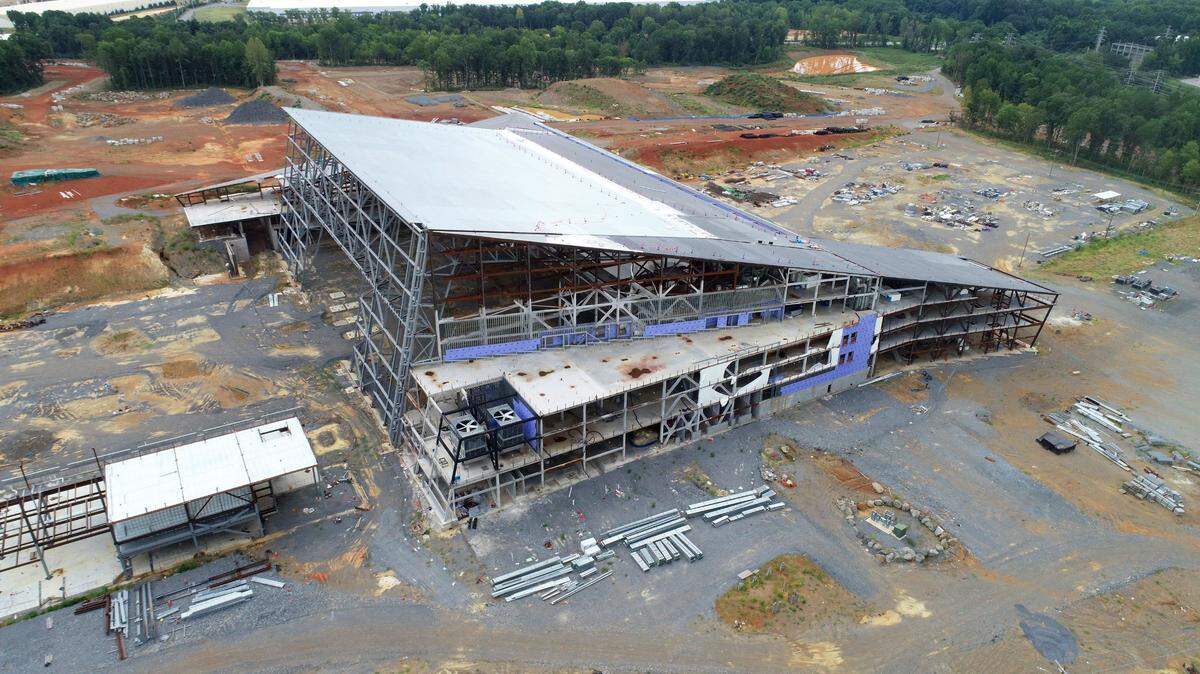
Elected officials voted Friday to use $10 million in public money to pave roads near the failed Carolina Panthers headquarters site in Rock Hill. The roads initially were to be funded by the team.
Friday’s vote came amid statements of frustration and resignation about the failed Panthers project. Rock Hill, York County and the NFL team are now entangled in bankruptcy court battling over how much money will be paid back — and to whom.
The road decision still requires final approval after a 30-day public comment period. And the approved funds are contingent on Rock Hill or York County taking legal title to the property where the roads are.
The Rock Hill-Fort Mill Area Transportation Study will accept online public comments at rfats.org. RFATS allocates federal and state funding throughout urbanized areas of Rock Hill, Fort Mill, York County, Tega Cay, Lake Wylie and Indian Land (in Lancaster County).
York County Councilman Tom Audette sits on the RFATS policy committee that voted Friday. He joined Tega Cay Mayor Chris Gray and Lancaster County Councilman Brian Carnes in voting against the allocation.
“I’m stunned, I guess, that this is coming in front of us,” Audette said. “This money is going to pave what the Panthers had stated they would be paving. And it’s presently owned by the Panthers.
“That piece of property is tied in litigation right now. This should not even be up for (a decision).”
Audette said the bankruptcy proceeding should finish before public money goes for paving roads.
Rock Hill Mayor John Gettys voted in favor of allocating the money. So did fellow committee members Jim Reno and Kathy Pender, both on Rock Hill City Council. Others in favor included S.C. Sen. Wes Climer and Chief Bill Harris with Catawba Indian Nation. County Councilman Joel Hamilton also voted yes.
“The option isn’t, ‘is this the greatest answer?’” Gettys said. “The option is, do we want to have a bridge to nowhere in York County?”
A final decision would mean $17.7 million, which had been slotted for the I-77 and Celanese Road project in Rock Hill, will be moved. Road work surrounding the new exit 81 interchange will get $10 million. That’s the Rock Hill exit built to serve what would’ve been the Panthers headquarters.
The other $7.7 million goes to the interchange at I-77 and exit 77 in Rock Hill. That’s where the interstate crosses South Anderson Road.
The new road work would link the exit 81 interchange with Mt. Gallant Road and Eden Terrace in Rock Hill. David Hooper, RFATS administrator, said federal, regional, state and local funds have about $149 million for the Celanese interchange, which isn’t likely to cost that much.
“I see both sides to this,” Carnes said. “My thought on this is, are we putting the cart before the horse? Shouldn’t we wait until all the legal process is taken care of before this is considered?”
Gray agreed.
“Until the legal matters are resolved,” Gray said, “it does no good putting roads on the piece of property.”
Gettys said the public part of the bankruptcy issue will be complete on Dec. 14. That’s in time for the final decision from the RFATS policy committee.
“This isn’t a great answer for anyone,” Gettys said.
Not fond of David Tepper, the Panthers
Several RFATS policy committee members expressed frustration with the NFL and Panthers owner David Tepper for this situation. One member wouldn’t say his name.
Fort Mill Mayor Guynn Savage recused herself from Friday’s vote. After discussion with her town council and legal counsel, Savage made the decision because she hadn’t been part of planning, discussions or agreements related to the Panthers project.
“I’m not going to use the name of the team, or the name of the despicable man that put us in this position,” Savage said. “I think it’s extremely unfortunate that our area’s been treated this way, and put people in these positions to have to fight to make right what was an agreement.”
Some RFATS members wondered if Tepper would benefit from the new roads. Gettys pointed out the land is in bankruptcy and that would not happen.
“This property is not in litigation,” Gettys said. “It’s in bankruptcy. The owner of that property in bankruptcy does not have, by the definition of bankruptcy, the opportunity to improve the property.”
That point matters to Harris.
“This is a very complex problem that has been dumped in the middle of this room,” Harris said. “And with that I think it’s left up to each of us to assess, what’s the value of it?”
Harris said it isn’t uncommon for the group to move funds from one project to another. The current setup isn’t ideal, but Harris said you can’t “have a ramp that goes up, and it just sits there.”
“It looked like a good project in the beginning,” Harris said. “It was going to benefit the city, the county, the surrounding area. But that fell through. And this is what we’re left with.”
Harris said it’s important to do what makes sense — allow use of the new interchange.
“Spend the money wisely,” Harris said, “but resolve the problem.”
Gettys also pushed back on the idea that his city would get a piece of property through bankruptcy without any impact from the team’s decision not to relocate in this area.
“Rock Hill...is not just getting a piece of property for $20 million,” Gettys said. “We’re having to pay Mr. Tepper to go away. To take control of a property so taxpayers can get the benefit of what they’ve invested in public roads.”
An ‘embarrassment’ for Rock Hill
Audette pointed to the idea Rock Hill stands to get the land where the failed project would have been.
“This is a conflict of interest of what we’re doing here,” Audette said. “I think that all legal matters should be resolved before any vote comes up.”
Hamilton said he has confidence the parties involved can continue to work toward resolution, including the roads. Hamilton said he doesn’t like the daily reminder drivers get as they drive down I-77 and can point to a new interchange “that goes to nowhere, and we haven’t been able to resolve that.”
“It has become an embarrassment, and frankly shameful,” Hamilton said.
Hamilton’s vote Friday was aimed to make the best of the current situation.
“The fact that this interchange remains unusable, and has thus far been a complete waste of taxpayer money...I don’t know we can tell the taxpayers of the county, the city, the state, the good folks in Lancaster who also paid their share of this coming from the state, that we’re going to continue to waste their funds,” Hamilton said.
For Gettys, there’s an expectation that if taxpayers fund a new interchange along the interstate, they’ll be able to use it.
“There is an intersection at I-77 that without a road, will not be operational,” Gettys said.
This story was originally published November 18, 2022 at 5:35 PM with the headline "Should $10 million in public money pay for roads the Panthers were supposed to pave?."