To save history, Charlotte ends a site’s historic status. Neighbors say it’s not enough
The Charlotte City Council approved the removal of historic landmark status to about 23 acres near significant structures in the Steele Creek neighborhood, paving the way for redevelopment and leaving neighbors feeling unheard.
On Monday, council’s approval amended the historic landmark designation of the Steele Creek Presbyterian Church and cemetery near Charlotte Douglas International Airport. While the sanctuary and the cemetery will remain historic landmarks, the surrounding land will no longer hold that designation.
All of the land and structures are owned by the city on behalf of the airport but negotiations are underway to sell the property to real estate investment firm Foundry Commercial.
The amendment allows Foundry to move forward with its plan to redevelop the land, building about 900,000 square feet of warehouse space.
The change will also help preserve the sanctuary, according to Brian Clarke, chair of the Charlotte-Mecklenburg Historic Landmarks Commission. The commission agreed with the de-designation in August.
Once the purchase is finalized, Foundry plans to gift the sanctuary to She Built This City, a nonprofit that introduces and trains women in the construction and manufacturing field. The 135-year-old sanctuary is currently empty.
She Built This will restore and preserve the sanctuary, turning the site into its new headquarters, Foundry attorney representative Collin Brown previously said.
The cemetery will remain untouched, along with the tree-lined front lawn of the sanctuary, Brown added.
However, neighbors say nothing is in writing and nothing can stop Foundry from potentially, or ultimately, demolishing the sanctuary.
“There needs to be a contract to hold (Foundry) accountable,” said Steele Creek resident Stephanie Lanse. “A conversation isn’t legally binding, so we’re looking for some protection… There’s a lot of unanswered questions and I feel like everything is just moving at lightning speed. We need to slow down and talk about this.”
Neighborhood concerns
Steele Creek residents have been asking for a pause regarding changes in their neighborhood, especially when it comes to the Charlotte airport.
Charlotte Douglas is one of the busiest airports in the world and to meet demand, the facility needs to expand. Part of the airport’s expansion plan calls for the creation of a logistics hub filled with warehouses and offices south of the airport, right in the Steele Creek neighborhood.
Another portion of the plan is to have nearby residents voluntarily sell their properties to the city, especially if they are in high noise areas. Once purchased, the city will demolish those properties, even those with historical value.
Overall, the city owns about 330 parcels south of the airport.

Those are 330 holes, according to Lanse, who said the airport is slowly picking her neighborhood apart in the name of economic growth, with little communication and little consideration.
“We want to save our neighborhood, Lanse said. “If we find ourselves in a position where we no longer feel comfortable or our quality of life is impacted too heavily by the airport’s actions, at that point, we want a fair price.”
Demolition and growing distrust
That feeling of being unheard is part of the reason residents opposed removing the landmark status surrounding the sanctuary and the cemetery.
The Steele Creek Presbyterian Church is the second oldest house of worship in Mecklenburg County. The congregation was established in 1760 and the sanctuary was built in 1889, according to the landmarks commission.
In 1991, the church was designated as a National Historic Landmark and had become “the nation’s largest rural Presbyterian church,” the commission added.
But by the late 2010s, membership had rapidly decreased. Many members had moved away due to noise concerns emanating from the airport.
The congregation agreed to sell the sanctuary, the surrounding land and the nearby Steele Creek Presbyterian Manse, which housed the pastors, in 2017.
The buyer? The city of Charlotte on behalf of the airport.
Members hesitated to sell the church to the airport in fear that the facility would demolish the structure. The airport told members they wouldn’t demolish the sanctuary — and it hasn’t.The same couldn’t be said for the manse.
In August, the airport demolished the Steele Creek Presbyterian Manse. It had the right to do so because it was city-owned property, but community members, as well as the landmark commission, had started a process to designate the manse as a historic site.
That process wasn’t followed through by city staff.
Neighbors are tired of feeling unheard.
“It’s exhausting but I feel like I don’t have a choice,” Lanse said. “If someone doesn’t force this conversation, nothing’s going to change.”
Foundry’s preservation plans
Residents are trying to ensure that Foundry sticks with its preservation plans.
Lanse said she requested a memorandum of understanding between residents, Foundry, and She Built This City but her request was denied.
During Monday’s hearing, Councilwoman Tiawana Brown, who represents Steele Creek, asked city attorney Patrick Baker if residents could request an understanding agreement. Baker said he’s never seen that type of agreement between a business and residents.
But Foundry’s attorney representative, Collin Brown, reiterated that the partnership between Foundry and She Built This City would allow for the sanctuary and the cemetery to be preserved.
Stewart Gray, the landmarks commission’s director, seconded that notion. If the building remains unoccupied, it would fall into disarray, Gray said. Having the nonprofit use this site would breathe new life into the space.
Foundry has also agreed to help save another historic site, the John Douglas House. Douglas was the minister of Steele Creek Presbyterian Church and Pleasant Hill Presbyterian Church in 1867 until his death in 1879, according to the landmarks commission. The house was built for him in 1867.
It sits behind the Steele Creek Church. Foundry said it would give $50,000 to the landmarks commission to help move the house onto Foundry property, where it will also be preserved.
But without a written agreement stating Foundry will preserve all the properties, residents are weary of the redevelopment plans. Not to mention the fact that there will be more warehouses surrounding their homes, Lanse said.
However, Clarke said he and the landmarks commission are working on a written agreement with Foundry and She Built This City to keep the historic landmarks preserved in perpetuity.
An airport spokesperson also said that the purchase contract with Foundry includes “a legal obligation for Foundry to protect this property through multiple deed restrictions, including the preservation easement.”
During Monday’s meeting, Tiawana Brown said she understood the community’s concern. However, echoing Clarke, Brown said de-designating the land and having Foundry take over the property was the sanctuary’s greatest chance in being preserved.
The airport spokesperson said the only way the project with Foundry and the preservation of the sanctuary moves forward is if the de-designation is approved.
“I care about the community being upset. But this is the time where you are put in a position where you have to make tough decisions and you may not be able to please everybody,” Brown said.
Brown added that She Built This City is a great organization to add to the community.
Brown supported the de-designation and her peers backed the decision. Moving forward, Brown said she wants more transparency for her constituents.
“The lack of transparency is why they are standing so firm,” Brown said. “We as a council, as a city, as airport staff, we have got to do a better job with being transparent…The right decision is not to have Foundry suffer because of this… It does not mean that the community loses.”
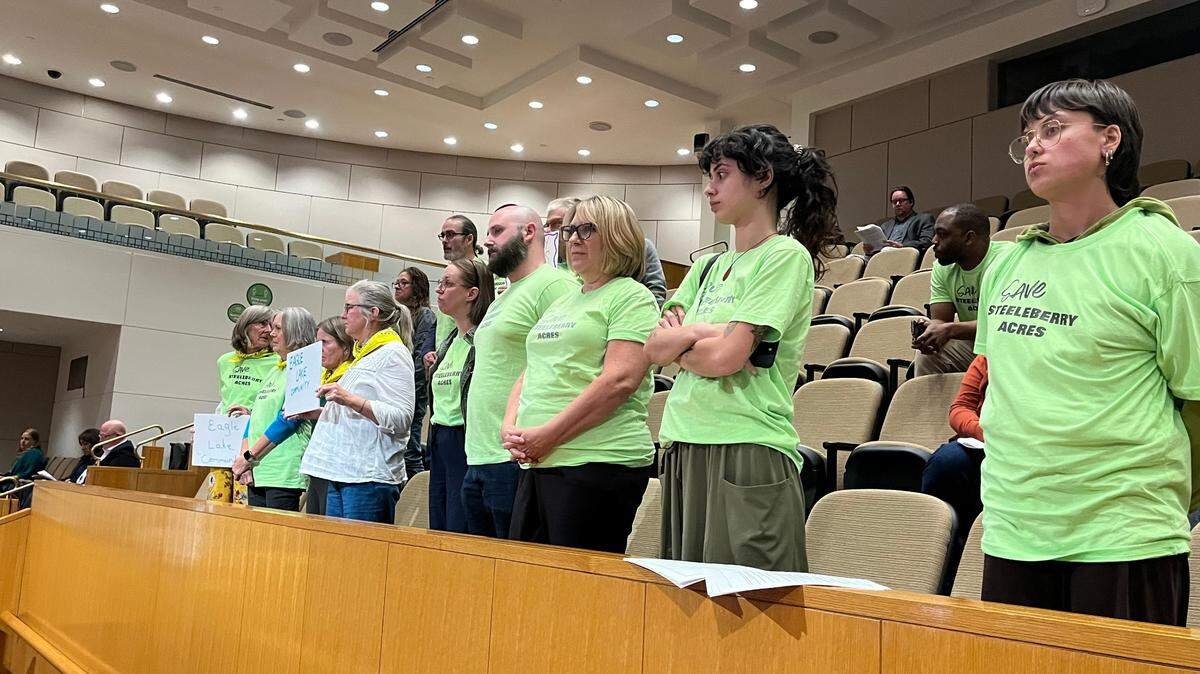
In the audience, community members clad in lime green shirts that read “Save Steeleberry Acres” could be heard saying, “Yes it does.”
This story was originally published October 15, 2024 at 9:25 AM.