Fueled by angry residents, Matthews creates regulations for short-term rentals
While some Matthews’ residents would never like to live near a short-term rental, the lodging option is here to stay. As long as some new rules are followed.
On Monday, the Matthews Board of Commissioners unanimously? approved a list of definitions, regulations and violation terms regarding how short-term rentals will work.
The regulations will go into effect in Nov. 14, and operators will have until Jan. 14, 2025 to comply.
Parties, parking and persistent problems
With a quick search on AirBNB and VRBO, there are about 60 short-term rental listings in Matthews.
For some residents, living next to these establishments has been a consistent nuisance.
“Once again, we had an eventful weekend,” said Joseph Martin, during Monday’s public comment where residents can speak on any topic. “A party with sometimes 15 to 16 people. I think we counted up to 10 cars at one time. One car pulled out of their driveway and drove through our yard… It’s very upsetting that we are still doing this.”
This isn’t the first time Martin has voiced concerns about the short-term rental property next door. He, his wife Dana and his mother-in-law Pat Robinson spoke during a public hearing in July when commissioners first began to discuss proposed regulations.
And they weren’t the only ones.
More than half of the speakers in July said issues ranged from parties lasting day and night to excessive cars lining the roads all equaling, in their opinion, a persistent disrespect to their neighborhoods.
In February, Robinson created a petition asking commissioners to ban short-term rentals in single-family districts.
But Planning Director Jay Camp previously said an outright ban cannot happen because it’s considered a use, or a benefit for the property owner. In Matthews, short-term rentals were an unregulated use but a use nonetheless.
New rental definitions and regulations
To regulate short-term rental operations, commissioners needed to update the town’s zoning code or Unified Development Ordinance. That includes adding definitions, rules and violation terms. Camp said many of the listed rules were modeled after Raleigh’s policies.
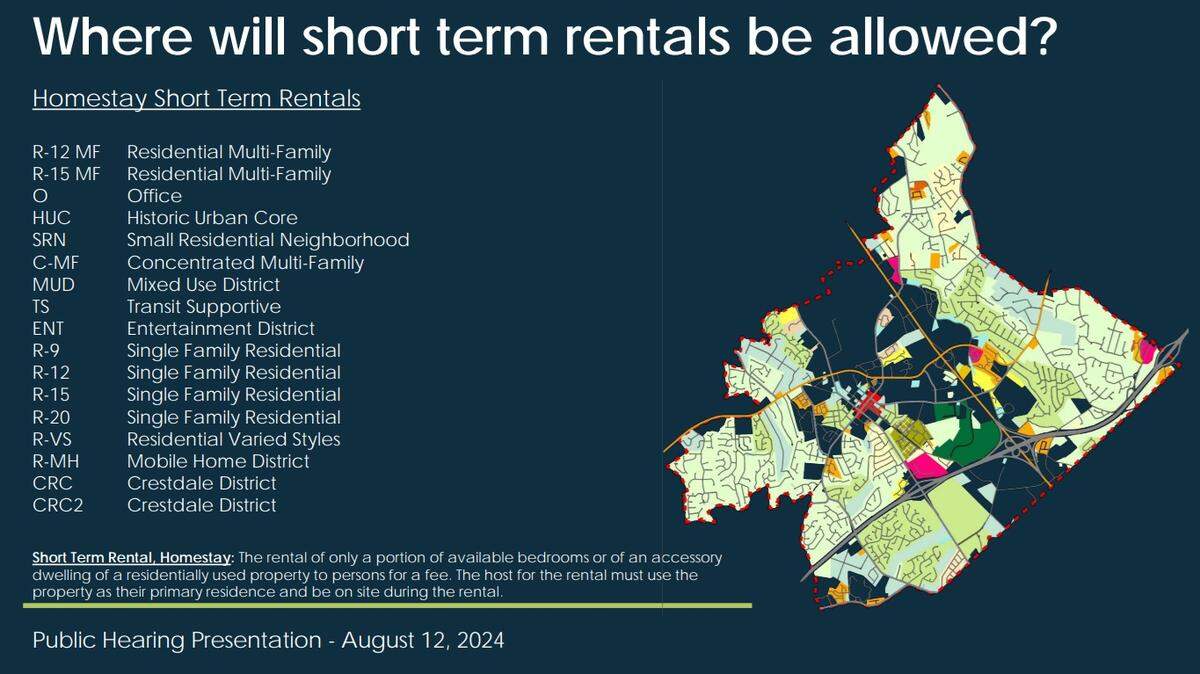
For starters, there’s now two types of short-term rentals: a homestay or a whole-house rental.
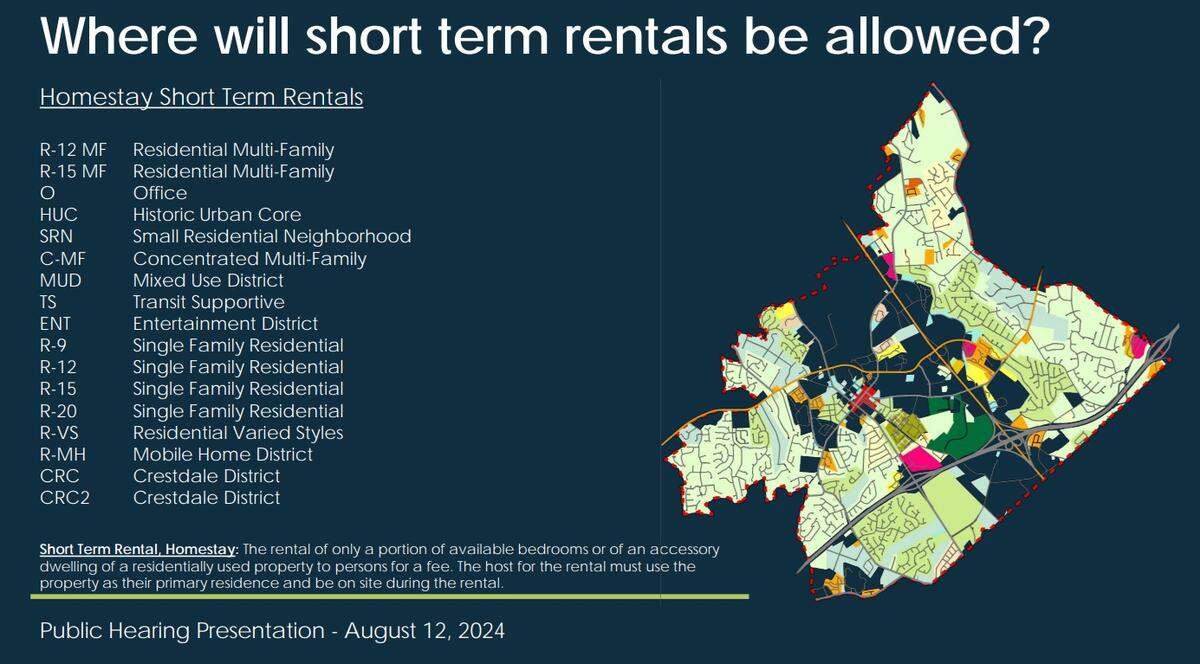
A homestay means the property owner rents a portion of their available bedrooms. They must use the property as their primary residence and must be on site when the rental is in use.
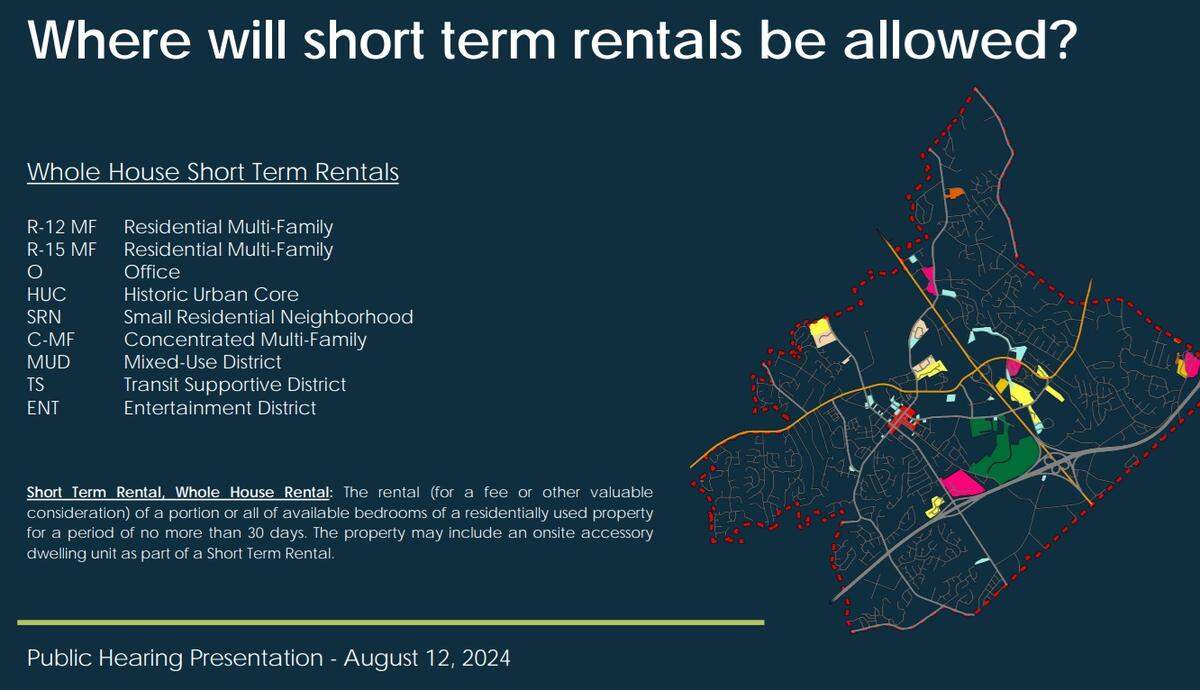
A whole-house rental is just that. An owner rents out either some or all of their available bedrooms for 30 days or less. Both options could be in an accessory dwelling unit.
Owners will need to apply for a zoning permit annually that will initially cost $250. The cost will be put on the city’s annual fee schedule and may be adjusted.
The manager or operator of the rental will need to either be located in or adjacent to Mecklenburg County, which will be verified during the permitting process.
Rentals must be 800 feet from each other, there can’t be more than two guests per bedroom and no parties are allowed, which is already a rule for Airbnbs.
There’s also zoning restrictions. Homestays can reside in most zoning districts, including single-family. Whole-house rentals can only be in multi-family districts or mixed-use.
Homestays are going in more districts, Camp said, because they could be less “disruptive” to the area since renters would only be using some rooms and the owner would be on site.
As for violations, permits will be revoked if any violation of criminal laws occur on the property, such as underage drinking or prostitution and if three “verified violations” have occurred.
A verified violation is made by either a police officer, a judge or a code enforcement official. Those violations would be not complying with the regulations, such as parties.
Once a permit is revoked, it cannot be issued or reinstated for 365 days.
Will this solve the problem?
During Monday’s hearing, Camp said the planning department will need to work with law enforcement to ensure the rules are followed.
Existing short-term rentals will be allowed to operate where they are, even if they aren’t in the right zone, Camp said. But hosts will need to apply for a permit.
But these regulations are really all the town can do by state law, and those laws aren’t strict. The only prohibition is that municipalities can’t require short-term rental owners to register their properties, according to a 2022 ruling by the North Carolina Court of Appeals against the city of Wilmington.
A couple sued Wilmington over its regulations, which included registration and a 400-feet distance requirement from other operations. Ultimately, Wilmington ended up paying $500,000 in taxpayer dollars on legal fees.
That ruling led to scrapped regulation calls in Charlotte and a fear of similar lawsuits. However, according to that same ruling, local governments can regulate where these rentals go and how they operate.
Which is what Matthews did.
This story was originally published October 17, 2024 at 12:34 PM.